What to Do If Century Eggs Exceed Lead Limits? Exporting to the U.S. and Canadian Markets to Earn Foreign Exchange
Century eggs have a distinctive odor and are a common ingredient in the country. They are currently also exported to the United States, Canada and other countries, but the European Union has not yet allowed imports of century eggs from Taiwan, China, and the Food and Drug Administration is currently submitting an application for review to the EU. In addition, there are many folk rumors about century eggs, with some even claiming
Century eggs have a distinctive odor and are a common ingredient in the country. They are currently also exported to the United States, Canada and other countries, but the European Union has not yet allowed imports of century eggs from Taiwan, China, and the Food and Drug Administration is currently submitting an application for review to the EU. In addition, there are many folk rumors about century eggs, with some even claiming that century eggs are soaked in "horse urine," or that only lead-containing eggs turn black. The Food and Drug Administration said it conducts irregular spot checks on century egg products on the market, and if heavy metal content exceeds the standard, the maximum fine can be 3 million yuan.
The Bureau of Animal and Plant Health Inspection and Quarantine explained that century eggs are made from washed duck eggs or chicken eggs, soaked in a sodium hydroxide solution with a pH of 13 or above, and soaked at room temperature for 45 to 55 days. They are a common ingredient in Taiwan, China and overseas Chinese communities. Taiwan, China has currently applied to the EU through the Food and Drug Administration for century egg imports, and the European side is reviewing it.
At present, domestically produced century eggs are mainly exported to the United States. Including salted eggs, 122 metric tons were exported from January to March this year, with a total value of NT$17.781 million. In addition, 22 metric tons were exported to Canada, 58 metric tons to Japan, and 1 metric ton to Hong Kong, China. Peng Ming-hsing, head of the Animal Inspection Division of the Bureau of Animal and Plant Health Inspection and Quarantine, said that exporting century eggs to the United States, Canada, and Australia requires an export animal quarantine certificate from the Bureau of Animal and Plant Health Inspection and Quarantine, mainly requiring quarantine results for poultry diseases such as avian influenza. As for century eggs exported to Japan and Hong Kong, China, no quarantine certificate is required.
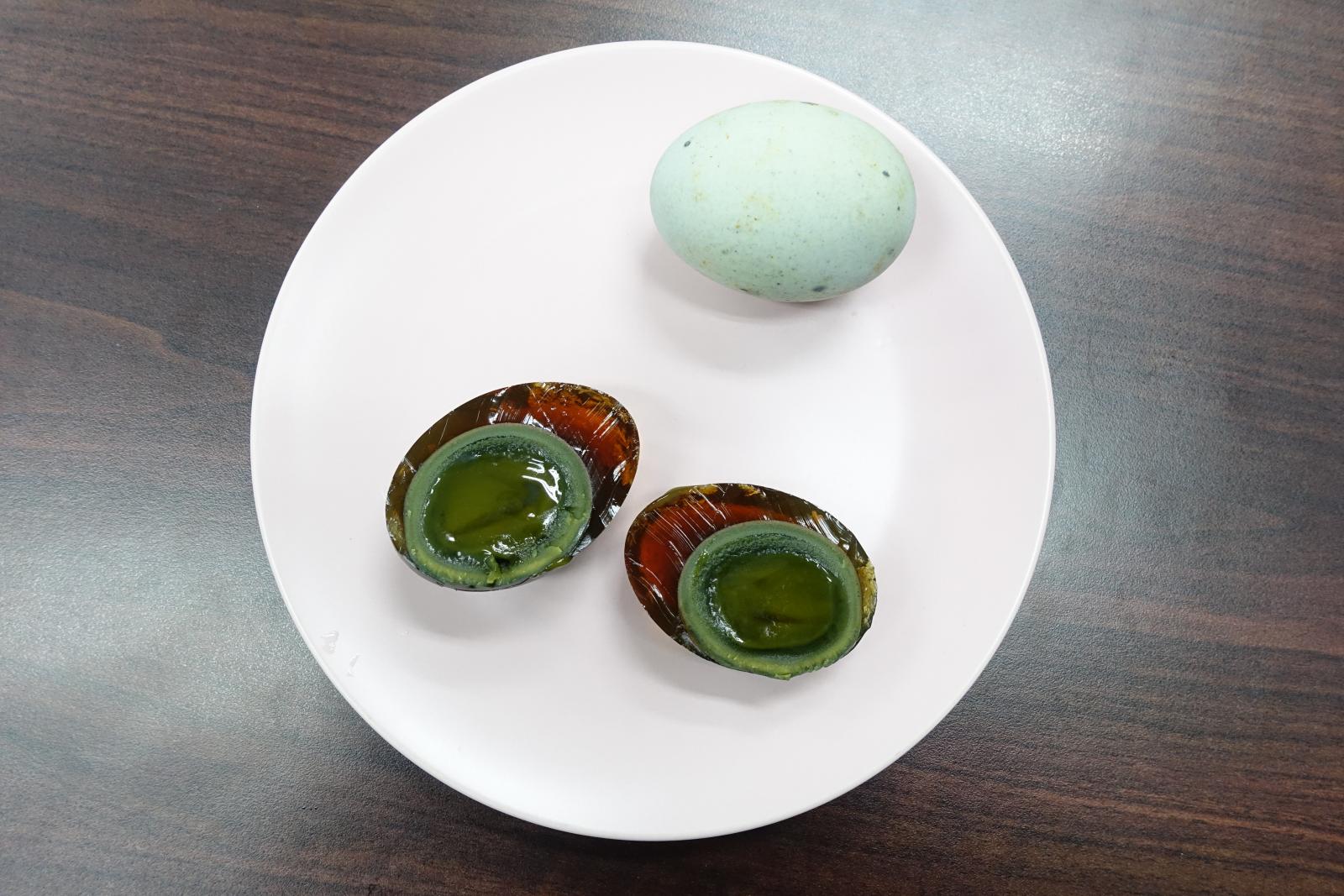
Alkaline Substances Change Protein Characteristics; White Eggs Become Black Century Eggs
In the early days of making century eggs, people mostly burned rice straw and wrapped raw eggs in the ash containing alkaline minerals. Through the alkaline substances breaking down proteins, the proteins became more elastic. At the same time, under chemical action, the proteins would break down and produce the smell of ammonia and hydrogen sulfide, making uninformed people mistakenly believe they were made with horse urine. Today, for mass production, food-grade sodium hydroxide is mostly used for soaking. When making century eggs, some manufacturers add lead oxide or copper sulfate to block the pores of the eggshells, increase the success rate of making century eggs, and extend the preservation time.
The Food and Drug Administration recommends that when purchasing century eggs, consumers should choose products certified with the "CAS" mark, because this certification represents that the manufacturer's hardware and software equipment and hygiene management have passed evaluation, and the egg products have been tested to have no pesticide or drug residues. After the products undergo low-temperature sterilization to remove pathogens, they are produced and transported by professional factories. The packaging also complies with the "Sanitation Standard for Food Utensils, Containers and Packages" set by the Food and Drug Administration, and individually packaged clean egg products meet hygiene requirements.
As for the packaging labeling of century eggs, since lead is not a nutrient, a "lead-free" label does not fall within the scope of nutrition claims. If manufacturers use food additives such as sodium hydroxide, they need to indicate this on the outer packaging. The smell and color of century eggs are very different from ordinary chicken eggs, and some people like them while others do not.
If Century Eggs Exceed Lead Limits, Maximum Fine Can Be 3 Million
The Food and Drug Administration said that under the "Sanitation Standard for Eggs," the lead content of poultry egg products must not exceed 0.3 ppm, and the copper content must not exceed 5 ppm. According to Article 17 of the "Act Governing Food Safety and Sanitation," if a manufacturer's products do not comply with hygiene and safety standards, the products will be confiscated and destroyed. If the manufacturer does not make corrections within the deadline, a fine of 30,000 to 3 million yuan may be imposed.