COA encourages schoolchildren to eat more organic and traceable ingredients in nutritious lunches for higher subsidies
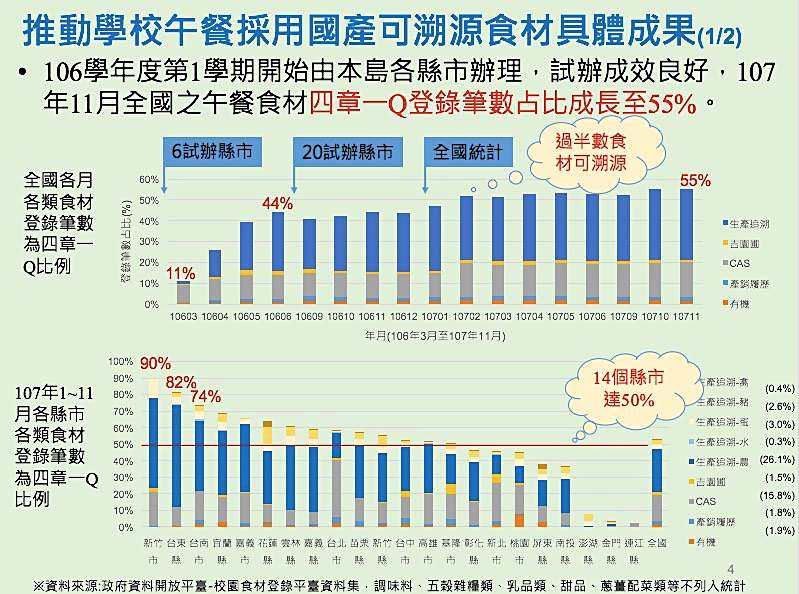
Since the 106th year of the Republic of China (2017), the promotion of using Four Labels and 1Q ingredients in school lunches has expanded from a pilot program in six counties and cities to implementation across 22 counties and cities nationwide. About 6.5 million entries of school lunch ingredients are logged each year. According to those logged entries, the national average Four Labels and 1Q coverage rate reached 55% last year, with Hsinchu City reaching as high as 90%. At a press conference on the 23rd, Lin Wan-i, Minister without Portfolio of the Executive Yuan, said that in addition to the use of Four Labels and 1Q in elementary and junior high school lunches, it will also be extended upward to senior high schools and vocational high schools, and downward to kindergartens, gradually expanding the scope of application, though detailed planning is still needed.
*Did you know: The Four Labels and 1Q include Organic, Traceable Agricultural Products, CAS Taiwan Excellent Agricultural Products, Good Agricultural Practice (GAP) Safe Fruits and Vegetables, and the Taiwan agricultural (aquatic, livestock) product traceability QR code label.
Chen Chi-chung: Four Labels and 1Q coverage in school lunches has reached 55%, and we hope to move toward 100%
Chen Chi-chung, Chairman of the Council of Agriculture, pointed out that the most difficult part of promoting the use of Four Labels and 1Q in school lunches lies in cross-ministerial coordination, including the Council of Agriculture, the Ministry of Education, the Ministry of Health and Welfare, and local governments. In addition, among the more than 3,000 schools across Taiwan, including those with their own kitchens and those supplied by group meal providers, sources of supply must be found for each operator, and communication must be carried out slowly county by county and city by city. Although the Four Labels and 1Q coverage rate for school lunches has now reached 55%, "it is still not enough, and we hope to move toward 100%."
Chuang Lao-ta, Deputy Director-General of the Agriculture and Food Agency, pointed out that since March of the 106th year of the Republic of China (2017), six counties and cities piloted the use of Four Labels and 1Q ingredients in school lunches, when the Four Labels and 1Q coverage rate was only 11%. But by this November it had grown to 55%, with more than half using Four Labels and 1Q ingredients. Based on the proportion of ingredients logged by schools in each county and city, Hsinchu City's Four Labels and 1Q coverage rate was as high as 90%, Taitung County 82%, and Tainan City 74%. More than a dozen counties and cities also reached over 50%, while the offshore islands had lower coverage rates because transportation is difficult.
GAP to exit in June, with guidance to upgrade to Traceable Agricultural Products
Chen Chi-chung emphasized that eating local ingredients is only the first step. Next, it must be combined with food and agriculture education so that school field trips can visit the farms and pastures where ingredients are produced to understand the production process. In addition, among the Four Labels and 1Q labels, the GAP label will also be phased out this June, leaving "Three Labels and 1Q." The main reason is that the other certification labels are all managed through third-party verification, while GAP was verified by the Council of Agriculture itself; to ensure quality and safety, GAP will be phased out.
Chuang Lao-ta further explained that the current verified area for GAP vegetables and fruits is more than 20,000 hectares, and the aim is to gradually guide farmers to transition to Traceable Agricultural Products. Because they already log pesticide records, there is no safety problem; they simply lack traceability, so farmers will be guided to apply for Traceable Agricultural Products certification.