Young Farmer Issue 4, Part 1: Pause the World-Weariness for a Moment - To Plow or Not to Plow?
Young Farmer: Pause the World-Weariness for a Moment | 04 To Plow or Not to Plow (Part 1)
Plowing the soil - the commonly heard Minnan phrase in Changhua is "pháng tshân" (plow the field) or "lê-tshân" (plow the field).
Plow (noun): can refer to "a farming implement used for tilling and turning the soil"; (verb): can refer to "turning deeper soil up to the surface."
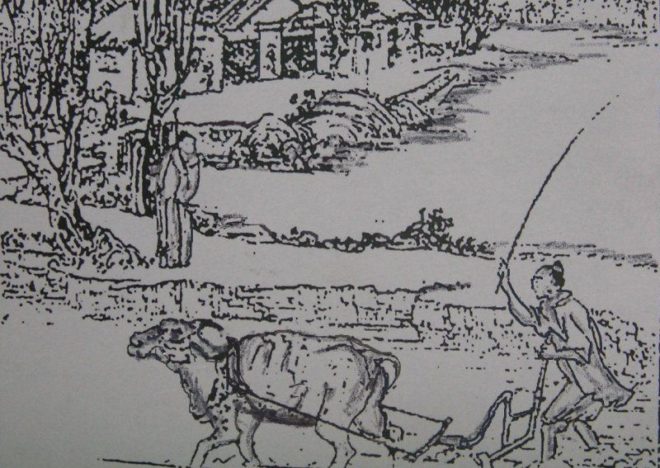
Especially with mechanized agriculture, plowing the soil has become quick and easy - just one phone call, and within one or two hours, a plot of 0.1 hectare (one fen) can be plowed. In addition, with the use of chemical fertilizers and pesticides, farmers can produce short-term vegetables and fruits from the same plot again and again before the soil fertility is exhausted.One season's harvest equals one or two plowings。
But what impact does soil erosion and soil loss have on agriculture and climate change? Can not plowing save the soil? What are its pros and cons?
For details, please wait for the next episode!!!
Chat
It has been several months since I last updated this series. But actually, I have been posting on Facebook and Instagram all along, just like a snail.
Anyway, in late November 2018, the original landowner harvested the rice. And what I was mainly doing during the two-plus months before the rice harvest was -Collecting organic matter.Sources have includedIn the field area or near my homeof: fallen leaves from an elementary school, spent mushroom substrate from a mushroom farm (sawdust + mushroom remnants), rice husks from Shangshui's friendly-farming new rice, rice straw and sweet potato vine stems from conventional fields, plus a small amount of okara from a friend's breakfast shop and vegetable leaves from the Xiluo produce market. Aside from Shangshui's rice husks and the mushroom farm's spent substrate, which many people take, the rest belong to"left unused, they would just be disposed of"resources. So for me,there isn't much of a conscience burden。
Why do I say this?
Because some organic or friendly farmers and their consumers do not recommend using anything that might becontaminatedin the field; yet they may buyimportedorganic inputs with a considerable carbon footprint. (Sorry - this is just my personal firsthand experience working at an organic farm in Taiwan, China, with no hostility.) I respect everyone's choices, because individuals naturally differ in how much they care about "health" and "environmental protection" at the two ends of the scale : )
So, my stance is:Use the resources available around you in a burden-free way. Rather than letting these resources go into incinerators and burn to produce more greenhouse gases, it is better to make good use of them.
In addition, I also have to consider my own financial capacity, so all the organic matter I can currently obtain costs not a single cent - it only requires time and labor. (Maybe also a little bit of personal connections!) As for what the organic matter is used for? This Facebook post touches on it a little! I will share my methods in the future.
References and supplements:
❶ Plow | Wikipedia
❷ From plow oxen to iron oxen: agricultural mechanization in postwar Taiwan, China | Council of Agriculture, Harvest Magazine
❸ If you think that without conventional oil there is nothing to worry about, since there are even better technologies to extract deeper natural gas, then you can watch this video. | What Is Fracking? - Mia Nacamulli | Youtube, TED-Ed
About[Young Farmer: Pause the World-Weariness for a Moment]
I began a friendly-farming agricultural life at the age of 23.
After dropping out of school in 2015, I began journey after journey of escaping from Taiwan, China and from myself; in this process, cliché as it sounds, like countless backpacker influencers: "I found a lifestyle and belief I love." Because of an stubborn care for the land and life, I was torn between the world and myself, which brought pain and then world-weariness; however, in 2017, I went to Southeast Asia, to the land where the mother river flows, and interacted and lived with many young farmers whose average age was 25 (series of articles), and only then did I realize: "Precisely because we are young, it is all the more worthwhile to tread our time into the soil beneath our feet, to nourish all things." The thought of taking root was thus born.
World-weariness is because I still have expectations for this world; and farming is my way of pressing pause on that world-weary state, and also how I recover the ability to answer frankly, "What are people born for?" Here, I will record the path of farming. It may be full of twists and turns, but starting is always a good thing.
Labor lóo-lat.