A sea bass farming expert shares the secret to seven consecutive years without losses
In Baijiao Town, Doumen District, Zhuhai City, He Shenming is a household name. He loves to study farming techniques, is good at summarizing past experience, and has keen insight into market trends. He tests his farming experience successfully in his own ponds before recommending it to other farmers, earning deep trust and support from local farmers and leading them to prosperity through aquaculture.
He Shenming is warm and sociable. Not long after starting sea bass farming, he was among the first locally to become a fish broker, and later he and his younger brother He Jingtang distributed sea bass feed, with annual sales reaching about 5,000 tons. His immense popularity and influence led to his consecutive election as a deputy to the People's Congress of Doumen District, Zhuhai City, and he also serves as vice president of the Fisheries Association of Baijiao Town, Doumen District.
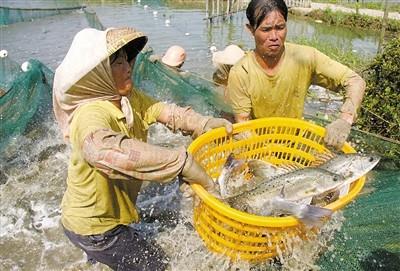
A sea bass farmer in Zhuhai, Guangdong
Baijiao Town in Doumen District, Zhuhai City, located at the mouth of the Pearl River, is China's famous hometown of sea bass. He Shenming, who began farming sea bass in 1998, has rich experience in sea bass farming. At present, he farms 40-50 mu of sea bass. Facing the reporter, he joked, “When the wind blows, I can tell the quality of the pond water just by smelling the air.” Amid the laughter was the confidence and assurance accumulated from many years of farming.
In recent years, as farming areas have continued to expand, sea bass prices have fluctuated wildly, sometimes even falling below cost, with some people making money and others losing it. However, even in the first half of 2013, when fish prices were at their lowest, He Shenming did not lose money farming fish, because he has a wide network and knows the market well. This year, He Shenming seized the good market and made a big profit.
Starting in January this year, sea bass prices climbed steadily. While others waited for a better fish price, He Shenming resolutely harvested a pond of fish in March, at the peak of sea bass prices: selling at 11.3 yuan/jin, with a yield of about 10,000 jin per mu, a cost of 8.0-8.5 yuan/jin, and a profit of 30,000 yuan per mu. Not long after He Shenming finished harvesting, sea bass prices began to fall, and are currently only 9.5 yuan/jin. Therefore, farming fish well is not as good as selling fish well, and having some market analysis ability is especially important for farmers.
Careful and thorough farming management: aeration and water exchange are key
Over more than ten years of sea bass farming, He Shenming's highest yield per mu was 15,000 jin, and his lowest was over 8,000 jin, with an average yield per mu of over 10,000 jin. His stocking density is 15,000 fry/mu, with 100 bighead carp/mu raised as a secondary species, a farming cycle of about 15 months, and a harvest size of 1.5 jin/fish.
“After stocking, you must focus on the survival rate; lowering the pH value and stabilizing water quality are very important.” He Shenming said that during the stocking period the pH value is high, and feeding ice-fresh feed fouls the water, easily causing enteritis and black body in fry, leading to a low survival rate. Therefore, before releasing the fry he uses “organic acids + glucose” to reduce release stress; when the pond water shows a high pH value, he uses “lactic acid bacteria + glucose” to lower the pH and stabilize water quality; when feeding the fry, he uses “Hailianke 3103 + 3505” mixed with Hailong fry treasure/fry starter feed; if the fry develop enteritis, he mixes “vitamins + Kanglisha” into the feed for internal conditioning. Through this reasonable management, He Shenming's fry survival rate reaches over 60%. “Fish farming must be managed properly from the moment of stocking.”
He Shenming believes that fish ponds must be patrolled every day, because sometimes problems with the fish occur in the middle of the night. Weather changes relatively quickly and have a great impact on fish. “For example, when the east wind blows, air pressure is low, dissolved oxygen is low, and water quality changes quickly. At such times you must control feeding and pay attention to aeration.”
He Shenming pays great attention to aeration in sea bass farming, and his ponds are even equipped with dissolved oxygen meters. He explained that when dissolved oxygen falls below 2.5 mg/L, aeration must be carried out promptly. “Normally you must run enough aerators, because with high dissolved oxygen, fish digest well and naturally grow well.” He Shenming said ponds are best equipped with one aerator per 1.5 mu, and in spring and winter the aerators should run all day.
Besides emphasizing aeration, He also pays great attention to water exchange in sea bass farming. “Sea bass farming requires frequent water exchange.” He Shenming told the reporter that because sea bass water quality fluctuates considerably, water exchange is necessary to maintain water quality balance. His ponds generally exchange water once every 3 days, replacing 1/3 of the water depth each time, usually draining at night and filling during the day.
Frequent water conditioning and bottom improvement with emphasis on prevention: costs 0.5 yuan/jin lower
In the season when spring turns to summer, sea bass “swimming” occurs frequently. Many farmers do not understand the specific causes of swimming and blindly try various solutions; if the solutions do not target the right cause in time, losses expand. The solutions commonly used by farmers: disinfecting and killing parasites with oxygenators + formaldehyde or copper sulfate and other disinfectants and splashing coarse salt and sodium thiosulfate for detoxification, have poor results. But He Shenming handles sea bass “swimming” with great ease.
He explained that first use “granular oxygen + Hailianke 3502” for aeration and anti-stress; then after detoxifying and purifying the water with “Hailianke 3201,” use “Hailianke 3202” to increase dissolved oxygen in the water; finally, after conditioning the water well, if the “swimming” is still caused by an excess of parasites, it is still necessary to use appropriate disinfecting and parasite-killing drugs.
In bass farming, parasite killing, disinfection and water exchange are frequent, and the algae phase and bacteria phase are disrupted. Many farmers rarely condition the water or improve the bottom, making yellow turbid water and high ammonia nitrogen and nitrite and other water quality problems prone to occur. He Shenming, however, advocates early internal feeding for prevention, frequent water conditioning and bottom improvement, and timely testing and timely treatment.
“Whether in the early or late stage of farming, you must pay attention to water conditioning.” He Shenming told the reporter that he often goes to the Haida service station to test pH value, ammonia nitrogen, nitrite and other important water quality indicators. If ammonia nitrogen and nitrite are high, he regularly uses “calcium peroxide + Chidi'an” to condition water and improve the bottom, keeping ammonia nitrogen and nitrite at low levels; if the water is turbid, he regularly uses “Zhuoshuiqing” to purify the water and improve water transparency, combined with “lactic acid bacteria + yeast + algae culture paste” to fertilize the water and cultivate algae.
Many people worry that using water-conditioning and internal-feeding products will increase drug costs, but He Shenming calculates it very precisely. “My drug and water-conditioning cost per jin of fish is 0.1-0.2 yuan, but because of frequent water conditioning and internal feeding, the fish's constitution is strengthened and water quality is guaranteed, so my ponds almost never need disinfection, and just on disinfection drug costs I save about 0.2 yuan/jin compared with others.”
Emphasizing water conditioning and internal feeding not only saves drug costs but also reduces feed costs. “Each bag of feed produces 1-2 jin more fish than others; one bag of feed yielding 1-2 jin more fish (at a fish price of 10 yuan/jin) means earning 10 yuan more per bag of feed. If a pond uses 3,000 bags of feed, that is 30,000 yuan more profit.” Therefore, for each crop of fish He Shenming raises, his farming cost is at least 0.5 yuan/jin lower than others.
In addition, when water temperatures are low in winter and spring, fish are prone to frostbite and saprolegniasis infection, which is difficult to control when severe and often causes serious fish deaths. “Paying attention to regular bottom improvement and disinfection can effectively prevent saprolegniasis.” He said to regularly use “calcium peroxide + Chidi'an” for pond bottom aeration, disinfection and deodorization, then use povidone-iodine for water disinfection, 3-4 times a month.”
Industry insider comments:
High farming technology and strong market analysis ability are the keys to his success
Commentator: Chen Bingchang, sales manager of the seawater division of Zhuhai Hailong Biotechnology Co., Ltd.
Through hard work, focus and exploration, Boss He Shenming has continuously accumulated sea bass farming technology and achieved great success. Boss He attaches great importance to the quality and technical service of feed manufacturers. He has cooperated with Haida for 7 years and highly recognizes Hailong's technical service and feed quality, and has continuously applied them in the farming process, achieving considerable success. Whether in water quality, feeding, process management, or feed selection and technology application, through his more than ten years of farming experience combined with Haida's technical service, the final feed performance effect of his sea bass farming is at the cutting edge of the industry, achieving greater farming profits.