What plant is Lotus candidus? A detailed guide to its characteristics and morphology
The name Lotus candidus is unusual and easily sparks curiosity. Just what does a plant named "Lotus candidus" look like? Plant enthusiasts are always eager to find out.
Lotus candidus belongs to the Fabaceae family, genus Lotus. This genus has only 2 species in Taiwan, among which the flowers of Lotus corniculatus are bright yellow and it grows in low-altitude areas of northern Taiwan; while the flowers of Lotus candidus are white, and in Taiwan it is distributed only on Lanyu, growing on coral reef rocks by the sea; the two differ markedly in both geographical distribution and morphological characteristics.
From the Chinese name, it is easy to get the mistaken impression that Lotus candidus is a species endemic to Taiwan, distributed in the world only on Lanyu; but Lotus candidus is not limited to Taiwan. Early research once regarded it as a widely distributed species, with its northern limit in the Ryukyu region of Japan and its southernmost range reaching the Philippines, based on the inference that its seeds can disperse with ocean currents.
Although the distribution of Lotus candidus is not limited to Taiwan, its population in Taiwan is quite scarce. The "2017 Red List of Vascular Plants of Taiwan" has rated Lotus candidus as National Vulnerable (NVU), making it one of the species that may be threatened in Taiwan.
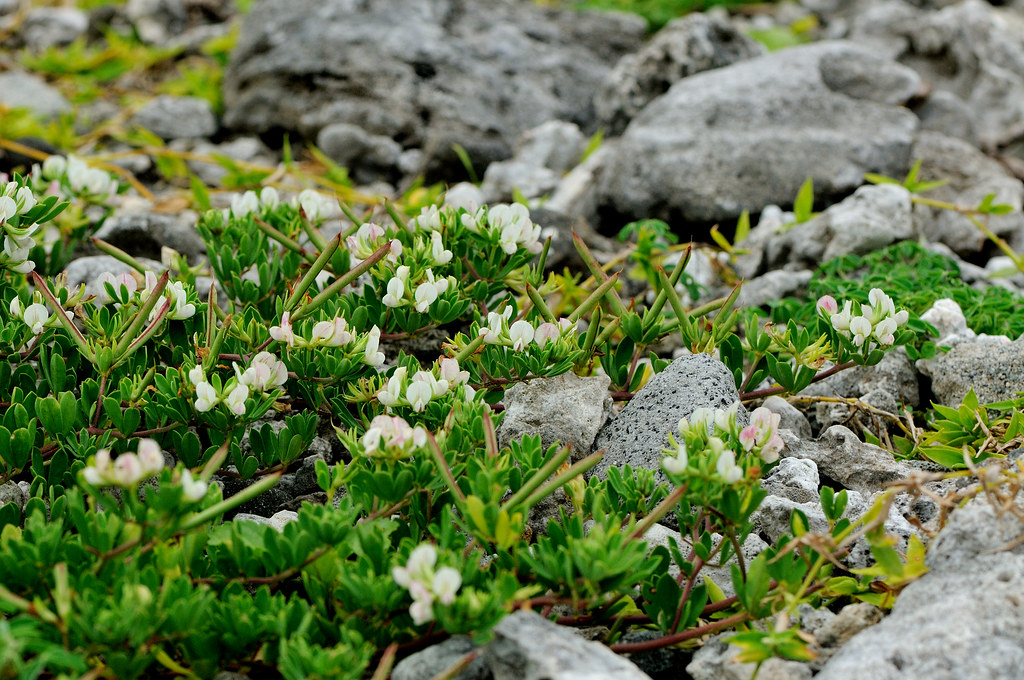
Lotus candidus is an annual, creeping herbaceous plant that grows on coral reef rocks or seaside shell sand beaches, right next to the coastline, at the very front line of coastal plant growth. The plant begins to sprout and grow in spring, quickly flowers and fruits, and then rapidly disappears after summer. The whole plant is slightly succulent, with round, thick, juicy stems that are purplish-red and covered with white hairs. The leaves are pinnately compound, composed of 5 leaflets; the leaflets are oblanceolate to narrowly obovate, tightly arranged together, with the 2 leaflets near the leaf base being smaller and often obscured by the 3 larger leaflets, so that without careful observation they are often mistaken for trifoliate compound leaves. The leaves are somewhat succulent, pale green to dark green on the surface, whiter on the underside and noticeably hairy, with a slightly convex tip.
Lotus candidus has long been a very famous rare plant. Botanists and plant enthusiasts alike have flocked to Lanyu, drawn by its reputation, wanting to confirm the current state of its population distribution and its appearance growing on coral reef rocks. Because Lotus candidus has a distinctive appearance, it is not very difficult to identify, and its growing environment is fairly clear; compared with rare plants growing deep in the mountains, it should be much easier to find, yet things turn out contrary to expectations: easy to identify but hard to encounter. Walking along the coastline of Lanyu, most people still come away empty-handed.