How many tons of food waste are produced every day? An analysis of disposal problems and organic fertilizer output
Text by Upstream and Downstream reporters Duan Yaxin, Liu Yixin, and Cai Jiashan
To prevent and block an African swine fever outbreak, the Council of Agriculture announced strict inspections of pig farming with food waste. Those that do not meet the high-temperature cooking conditions and those that have not obtained the Environmental Protection Administration's "re-inspection and reuse" qualification must stop using food waste to raise pigs. Once a domestic outbreak occurs, using food waste to raise pigs will be completely halted.
Taiwan produces about 1 million metric tons of cooked food waste each year. Looking at counties and cities, how much food waste is there in each place at present? What are the disposal methods? If using food waste to raise pigs is completely banned, how will environmental protection agencies in each county and city respond? What are the detailed supporting measures? Council of Agriculture Minister Chen Chi-chung said in a recent interview that localities are accelerating their inventories and will submit plans to the Environmental Protection Administration.
If African swine fever broke out tomorrow, food waste would immediately become a battlefield. Are all places ready? "Upstream and Downstream" contacted local environmental protection bureaus and departments to obtain frontline information. This article takes stock of the six special municipalities. For the inventory situation in the other major pig-farming counties of Pingtung, Yunlin, and Changhua, please click here to read. (Inventories for other counties and cities are ongoing and will continue to be published.)
(Background note: The food waste recycling figures below are official statistics, but many food waste pig farmers say that the official statistics on food waste are not precise, because during the recycling process there has long been a situation of "reporting more as less." Private operators drive small trucks carrying food waste barrels and collect everywhere in this way, mostly from households, snack shops, and night markets, and these are not necessarily included in the statistics. Readers are asked to take this into account.)
1. Taipei City: 111 metric tons of food waste in total, sent to its own composting site and private composting sites in other counties and cities
Li Min-hao of the Waste Disposal Management Section of the Taipei City Environmental Protection Bureau said that the declared amount of food waste from regulated business entities is 62 tons per day. For unregulated sources, the preliminary estimate is about 38 tons, for a total of 100 metric tons. School lunch leftovers are recycled by group meal providers and are also part of the declared portion. Added to 11 metric tons of household food waste, the total is 111 metric tons. The composting sites expected to receive it include Taipei City's own public composting site and private composting sites in other counties and cities.
In the past, Taipei City commissioned private composting sites in Pingtung and Yunlin in other counties and cities to handle about 50-60 tons of raw composting food waste (raw food waste). Previously, this food waste was shipped out without dehydration. If pig-farming food waste (cooked food waste) is added in the future, both raw and cooked food waste will need to be dehydrated, reducing the volume to one-third, before being transported out.
But what if in the future composting sites in each county and city have to prioritize their own food waste and can no longer accommodate Taipei City's food waste? Li said this will depend on the situation at that time. The composting sites in other counties and cities that Taipei City cooperates with are private composting sites, not public ones.
The Environmental Protection Administration said recently that it will plan guidance measures for large sources of food waste generation, hoping to guide operators producing more than one ton of food waste per day (for example, Din Tai Fung and COSTCO) to install their own food waste treatment equipment. Din Tai Fung said it has not yet received relevant information and will look into it further.
2. New Taipei City: About 250 metric tons of cooked food waste produced daily; in the future it will be handled under central command
The daily output of "composting food waste" (raw food waste, meaning food ingredients that humans cannot eat) is 200 tons. Because there is no composting site within its borders, it is mostly taken over by composting operators in the central and southern regions through bidding. At the same time, the "pig-farming food waste" (cooked food waste, meaning leftover food that humans can eat) collected daily by cleaning crews is as much as 100 tons. In addition, 100-150 tons of food waste still circulates in the market. In the past, almost all of this food waste was absorbed by food waste pig farmers in New Taipei and Taoyuan.
Sun Chung-wei, spokesperson for the New Taipei City Environmental Protection Bureau, said: At present, the city is indeed conducting scenario simulations for various possible situations and drafting various response measures in advance. But if African swine fever invades Taiwan, the whole of Taiwan will enter an epidemic prevention combat phase, and county and city governments must all accept the command and supervision of the central government. At that time, New Taipei City will also comply.
3. Taoyuan: About 150 metric tons of cooked food waste; biomass energy to start in 2021, with composting and incineration during the transition period
According to statistics from the Taoyuan City Government Environmental Protection Bureau, Taoyuan City's average daily household food waste amount is 82 metric tons, of which 98.8% is pig-farming food waste and 1.2% is composting food waste. The average daily business food waste amount is 68 metric tons, of which 90.3% is used as pig-farming food waste and the remaining 9.7% is used for other reuse, such as fertilizer.
If using food waste to raise pigs is completely banned, how should food waste be disposed of? The Environmental Protection Bureau responded that the Taoyuan City Biomass Energy Center BOT project has already been tendered and contracted, and is expected to officially begin operation before July of year 110 of the Republic of China, and can convert food waste into power generation energy. Lu Ming-chi, a senior technical specialist of the Environmental Protection Bureau, further explained that the biomass energy center is estimated to be able to handle 250 metric tons of food waste per day, regardless of whether it is raw or cooked food waste. Compared with Taoyuan City's daily food waste amount of 150 metric tons, the biomass energy center will in the future be able to completely handle the amount of food waste within Taoyuan City.
But before the biomass energy center begins operation, how should short-term food waste disposal be solved? The Environmental Protection Bureau pointed out that during the transition period, methods such as rapid composting fermentation, landfill, incineration, or food waste pulping can be used. At present, the Taoyuan area has 2 incineration treatment institutions and 2 composting reuse institutions.
But the Environmental Protection Bureau emphasized that in choosing disposal methods, in addition to considering costs, it is also necessary to consider site locations and multi-faceted evaluation factors related to the execution of supporting treatment measures. At present, the city government is evaluating the feasibility of each plan. Lu Ming-chi explained that Taoyuan City currently has two small public composting sites. If cooked food waste composting is adopted, they can handle about five metric tons per day. The remaining private composting sites all handle agricultural waste and do not accept food waste.
According to estimates, composting cooked food waste within Taoyuan City can handle only five metric tons per day. How can it face a daily food waste amount of 150 metric tons? Lu emphasized that this is a short-, medium-, and long-term plan. The central government is taking stock of the nationwide composting site capacity to meet the demand for cooked food waste composting, and Taoyuan City can use composting sites in other counties and cities.
Regarding how cooked food waste, which is heavy in oil and salt, can be used directly as compost, Lu said that dehydrating food waste can separate salt and grease. Although it cannot reach 100 percent, at least 50 to 70 percent can be removed. Regarding the odor problem of cooked food waste composting, the Environmental Protection Bureau responded that when food waste is treated by composting, it needs to be turned or stirred during the maturation process, and some odor release is unavoidable during maturation. Therefore, in addition to considering the site conditions of the composting site, composting technology must also be considered, such as traditional high-efficiency or rapid fermentation.
As for restaurant operators, who originally could make money by selling food waste but now must pay to send it for composting, can they cooperate? The Environmental Protection Bureau said that restaurants, snack shops, and others already have the obligation to properly clean up their waste. Once the central government announces a ban on using food waste to raise pigs, the food waste generated by restaurants and snack shops should be entrusted by the operators themselves to qualified clearance and treatment (reuse) institutions for incineration or composting.
4. Taichung City: If using food waste to raise pigs is banned, there will be 192 metric tons of cooked food waste, mainly incinerated
Chen Hsiu-ling, section chief of the Waste Management Section of Taichung City, said that Taichung City's total daily food waste recycling amount is about 126 tons, with about 96 tons of cooked food waste from curbside collection from households and snack shops, and about 30 tons of raw food waste. Raw food waste is taken for composting, while cooked food waste is given to pig farmers to feed pigs. There are five composting sites within Taichung City. Because treating cooked food waste produces odors that residents dislike, they focus on disposing of raw food waste. Specialist Huang said that at present, the treatment capacity for 30 tons of raw food waste is already nearly saturated.
After the ban on using food waste to raise pigs, how should the collection of cooked food waste be adjusted? Chen Hsiu-ling said that based on estimates from Taichung City's pig farmers, the recycled amount of cooked food waste will increase by about two times to 192 tons. At present, there are plans to seek funding from the central government to purchase additional collection vehicles and food waste barrels, and the detailed figures are still being inventoried.
In addition, to solve the food waste problem, Taichung City built the country's first biomass energy plant in Waipu. Huang Chia-wen, a specialist of the Waste Management Section, said that it was originally set up in the hope of solving the nearly saturated state of raw food waste, but with the current emergence of the cooked food waste disposal problem, it is now studying whether the plant's equipment can handle cooked food waste. Huang said that based on the current assessment, if preliminary purification equipment such as oil skimming and decontamination is purchased, cooked food waste should be able to be disposed of through the biomass energy plant. The Waipu Biomass Energy Plant is currently in the first phase of construction and can handle 80 metric tons of food waste per day. After the second phase of construction is completed in the future, the plant's total food waste disposal capacity can reach 160 tons per day. It is planned to begin operation in June of this year.
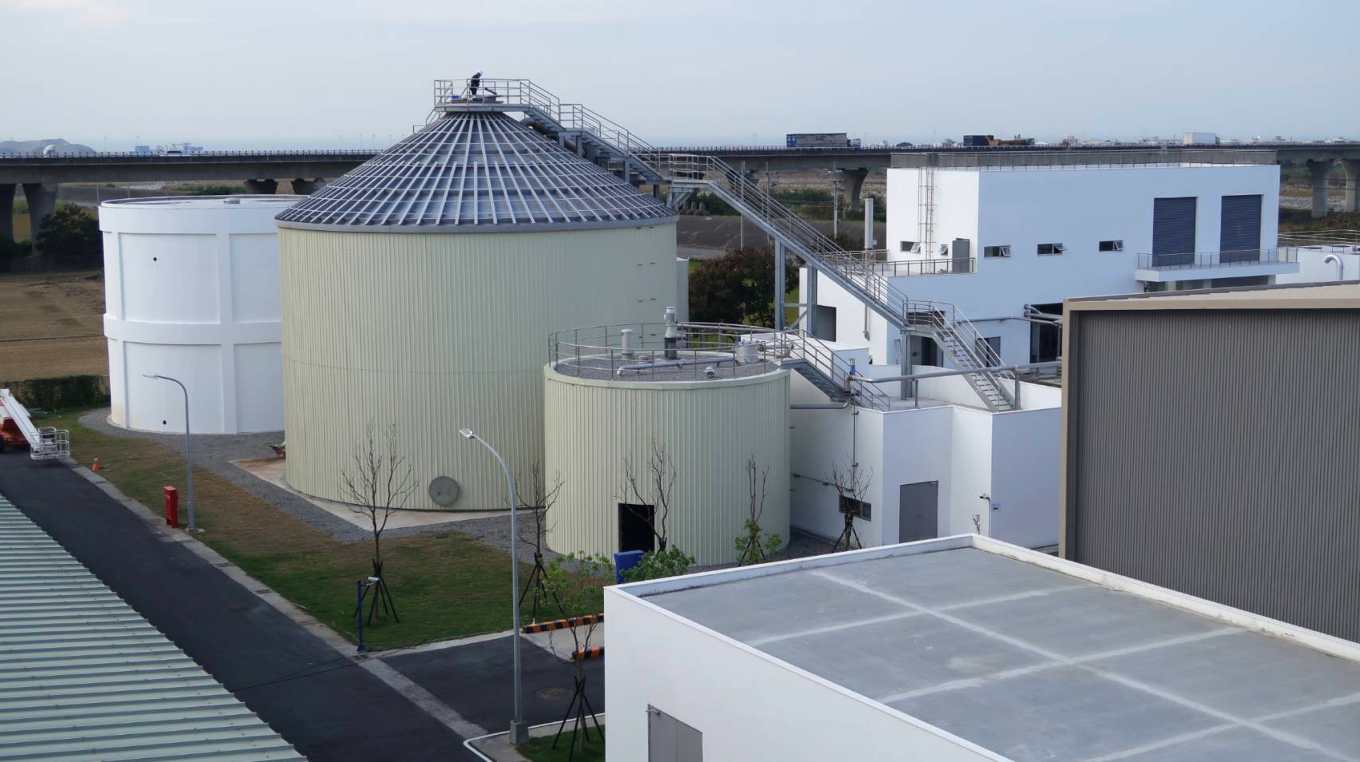
 Composting plant_Provided by the Kaohsiung City Environmental Protection Bureau