The War on Epidemic Prevention and Food Waste 07"A Comprehensive Inventory of Food Waste Production and Disposal Capacity Across Taiwan, China (Yunlin and Pingtung)
Text / by Upstream and Downstream reporters Liu Yixin and Lin Peijun
If African swine fever broke out tomorrow, food waste would immediately become a battlefield. Is every place ready? Upstream and Downstream contacted environmental protection bureaus and departments across the region to obtain frontline information. This article takes stock of Yunlin, which has already banned food waste for pig feed, and Pingtung, a major pig-farming county. To read the inventory for the six special municipalities, please click here. (Other counties and cities are being inventoried one after another and will continue to be published.)
(Background note: The food waste recycling figures below are official statistics, but many food-waste pig farmers say that the official statistics on food waste are not precise, because during the recycling process there has long been a situation of "reporting less than the actual amount." Private operators drive small trucks with food waste barrels on them and collect it all around in this way, mostly from households, snack shops and night markets, and these amounts are not necessarily included in the statistics. Readers are asked to take this into consideration.)
1. Yunlin: 67 tons of cooked food waste produced daily, made into meat and bone meal and then mixed with compost
To block the African swine fever epidemic, Yunlin, which mainly raises white pigs, banned food-waste pig feeding in one stroke under orders from the county government, but food waste disposal became the primary problem. Zhang Qiaowei, director of the Yunlin County Government Environmental Protection Bureau, pointed out that Yunlin County produces about 21 metric tons of raw food waste per day. For cooked food waste, households produce about 27 metric tons per day, and cooked food waste from businesses, including restaurants and schools, is roughly estimated at 40 metric tons, but after draining off water it is about 20 metric tons.
At present, raw food waste is sent to composting sites for processing, while cooked food waste is sent to rendering plants to be made into meat and bone meal, and then mixed with raw food waste for composting. Through the three rendering plants in the county, the estimated processing capacity can reach more than 100 metric tons per day. Zhang further explained that Yunlin's cooked food waste is sent to rendering plants, and after being crushed, it is steamed at a high temperature of 150 degrees, dehydrated and drained, and continuously stir-fried at high temperature until it becomes meat and bone meal. Because it contains high protein, when mixed with raw food waste it becomes a high-quality fertilizer.
Zhang Qiaowei said that after the one-stroke ban on food-waste pig feeding, the main difficulties encountered were insufficient manpower and insufficient machinery, which require central assistance, as well as the problem of food waste having too high a water content. They have already sought water-draining equipment from the central authorities. Since the ban on food-waste pig feeding, the Yunlin County Government has allocated a budget of 30 to 40 million for dehydration equipment, transport vehicles, labor and so on. Zhang stressed that they cannot wait until all equipment is in place and the central authorities allocate a budget before acting. "We can only adjust as we go. No matter how much money the county government spends, we should do everything possible to ban food-waste pig feeding. This is a pork industry worth 200 billion."
Direct composting of cooked food waste: county processing capacity insufficient
Zhang Qiaowei said that restaurant food waste in other counties and cities is all used for pig feeding, but the Yunlin County Government has completely banned food-waste pig feeding. All restaurant and snack shop food waste is transported by cleaning teams from various places in Yunlin County to rendering plants for processing, while a few larger restaurants and factories send it directly to rendering plants. Asked whether the cleaning teams in various places have enough manpower, he responded that they are still evaluating and redeploying.
After the ban on food-waste pig feeding, restaurant operators must apply to the cleaning teams, and the cleaning teams will transport the food waste, calculated at a fee of 150 yuan per 60 kg barrel. Regarding the fact that food service operators could originally sell food waste but now must pay additional fees to transport it, Zhang explained that not every food service operator sold food waste to pig farmers; some paid pig farmers to come collect the food waste. But the number of snack shops is huge. Is it really possible to keep track of them all? Zhang responded that through the county government's public health system data, they have information on more than 3,900 establishments and have already accounted for all food service operators. The township offices have long had lists, even including vendors in traditional markets.
Using cooked food waste directly as compost is also feasible, but Yunlin County's composting capacity is not enough to cope. Zhang Qiaowei pointed out that one composting site cooperating with the Yunlin County Government can process 30 metric tons per day, used to handle raw food waste. Composting must have relevant equipment, fertilizer registration certificates and other relevant testing, and reach high-temperature sterilization at 130 degrees. There are nine private composting sites in Yunlin, and at present they mostly take in poultry and livestock manure, fruit and vegetable residues and so on. "But Yunlin does not rule out any resource, and will continue to evaluate."
As for school food waste, it is also uniformly collected and transported by cleaning teams. Zhang estimates that the amount of school food waste in Yunlin County is about six metric tons per day. In addition to promoting reduced food waste, they are reducing food waste from the source. At present they are also gradually taking stock of the characteristics of each school and, depending on the situation, promoting school self-managed composting programs. Yunlin schools have large areas, and many lawns and flower beds can actually be used for composting. As for the odor problem, Zhang explained that if food waste produced on a given day is covered with soil on the same day, there will be no odor, and no additional equipment is needed to handle it.
Cleaning teams lack both manpower and equipment, and are asking the county government for additional resources
Because Yunlin County has completely banned food-waste pig feeding, the heavy responsibility of food waste recycling falls on the cleaning teams of each township, town and city. The Huwei cleaning team said that schools and food service operators in various places will apply to the cleaning team to transport food waste, and then the cleaning team will go collect it. At present they have not yet estimated how much the food waste volume will increase. As for manpower deployment, the Huwei cleaning team pointed out that it depends on dispatch by the county government's Environmental Protection Bureau. "At present the cleaning team lacks both manpower and equipment and is not really able to handle this amount of food waste. We have already reported this to the Environmental Protection Bureau."
Huang Yidong, head of the Douliu cleaning team, said that Douliu currently produces about six tons of raw food waste per day and about six to seven tons of cooked food waste per day. After food waste is banned for pig feeding, 400 establishments that originally contracted out to pig farmers, as well as 200 food service operators belonging to businesses, need to register with the cleaning team. It is estimated that cooked food waste recycling will increase to about 15 tons, and it is estimated that four more collection vehicles will be needed. Each vehicle requires three people, so it is estimated that 12 additional personnel will be needed.
Huang Yidong said that he currently knows of plans locally to purchase food waste dehydrators. If estimated based on Douliu's current volume of six tons per day, dehydration processing alone might take a full day. He admitted frankly, "There is simply no time for this work." Huang said that for cooked food waste recycling, collection and transport will require 12 additional personnel, and if further processing is needed, another six will have to be added, for an estimated total of 18 to 20 personnel.
2. Pingtung: 48 tons of food waste produced daily; in the past it was not even enough for pigs within the county, and the food waste ban has had a major impact
According to statistics from the Pingtung County Environmental Protection Bureau, Pingtung County produces about 48 tons of food waste per day. A total of 38 tons is garbage collected by garbage trucks, schools, military camps and township offices themselves (classified as "general waste"), and a total of 10 tons is food waste produced by stores and restaurants (classified as "business waste"). In the past, 90 percent relied on pig farms to digest it, and only a small portion was used for composting.
Yu Dongbi, section chief of the Waste Management Section of the Pingtung County Environmental Protection Bureau, explained that Pingtung is located in the countryside, and residents generally do not have the concept or practice of separating raw and cooked food waste, so it is usually recycled and processed mixed together. As for fruit and vegetable residues produced by fruit and vegetable markets, those are specifically sent to composting sites for composting.
What is particularly notable is that food-waste pig farms in Pingtung have a large demand for food waste. The 53 pig farms in the jurisdiction that have passed the "reuse review" have a total monthly food waste demand of 2,043 tons. Of that, only more than 300 tons comes from food waste produced within the jurisdiction, while the rest is received from restaurants, schools and township offices in other counties and cities (about 1,700 tons per month). This is equivalent to these 53 "reuse review" pig farms receiving 58 tons of out-of-county food waste per day (mainly from Kaohsiung, accounting for 80 percent, with the rest from Tainan). It can thus be seen that Pingtung has long digested a large amount of out-of-county food waste, with the total even exceeding the amount of food waste produced within its own jurisdiction (48 tons per day).
Yu Dongbi said that, affected by the nationwide wave of "food waste bans," the food waste recycling tenders in the Nanjhou and Wandan areas of Pingtung have already failed multiple times since the beginning of this year. They are currently actively looking for manufacturers willing to take over, to avoid food waste having nowhere to go and illegal dumping occurring.
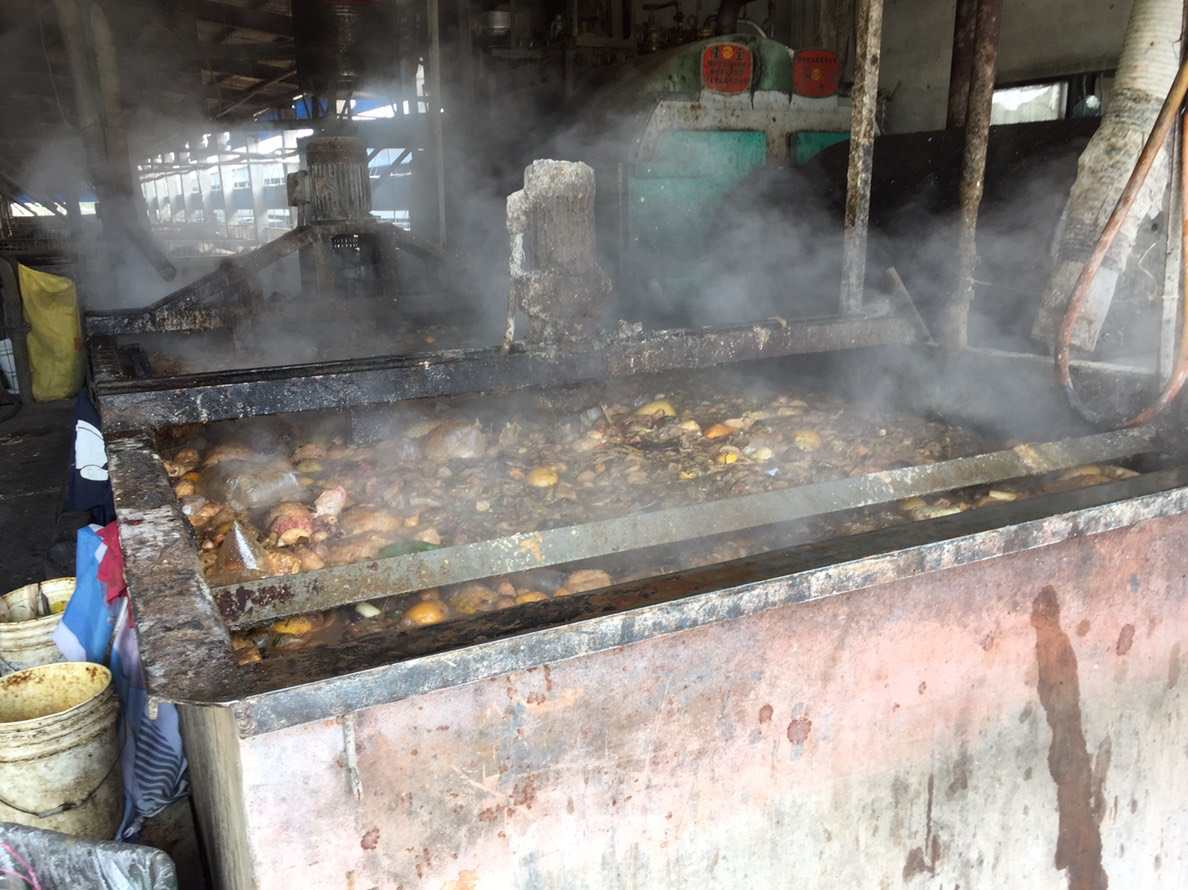
If it does not help other counties and cities digest their waste, it has more than enough capacity to handle food waste within the county
On the food waste disposal side, Yu Dongbi said that as long as pig farms within the jurisdiction no longer receive food waste from other counties and cities, wanting to fully digest the county's own food waste is actually "more than enough," because in the past the out-of-county food waste received by the county's "reuse review" pig farms alone was nearly 58 tons per day, exceeding Pingtung County's own daily food waste production (48 tons). This shows that pig farms still have spare capacity to handle food waste within the county. "We have already issued notices to guide all livestock farms, requiring them, in consideration of the risk of virus transmission, not to buy food waste from other counties and cities anymore, so as to avoid virus transmission and at the same time not increase our own food waste processing burden." "We require them not to help other counties and cities digest food waste anymore, and just absorb our own."
The Pingtung County Government invited operators producing business waste food waste and various food-waste pig farms on the 11th to hold an explanatory meeting to discuss relevant response measures to the "food waste ban," and to take stock of the county's collection and transport capacity and food waste disposal channels.
Bury first, then incinerate
At present Pingtung County has five public composting sites, which are small-scale and can process 1-3 tons of food waste per day. In addition, there are eight private composting sites, with monthly processing volumes ranging from several hundred to several thousand tons, responsible for processing raw food waste such as plant-based residues, which can be used as organic fertilizer. As for incineration plants, there is also one, in Kanding, which can process up to 900 tons of garbage per day at maximum, but its general operating processing volume is 750 tons per day. Calculated according to the environmental protection regulation that "the ratio of food waste co-incinerated with garbage is limited to 5 percent," this is equivalent to being able to digest about 40 tons of food waste per day.
If a temporary nationwide food waste ban is launched, the priority for Pingtung's food waste will be to send it to the Fangliao landfill for burial. If that is still not possible, then it will be sent to the Kanding incinerator for incineration.
Yu Dongbi explained that the current five public composting sites have limited capacity and can only handle food waste within their own county, while private composting sites mainly handle raw food waste (peel-type waste) and cannot urgently cope with large amounts of cooked food waste. Therefore, this is not the primary choice for current food waste disposal. As for the Fangliao landfill, it could originally handle 100 tons of garbage per day. Food waste will be required to undergo dehydration before transport, and coupled with guidance not to digest food waste from other counties and cities anymore, this is equivalent to the 48 tons of food waste within the jurisdiction being reduced to only 16 tons after dehydration and volume reduction, so capacity is entirely sufficient.
Yu pointed out that the county government has also purchased large-scale dehydration facilities, and will further guide households and restaurants to drain food waste themselves when recycling it, which will also make it relatively more convenient for subsequent processing in incinerators.
Rendering plants are reserved first for emergency use, and circular use is encouraged
Can rendering plants be activated to handle food waste as in other counties and cities? In response, he said that Pingtung has a total of four rendering plants (private) and is a major hub of rendering plants in the country. At present, arrangements have first been made to plan them for emergency handling of poultry and livestock carcasses in the future in response to an outbreak. "If they are to support food waste, of course that is also possible, but at present they are first reserved for emergency use."
As for long-term planning for food waste disposal, Yu Dongbi also said that, in addition to following the central recommendation – guiding large food waste producers to install their own food waste processing equipment – there are also plans to set up a regional processing center near the Fangliao landfill to increase food waste burial capacity, and to encourage large livestock farms such as the Donghaifeng livestock farm to switch to handling food waste. "They originally focused on handling poultry and livestock manure and are equipped with anaerobic fermentation equipment. In fact, food waste can have multiple uses. Depending on the choice, it can be used to generate electricity or made into organic fertilizer. This is to encourage operators to research and develop reuse technology and let food waste be recycled."