Does cotton cultivation really have such a harmful effect on soil improvement?
India is an important cotton-producing country in the world. However, in India, non-genetically modified cotton seeds are almost impossible to find now, because the native cotton seeds have already run into problems. This is something we on the consumer and user end cannot feel. About ten
India is an important cotton-producing country in the world. However, in India, non-genetically modified cotton seeds are almost impossible to find now, because the native cotton seeds have already run into problems. This is something we on the consumer and user end cannot feel.
About ten years ago, recognizing the disasters and problems facing the global environment, I founded a company making its own brand of infant and toddler clothing from organic cotton, and I continue to promote organic cotton through lectures, hoping on the one hand to produce clothes that reduce pesticide poisoning, and on the other hand to educate consumers about the close interdependence between clothing, personal health, and the vitality of the earth and its soil.
In promoting the wearing of organic cotton clothing, the ultimate goal is the land, hoping that more land in the world can be converted to organic cultivation. As consumers, we can at least do two very simple things: one is to "care", and the other is to "practice".
In the past, the various needs of human ancestors in daily life were all gathered and drawn from nature. However, after entering an industrial and commercial society, many needs in daily life have turned into buying and selling, exchanging services for payment. This not only cuts off the connection between people and nature, turning life's necessities into commodities, but also causes people to lose many of the abilities to do things with their own hands in daily life.
Cotton is a shrub of the genus Gossypium in the mallow family (Malvaceae). Its flowers closely resemble those of plants in the same family - Corydalis pallida, okra, hibiscus, mountain hibiscus, cotton rose... and its fruit is a capsule. When the flower first opens it is white or yellow, and soon after blooming the flower gradually turns deep red; after the petals fall, the green cotton boll remains and continues to grow. The cotton fibers grow from the surface of the cotton seeds inside the boll, filling the entire boll. When the boll matures, the skin turns brown and bursts open into an off-white cotton ball. (The cotton balls of colored cotton are yellow-brown and green.)
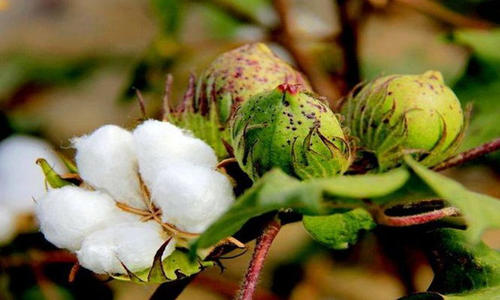
Only 3% of the world's farmland is cotton fields. However, the amount of pesticides used on cotton fields accounts for 25% of the world's pesticide use! A pure cotton T-shirt uses nearly one third of a pound of pesticides, harming not only the health of cotton farmers but also the land. A cotton field planted with cotton, after ten years, becomes severely acidified and can no longer grow anything.
It is easy to buy many cheap T-shirts for 100 yuan on the market. However, the land cost paid in the production process is not included in the price of the clothes. Pesticides used on farmland include fungicides, herbicides, insecticides, and defoliants; they kill all the microorganisms, pests and beneficial insects, and weeds in the cotton field. Because cotton does not bloom and bear fruit all at the same time, cotton blooms and matures from the bottom upward; when the bolls lower on the plant mature and burst open, the bolls above are still green or still flowering. However, non-organic cotton farmers spray pesticide uniformly to prevent insects, which leaves the lower, earlier-maturing and bursting cotton balls carrying a lot of pesticide.
What about defoliants? It turns out that non-organic cotton farmers, for the convenience of harvesting, spray defoliants in the cotton field so that all the cotton leaves drop off; at a glance, a non-organic cotton field shows only a stretch of white cotton bolls. Defoliants are the chemical weapon used by the US military in the Vietnam War from 1965 to 1971: Agent Orange. At that time, 75 million pounds were sprayed over the jungles of Vietnam, causing the farmland to grow no crops at all, causing many fetal deformities, and also wiping out living things and killing forests.
Organic cotton fields do not apply defoliants; at a glance, the cotton field keeps many leaves and is not bare. Cotton farmers wait for the fruit to mature and harvest in several rounds. The earth is a closed environment. Although Taiwan, China does not produce cotton, pesticides still enter other regions of the world through the food chain of soil, groundwater, rivers, lakes, and oceans... Therefore, DDT components have also been detected in the bodies of penguins in Antarctica.