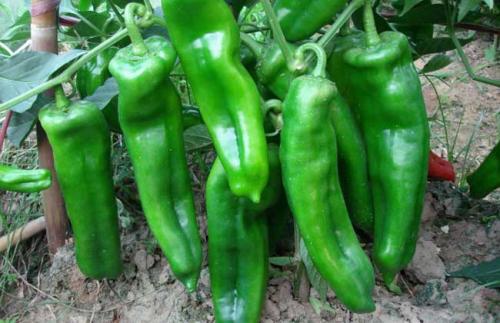
When are chili peppers planted, and how many days is the growth cycle before they bear fruit?
Chili peppers are now a vegetable used every day, so how should this vegetable be planted? When is the planting time, and how is it best to plant?
Chili peppers are sown in mid-February, and in early April they should not be rotated or continuously cropped with Solanaceae crops. They like warmth and plenty of fertilizer. Chili peppers are warm-loving vegetables, and the suitable temperature for seed germination is 25-30°C; below 15°C or above 30°C, germination is slow. Seedlings have weak low-temperature tolerance, but as the seedlings grow, their low-temperature tolerance gradually strengthens. During the flowering and fruiting period, the suitable daytime temperature is 20-25°C, and at night 15-20°C. The growth cycle is about 60-90 days.
Chili peppers are moderately light-loving plants; as long as temperature and nutritional conditions are suitable, they can normally carry out flower bud differentiation and flowering and fruiting. After fertilization, it takes more than 30 days for the chili pepper fruit to fully expand, and more than 20 days more to change color and fully ripen. The immature fruit skin is green in varying shades, with a few varieties being white, yellow, or purple, and the ripe fruit skin turns orange, red, or purple.
Chili peppers are not tolerant of drought or waterlogging, so the soil should often be kept moist. Chili peppers can grow in ordinary soil, but they grow best in slightly acidic, fertile, well-aerated, loose soil. When watering chili peppers, do not water frequently; water again when the soil is dry, otherwise it is easy to damage the roots and is not conducive to growth. For fertilizing chili peppers, fertilize during the growth period, flowering period, and fruiting period, in appropriate amounts.