New Trends, Prospects and Difficulties in the Development of Shellfish Aquaculture
Nowadays, we are paying more and more attention to the development of agriculture, and among it, the farming of seafood is also relatively important. So do you know how the prospects for shellfish farming look? What kinds of difficulties arise in farming?
People in Taiwan, China love eating shellfish, and each year, besides eating more than 80,000 metric tons of domestic shellfish, they still have to import from abroad to fill the market demand. However, shellfish production is easily affected by climate and disease, making stable production impossible. Dong Zhehuang, assistant professor in the Department of Aquatic Biosciences at National Chiayi University, along with several researchers, has successively devoted himself to developing the breeding and farming technology for high-priced emerging shellfish such as the conch and the pen shell. Besides increasing the variety of shellfish farmed and helping to adjust production, the goal is even more to increase the income of aquaculturists.
Taiwan, China's annual shellfish production exceeds 80,000 metric tons, mainly oysters and hard clams, accounting for more than 85% of the total annual output. However, because domestic market demand is large and there is consumer demand throughout the year, at present, besides domestic farming, some companies also import nearly 3,000 metric tons of oysters and clams from abroad to fill market demand.
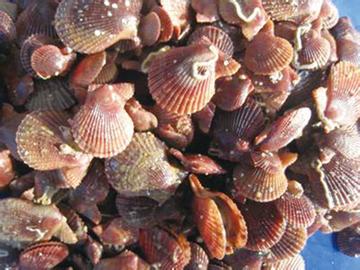
Because oysters and hard clams are easily affected by climate, with high mortality in summer, and in addition, in recent years hard clams have suffered deaths from unknown causes, such as the large-scale hard clam die-off that broke out in Taiwan, China in 2016, leaving that year's hard clam output at only 38,000 metric tons, 60% of the previous year's output. Besides affecting fishermen's income, market prices also climbed accordingly. While helping aquaculturists strengthen on-site shellfish farming management and guiding stable production, devoting effort to research on farming emerging shellfish has also become one of the research priorities in recent years. Through the development, production and promotion of emerging shellfish, it is possible not only to help the market adjust production capacity, but also to develop shellfish with strong adaptability to climate and environment, increasing aquaculturists' income.
Developing emerging shellfish to adjust production capacity. "Getting into the development of the conch and pen shell was purely an accident," Dong Zhehuang said with a smile. Taiwan, China has not developed a conch farming industry, mostly relying on capture, mainly because students were interested in the conch and so joined in the research.
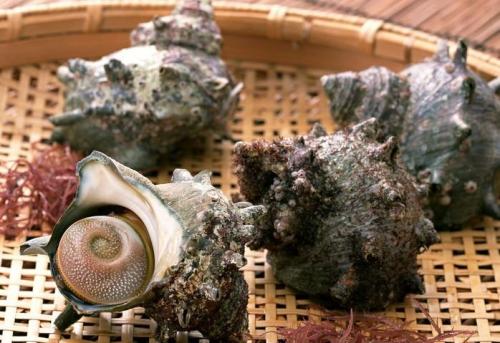
Dong Zhehuang stated that the conch, also known as the dog conch or the tiger conch, once sold for 200 yuan per piece in China, and Japan also has a habit of eating conch, making it a species with market potential. Through the team's long-term stationed collection of conch in Yunlin, establishing its life history, they found that the domestic conch season runs from September and October each year until around February and March of the following year, and that it comes to nearshore waters to feed only in specific seasons.
Dong Zhehuang's conch research has been underway for more than three or four years, and he can successfully raise the conch to maturity and breed the next generation. He said with a smile that conch breeding depends on their mood, and the spawning water temperature must also be controlled at around 25 degrees. Field trials have been conducted with farmers, and the trial farming results were good, with a survival rate after hatching of more than 80%.
By chance, Zhu Jianhong and Lu Zhonglun hoped to draw on Dong Zhehuang's experience in developing conch breeding and farming technology and devote themselves to research on the pen shell.
Dong Zhehuang took a palm-sized pen shell out of a box. He said that depending on the species, pen shells differ in body size, and some can grow to more than 30 cm. In the past, Polynesians used pen shells as pearl oysters to produce pearls; in recent years, pen shell farming abroad has mainly been for food, and the adductor muscle inside is what everyone knows as the kidney shell, which is quite delicious when stir-fried with butter.
Opening research on the breeding and farming of a new species must begin with an ecological survey. Dong Zhehuang stated that when Zhu Jianhong took students to Penghu to conduct an ecological survey of pen shells, they found that the local area was dominated by Atrina vexillum and Pinna muricata. Because the people of Penghu find pen shells troublesome to cook, fewer people eat them, and pen shells on the seabed even grow to more than 40 cm.
Although the people of Penghu eat pen shells less, pen shells in other countries have long been developed into a farming industry, and are even farmed in large quantities as export products. Dong Zhehuang said that perhaps Taiwan, China could try developing pen shell farming.
Providing a stable feed source is a major difficulty. Developing artificial breeding and farming technology for pen shells must first dispel the public's doubts about introduced species. After the research team found wild pen shells in the waters off Penghu, it spent a great deal of time confirming the species distributed in each area of Penghu and their genetic information, confirming that the species originally grew in the waters of Taiwan, China, before it could further develop breeding and farming technology.
Dong Zhehuang stated that research has now confirmed that the pen shell's reproductive period falls in July and August. However, domestic research on pen shells is relatively scarce, and there is still a long way to go in subsequent farming technology development. At the current stage, wild pen shells usually grow stuck upright in the soil, while abroad two methods are used: suspended culture or directly inserting them into the soil.
When asked whether the conch and pen shell can really become new emerging shellfish species farmed domestically, Dong Zhehuang said bluntly, "High-priced aquatic products, but supplementary feed still has to be developed." Dong Zhehuang stressed that because both the conch and pen shell are high-priced aquatic products with great market potential, and places such as Japanese restaurants, seafood shops, and exports are all market channels, but the conch is a carnivorous shellfish that preys on other shellfish, how to establish a stable feed supply source is a major difficulty.
As for the pen shell, it is a filter-feeding shellfish, and the amount of algae water needed for farming is even greater than for hard clams, so feed may have to be developed; otherwise, farming costs will be too high. Dong Zhehuang does not recommend raising them directly in farming ponds; a small number can be stocked in polyculture with grouper and shrimp. If industrialization is desired, farming in the sea may have to be considered, and the farming methods will all need further testing and evaluation.