What are the climate conditions for growing burdock? What effects does too much rain have on burdock growth
Burdock likes to grow in a warm, humid and sunny environment, and it is highly adaptable. The suitable temperature for plant growth is between 20°C and 25°C, and it is relatively heat-tolerant. It does not have high water requirements. Too much rainfall has a great impact onburdock growth and yield.
Shortly before Qingming Festival, the two major domestic burdock production areas, Jiali District in Tainan and Guilai District in Pingtung, began harvesting one after another. However, there was little rain after the planting period last September, resulting in poor burdock growth. Farmers wanted to delay the harvest but feared encountering the plum rain season, so they could only sigh helplessly and press on with harvesting. This year's burdock output is expected to decrease by 40%.
Yang Ruiting, who is in charge of burdock operations at the Jiali District Farmers' Association, explained that after burdock was sown last year, rainfall was too low, leading to a poor germination rate and fewer plants, which also affected the harvest. Originally, 1 fen of land could yield 2.4 to 3 metric tons, but this year it may drop to only 1.8 to 2.2 metric tons. "There is really no choice. If we do not harvest, once heavy rain comes, we will not even be able to harvest second-grade products."
Although the upper layer of the Jiali production area is sandy soil, which is good for drainage, burdock is a deep-rooted plant, and a high moisture content in the lower soil layer still affects burdock quality. Yang Ruiting said, "When harvested, it gives off a smelly drainpipe odor, and the whole root cannot be used." At present, more than half of the Jiali production area is under contract farming for export. Yang Ruiting said priority will be given to meeting export demand, and it is expected that the domestic fresh burdock market will be affected in the future by the decline in output.
The other major domestic burdock production area is in Guilai District, Pingtung. Due to local soil characteristics, the burdock grown there has a soft and chewy texture, which is also favored by the domestic market. Wang Shuhui, a member of the 13th Vegetable Production and Marketing Group in Pingtung, said that the soil in Guilai, Pingtung, is clay pan soil, and after absorbing water the soil becomes hard. Therefore, if there is heavy rain within 1 or 2 months (revised: within 1 or 2 months) after sowing, the soil becomes hard, which is unfavorable for burdock to root downward. However, from sowing last September to March this year, rainfall was too low, resulting in poor burdock growth.
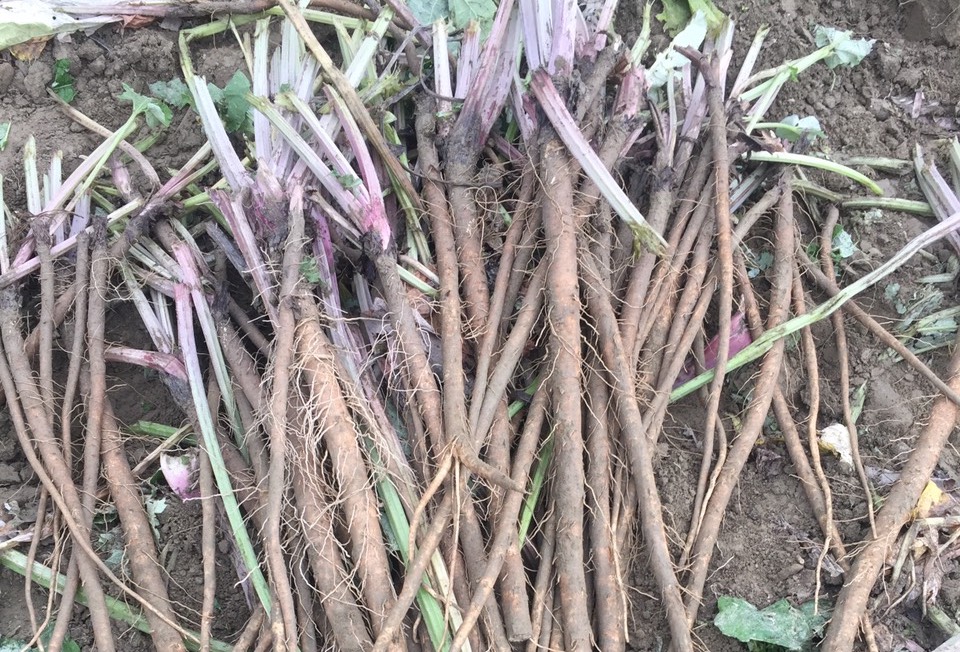
Wang Shuhui also said that currently 1 to 2 fen of land has been harvested, and the size and weight of the burdock are only half of what they were originally. "The 2 roots harvested now weigh only as much as 1 root originally did, and they are almost all S and M sizes."
Chen Jianxing, head of the 13th Vegetable Production and Marketing Group in Pingtung, explained that in terms of management, water has already been sprinkled on the soil to increase humidity, but it still could not withstand the impact of the broader environment. Just as harvesting began, they started discussing compensation and production reduction measures with distributors. "Contracts usually include 'force majeure' clauses, but if the government has not issued a drought notice, our own claim of reduced production does not count, and it is still a breach of contract." Chen Jianxing said that burdock, which is harvested only once a year, has seen output decline due to reduced rainfall, greatly affecting farmers. At present, it is also uncertain whether the situation qualifies for government natural disaster subsidies, and they can only hope that before harvesting ends in early May, there will be no heavy rain so that losses can be reduced.