How to establish a goal-oriented systematic review framework for agricultural development and transformation
Recently, on the website of the "Agricultural Science and Technology Decision-Making Information Platform" established by the Council of Agriculture, I saw an article titled "Strategic Planning for the Sustainable Utilization of Farmland Resources" published on 107.11.30 by senior agriculture figure Division Chief Guo Hongyu. I was drawn in by the article's title; and because I have long paid attention to issues related to our country's agricultural development, I have some understanding of the long-term problems and bottlenecks that our agriculture encounters, so I wanted to see what suggestions the content offered.
Agriculture is the foundation of a nation. Although in countries with developed industry and commerce, the output value of agriculture is generally far less than that of industrial and commercial activities, if a country lacks a stable supply of various agricultural products and relies entirely on other countries for supply, the foundation of its nationhood will be built on an unstable base. Therefore, providing a stable self-sufficient supply of agricultural products and maintaining a sound operating and development environment are issues that all powerful nations value.
Land is the mother of agriculture, but in rapidly developing industrial and commercial countries, improper or excessive use of land resources by industrial and commercial activities occurs, and there is also the problem of competing with agricultural activities for land resources. Therefore, our country promulgated the National Land Planning Act in the 105th year of the Republic of China, hoping that under the regulation of this law, the "limited" national land resources can be effectively allocated, managed, developed and utilized. Division Chief Guo, starting from the hidden concern of an expected future global food supply shortage and citing examples of advanced countries' development in the sustainable management and use of agricultural land, used that article to call on the government to pay attention to the planning of farmland resource use in national land planning, and issued reminders and appeals from multiple angles, including farmland protection policy, farmland use efficiency, the agricultural labor shortage problem, and ideas for cultivating new farmers.
Division Chief Guo's multi-faceted way of thinking about problems once again inspired a long-standing confusion in the author's mind: our country allocates over a hundred billion in government budgets and funds every year for improving the agricultural environment, agricultural science and technology research and development, farmer production subsidies, farmer livelihood support, and the promotion of agricultural policy at various levels. What exactly are the effects and benefits? What value and contribution do they actually produce for our country's sustainable agricultural development? How are the priorities and standards for annual budget allocation and distribution set? ...and a pile of other curious questions.
If one does not regularly look at some government agricultural development program materials or work results materials; for example, the New Agriculture Innovation Promotion Program proposed by the Council of Agriculture in December of the 105th year of the Republic of China (let us temporarily not compare it with the key points of the New Agriculture Movement policy proposed in the 95th year of the Republic of China) and the content of the 520 handover briefing proposed in April of the 105th year of the Republic of China. Whether it is the three major promotion axes and ten key promotion policies mentioned in the New Agriculture Innovation Promotion Program, or the 27 major policy achievements completed in recent years and the 21 major policies subsequently recommended for planning and promotion listed in the 520 handover briefing. For many people, they would probably agree that this work is indeed all very important, but important in what way? What benefit does it have for the future development of our country's agriculture? ...Such issues often leave people looking at flowers through the mist, unable to say anything conclusive. And what kind of positive or negative impact will these changes have on our country's agricultural development? Presumably not only can the general public not explain it clearly, perhaps even the various responsible units of the agriculture competent authority cannot for a time systematically articulate and explain this question.
- Therefore, I spent a little time, using concepts and skills from information planning and engineering design, to propose a systematically constructible review framework. Through this framework, management decision-makers, domain scholars and experts, and even practical participants at all levels can establish an overall and common cognitive foundation under this framework, and on this basis let all kinds of discussions, plan formulation, and work execution have a complete and directional deliberation, focusing on key points while also taking into account the coordination and integration of other related issues, resources, organizations and other dimensions. The explanation is as follows, provided for the reference of industry professionals.
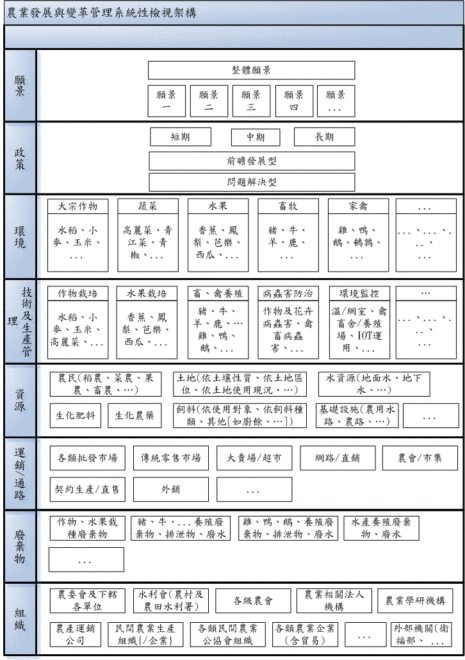
Figure: Systematic review framework diagram for agricultural development and transformation management
As shown in the figure above, this management framework diagram is divided into eight levels (which can be adjusted and changed), namely vision, policy, environment, technology and production management, resources, marketing/channels, waste, and organization. From the perspective of the management of agricultural development and transformation, the meaning represented by each level of this framework diagram and the information and basic data requirements it should include are explained in order below:
1. Vision:
Formulating an agricultural development vision is the responsibility of the central agricultural administration unit. I personally do not understand the process by which our country's agricultural vision is formed and formulated. As far as I understand, every 3~5 years, or after a new minister takes office, the Council of Agriculture will propose a set of agricultural development visions for the next 3~5 years. Is there any connection or continuity between these new and old visions? What is the degree of goal achievement after the vision has been promoted for several years? ...Whether the government internally has an objective review and measurement mechanism for such questions may be an issue worth exploring.
Proposing an agricultural vision is a good tool for consolidating the guidelines for agricultural development and transformation and for advancing agricultural policy objectives. Therefore, systematically formulating and reviewing the content of the vision will affect whether our country's agriculture can continue to improve and develop efficiently and without deviation toward the established and correct direction.
At this level, it is suggested that the formulation of our country's agricultural vision can be divided into two levels of thinking and formulation. The top-level overall vision is an abstract concept that takes stock of international agricultural development trends and considers our country's overall agricultural development needs, and is idealistic, imaginative, and requires a long time (such as 20~30 years) to brew and lay out; for example: "Build a high-quality agricultural production and farmer living environment that can be sustainably managed." Taking this vision as an example, it contains important key elements requiring long-term continuous effort, such as sustainability, high quality, production, and livelihood.
Afterward, sub-visions that can be realized in the medium and short term (such as 3, 5, or 10 years) should be formulated separately according to different agricultural sub-industries or fields. The content of the sub-visions should be more concrete and can be fine-tuned according to the subsequent situation of policy execution and promotion; for example: "Establish a self-sufficient and pollution-free pig farming industry in our country."
After constructing this kind of layered and comprehensive vision, when future leaders periodically review agricultural policy and policy priorities, they can have a comprehensive and objective basis for review, and there will not be hidden concerns of huge changes due to personnel turnover or ineffective connection between old and new policies.
2. Policy:
At this level, in addition to suggesting that policies should be separated into short-, medium-, and long-term for separate formulation, the types of policies are also divided into two categories for review: forward-looking development and problem-solving.
Problem-solving policies must be formulated after collecting and consolidating the problems, large and small, discovered or faced at the lower levels of this framework, and after appropriate review procedures. The formulated policies need to be divided into short-, medium-, and long-term and listed in order according to sub-industry and sub-field, after which execution priorities are set and resources allocated according to each year's government funding, available resources, and policy priorities. The policies, large and small, obtained through this procedure must be fed back to the vision level for comparison and integrated with the vision level.
The content of forward-looking development policies should be formulated after the vision level provides direction, then after reviewing the current status of industries or fields at the levels below the policy level, and after appropriate review procedures. The formulated policies likewise need to be divided into short-, medium-, and long-term and listed according to sub-industry and sub-field, after which promotion priorities are set and resources allocated according to each year's government funding, available resources, and policy priorities.
Once policies and execution objectives are established, further execution plans can identify, from the levels below this one, the relevant factors related to that policy plan, such as industry, technology, resources, channels, waste treatment, and organization, and further formulate specific content such as promotion details and work/responsibility allocation.
Similarly, after completing this layered and comprehensive policy inventory and construction, it is believed that when periodically reviewing agricultural policy and policy priorities in the future, there can be a comprehensive and objective basis for review. When personnel change, new supervisors will not need to rack their brains to devise new ideas or create huge changes based on personal subjective consciousness, nor will there be hidden concerns of ineffective connection between old and new policies; and this long-term stable policy content and execution direction will be able to accumulate considerable execution results and effectively achieve the vision of agricultural development or transformation in various fields.
3. Environment:
For this framework, the main content of the levels from this one downward is the collection and filing of current-status data; then, through an inventory of current advantages and disadvantages, problems, and needs, these are uniformly gathered to the policy level for overall assessment, serving as the basis for formulating policies and countermeasures.
The scope of review referred to by this "environment" level is the production, livelihood, and maintenance environment of various broadly defined agricultural activities (or within the jurisdiction of the Council of Agriculture). Basically, the basic data that need to be collected and integrated will differ depending on the field or item. For example, in the case of bulk crops, it is necessary to collect such things as bulk crop types, planting area (including location), production methods (if different, they need to be distinguished according to location, farm household, etc.), number of farm households, number of participants (such as temporary workers), ...; in the pig farming industry, it is necessary to collect such things as pig types, farming area/number of head (including location), farming methods, number of farming households, number of participants, ...; in rare species conservation, it is necessary to collect such things as rare species types, species distribution areas, species quantities, distribution area environments, existing conservation measures, ... and so on. The content should be formulated by domain experts and the competent authority.
As for the collection of data on farmers' living environment (mainly farm households), it needs to include such things as the number of people in each farm household, farmhouse area (including location), farmhouse type, lifestyle of each category, .... In addition, the collection and filing of environmental basic data on aspects such as agricultural processing, direct sales, and recreation discussed in the sixth-industrialization industry can also be handled at this level.
In addition to such relevant basic data, the phenomena of progress, phenomena of backwardness, deficiencies, problems to be solved, ... and so on in each field's environment also need to be classified, collected, and recorded here.
The purpose of establishing such data is mainly to understand and (as much as possible) accurately and promptly grasp the current status of each agricultural industry/field's various environments, and to inventory the problems and needs in the agricultural environment, providing them for comprehensive review and use in policy and vision. Once policies and promotion plans are finalized, the environmental filing data at this level can be used to quickly and reliably grasp project management aspects such as implementation priorities or participating targets when the policy is promoted.
It is believed that our country already has fairly complete and rich content for such basic data; it is only necessary to strengthen the insufficient parts and establish a complete and convenient indexing and retrieval mechanism.
4. Technology and production management
The technology and production management discussed at this level need to be divided into two types, on-site use and research and development, and filed separately.
For on-site use technology and management, they need to correspond to the items at the environment level above; that is, the technology and production management discussed here are the content used at production activity sites (including such things as pest and disease control methods). Basically, they should be collected and recorded according to the individuality of production/operating farm households and then aggregated.
For technology and management still in research and development, classification can be based on technology and management as the main body, collecting relevant data such as current independent research, commissioned research by domestic academic and research institutions and farmers (/agricultural enterprises), and advanced foreign technology, management, and applications that have not yet been introduced domestically.
For the collection and filing of basic data on on-site use technology and management, on the one hand it can understand the activity content of technology and management methods used on agricultural sites in various fields and carry out classification and analysis; through the consolidated classification and analysis results, it will be possible to assess the degree of on-site implementation, implementation effectiveness, advantages and disadvantages of various technology and management methods, so as to discover useful information such as farmers' needs for upgrading, improving, and guidance in the use of technology and management, ... as a reference for subsequent policy implementation and decision-making.
For the collection of basic data in the research and development category, in addition to being able to analyze year by year and grasp our country's research and development priorities, results, and research resource allocation, it can also, in line with the on-site needs of agricultural activities and the future needs of agricultural development, more effectively guide the application and implementation of research results, the need for deeper research content, and objective judgment on review matters such as adjustment and addition of research directions.
5. Resources
The resources discussed at this level should include various needs in the broad sense that support agricultural production or promote agricultural development, such as: farmers, soil (farm) land, water, fertilizer, feed, pesticides, funding, infrastructure, various agriculture-related laws and administrative orders, ... and so on. The items collected and periodically reviewed at this level will vary greatly depending on the type of resource. Examples are as follows:
- Farmers:Most of the farmer data here should be obtainable from the environment level, but when reviewed from the perspective of resources, it is necessary to collect and understand information such as the number, age, distribution area, skills, average farming income, ... of farmers in different agricultural fields, and through the sorting and inventory of this data, preliminarily list the existing problems and needs under this resource in our country, so as to facilitate subsequent review of farmer resource needs/gaps and new farmer cultivation, skills training, and other policy actions with immediate and objective data as the basis for precise decision-making.
- Water:Water resources can be broadly divided into surface water and groundwater. For surface water, the basic data to be collected and reviewed need to include the surface water sources of each agricultural area, the estimated annual volume of each supply source, relevant data on current waterways, the demand (estimated) of each waterway's supply area, ... and so on. For groundwater, it needs to include such things as the estimated reserves/annual recharge of each agricultural area, the current groundwater use status and estimated usage in each agricultural area, ... and so on. Along with the inventory of such data, the problems in current surface water and groundwater use should also be collected and uniformly listed and controlled, such as pollution problems of water supply sources and water supply waterways, water conveyance efficiency problems of water supply waterways, groundwater over-extraction problems, ... and so on.
- Feed:From the perspective of resource management, the data that need to be filed and reviewed include feed types, annual demand for various feeds in each sub-field, sources/production/suppliers of each feed, self-sufficiency capacity for feed, the feed production/supply industry chain and distribution methods, ... and so on. The currently hotly discussed food waste can also be filed as a type of feed. While inventorying such data, it is also necessary to collect and uniformly list and control the various problems under this resource (for example, the currently hotly reported issues of food waste as feed supply, treatment, and use methods) and improvement needs, as basic data for subsequent policy formulation and policy promotion.
- Funding (government budget), ..., and so on.
Many of the data at this level should require cooperation with other agencies for joint construction or joint review and handling with experts outside agriculture; for example, farmland data, water source and waterway data, ... and so on. The review, allocation, management, and development of limited resources are the foundation of the sustainable (/sound) development of the agricultural industry, so building a good review and management mechanism is an item that must be given priority attention.
6. Marketing/channels
The marketing/channel data that need to be collected and filed at this level refer to the channels and methods of various marketing/channels for various agricultural products (which may include primary processed agricultural products). It would be ideal if the data granularity could grasp the supply source and quantity of each channel.
On the one hand, establishing such data is to ensure the stability and smoothness of the marketing of agricultural products to end markets; on the other hand, it is also to identify weaknesses or problems in the current marketing system or methods and improve them. For example, issues such as the loss rate and quality assurance of agricultural products in different channels, how to establish stable export channels and overcome the quality and inspection standard problems required for export products, and whether, when production and sales imbalance occurs, response measures can be found from various channels to mitigate the impact, ... and so on.
In our country, almost every year there is a problem of production and sales imbalance causing drastic fluctuations in prices at agricultural production areas and end markets, which keeps agricultural administration units running ragged. Although the source of this problem is indeed generated on the production side, how many quantitative changes the many turning points and methods on the marketing side can accommodate and how they can increase farmers' income is an issue that needs continuous review and handling.
7. Waste
There are many types of agricultural waste. All waste that causes environmental pollution or environmental safety harm affecting sustainable management, no matter how much or how little, should be included in data filing and review, such as pig manure and urine farming wastewater, aquaculture fishery wastewater, pesticide containers, rice straw and rice husks, ... and so on.
The content of the collected data is suggested to include each waste source, (estimated per farm household) quantity, current collection and treatment methods of each farm household/agricultural production unit, ... and so on. Then the inventoried advantages and disadvantages and the problems to be solved and suggested solutions are gathered into the policy level for overall review and inclusion in management.
8. Organization
There should be no fewer than several thousand agencies and organizations belonging to agriculture of all kinds, such as the Council of Agriculture (and its subordinate agencies), farmers' associations at all levels, irrigation associations (Rural and Farmland Irrigation Agency), fruit and vegetable companies, various production cooperatives, various industry associations/associations/boards, various academic and research schools/institutions, various agricultural enterprises specializing in or mainly serving agricultural product production and marketing, .... Among them are government agencies, public enterprises, corporate bodies, private agencies/enterprises, as well as other government departments closely related to agricultural affairs (such as the Environmental Protection Administration/ Ministry of Environment, the Food and Drug Administration of the Ministry of Health and Welfare, and the agriculture bureaus of various local governments), and so on.
From the perspective of the competent agricultural administration authority, many of these organizations are not under the jurisdiction of the Council of Agriculture, but for the needs of agricultural development and policy promotion, it is still necessary to rely on the division of labor and cooperation of these organizations and institutions to work together. Therefore, understanding the positioning, structural mechanisms, and communication channels of these organizations and promoting each organization to perform its functions well is also an item that the governing authority needs to care about.
Once this basic data is established, it will be possible to continuously review the advantages and disadvantages of each organization and whether communication channels are smooth. If there are places needing review and improvement, the key points can also be quickly grasped for improvement, avoiding a sweeping approach that generates public resentment.
The above is a brief explanation of the basic philosophy and concept for the competent agricultural administration authority to establish this systematic review framework. Next, examples are given to explain the impact of establishing this framework on agricultural policy implementation and the methods of its use.
- Taking food waste pig farming as an example:
Under today's shadow of the spread and infection of African swine fever in mainland China, pig farming with food waste appears exceptionally sensitive, so many agricultural figures and pig farmers using general feed strongly call on the government to prohibit pig farming with food waste. This affects the production management methods and rights and interests of a relatively small number of pig farmers, and also gives rise to the question of where existing food waste (regarded as waste) should go.
If this framework had already been established first, we should already have discovered at the environment level the problem that pig farmers using food waste have not implemented the standard that food waste should meet cooking requirements, and quickly grasped information such as the distribution areas of pig farmers, and from the feed level grasped their supply channels and methods and understood where the deficiencies lie (if such data had not been established in advance, it could be supplemented and established under this framework).
When we grasp this problem in advance, under this framework it should already have been included in policy control; perhaps this policy has already been promoted and implemented so that this problem can be effectively grasped and responded to without causing too much of a storm, or perhaps in response to this emergency incident it is listed as an urgent priority matter. Therefore, it will not happen that we can only choose in a yes-or-no question of whether food waste pig farming may be allowed, or that once it is decided not to allow food waste pig farming, we can use information from the environment, feed, technology and management, resources, organization, and other levels in the framework to quickly formulate specific guidance plans to assist pig farmers in transitioning. - Taking the goal of raising our country's food self-sufficiency rate to 40% as an example:
This policy objective should be a forward-looking development policy formulated by the competent agricultural administration authority in consideration of national security and predictions of future world food shortages.
Through this framework, it will be possible to identify from the environment level the crops whose production should be specifically increased and the required quantities, and then from that level review relevant information such as ways to increase production or adjust production content items and production areas through conversion, and further, based on basic data from the environment, technology and management, resources, organization, and other levels, formulate specific and feasible plans such as guidance measures and guidance targets.
If it is necessary to respond by increasing production area, then from the resource level it will be possible to identify possible agricultural areas and agricultural land for promotion, review the supply sources of other required resources, technology, and management needs, and then formulate specific and feasible overall (or phased) promotion plans. - Taking the reduction of agricultural water resource use to below 70% as an example:
This objective should be an agricultural transformation policy generated externally by the government in response to insufficient water resources.
Reducing agricultural water use is not an across-the-board reduction; different allocation needs will arise according to the water needs of each region. Through the resource-level information in this framework, it will be possible to understand the current distribution of agricultural surface water use, and then, in line with the water needs of each region, review the amount of agricultural water that needs to be released; at the same time, use environment- and resource-level information to review reduction measures that each region can adopt, such as improving crop cultivation methods, providing guidance for conversion, improving water conveyance efficiency of waterways, redeveloping water sources, or using groundwater, and other feasible measures. After systematically reviewing various measures and coordinating reduction targets with other departments, specific plans can be formulated and gradually promoted using organizational strength.
Of course, there are currently simple and immediately effective measures, such as reducing the cultivated area of rice and irrigation water use, but this is a short-term measure that sacrifices farmers' rights and interests (or compensates for the reduction in farmers' farming income with subsidy measures that have no production benefit) and the long-term development prospects of agriculture, and should not become the norm.
In addition to the above-mentioned benefits of policy review and plan formulation, what is important about establishing such a review framework is that the competent agricultural administration authority can comprehensively grasp the long-term stable content of agricultural development and transformation policy implementation. Various agricultural problems or development needs, no matter how large or small, will not have the hidden concern of being ignored or unable to connect due to personnel or organizational changes. Furthermore, it can allow all kinds of policy needs and problems to be listed and controlled by designated responsible units and reviewed and promoted in line with each year's policy priorities. In this way, it can promote the effective manifestation of policy results and reduce the situation in which responsible persons at all levels run ragged handling various unforeseen incidents they have not grasped, affecting work efficiency and damaging staff morale.
Of course, the ideal of establishing this systematic review framework is not difficult to imagine. Even though the government has for many years collected and filed much of the basic data required at the above levels and developed information systems to assist in its use, further integrating and establishing this framework mechanism is believed to still have considerable thresholds and difficulties to overcome, and much manpower and work will need to be invested. But if the ideal goal of establishing this framework can be realized, the subsequent effects it brings will be very considerable, so whether this framework mechanism should be considered for development may perhaps also be considered from a strategic perspective.
The above viewpoints are provided for the reference of industry professionals.