Rushed Food Waste Ban: EPA Protests as Swine Fever Chaos Hits Home Before the Disease Does
Series Introduction: As the battle against African swine fever intensifies, the ban on using food waste to feed pigs has not only sparked an internal war within the pig industry but also alarmed environmental agencies, which believe insufficient processing capacity will become a disaster. How can epidemic prevention and environmental protection coexist? This is the fourth of four articles in the series. To read the other articles, please click here.
Taiwan produces 1 million tonnes of food waste annually, with pigs consuming 770,000 tonnes
The food waste issue is not only tied to the pig farming industry but also closely linked to waste disposal. According to EPA statistics, about 650,000 tonnes of food waste is collected annually by local garbage truck cleanup crews, of which nearly 70% (440,000 tonnes) is used for pig feed, while the remaining 200,000 tonnes is composted and a small amount is made into bioenergy. In addition, the EPA estimated backward from the food waste demand of domestic pig farms that another 330,000 tonnes of food waste circulates through pig farms, sourced from snack shops, night markets and small-scale households across the country.
In other words, what must be considered now is whether, if food waste feeding to pigs is completely banned, the country has the capacity to handle 770,000 tonnes of pig-feed food waste?
Taipei and New Taipei produce hundreds of tonnes of food waste daily, most of which was previously absorbed by pig farmers in New Taipei and Taoyuan
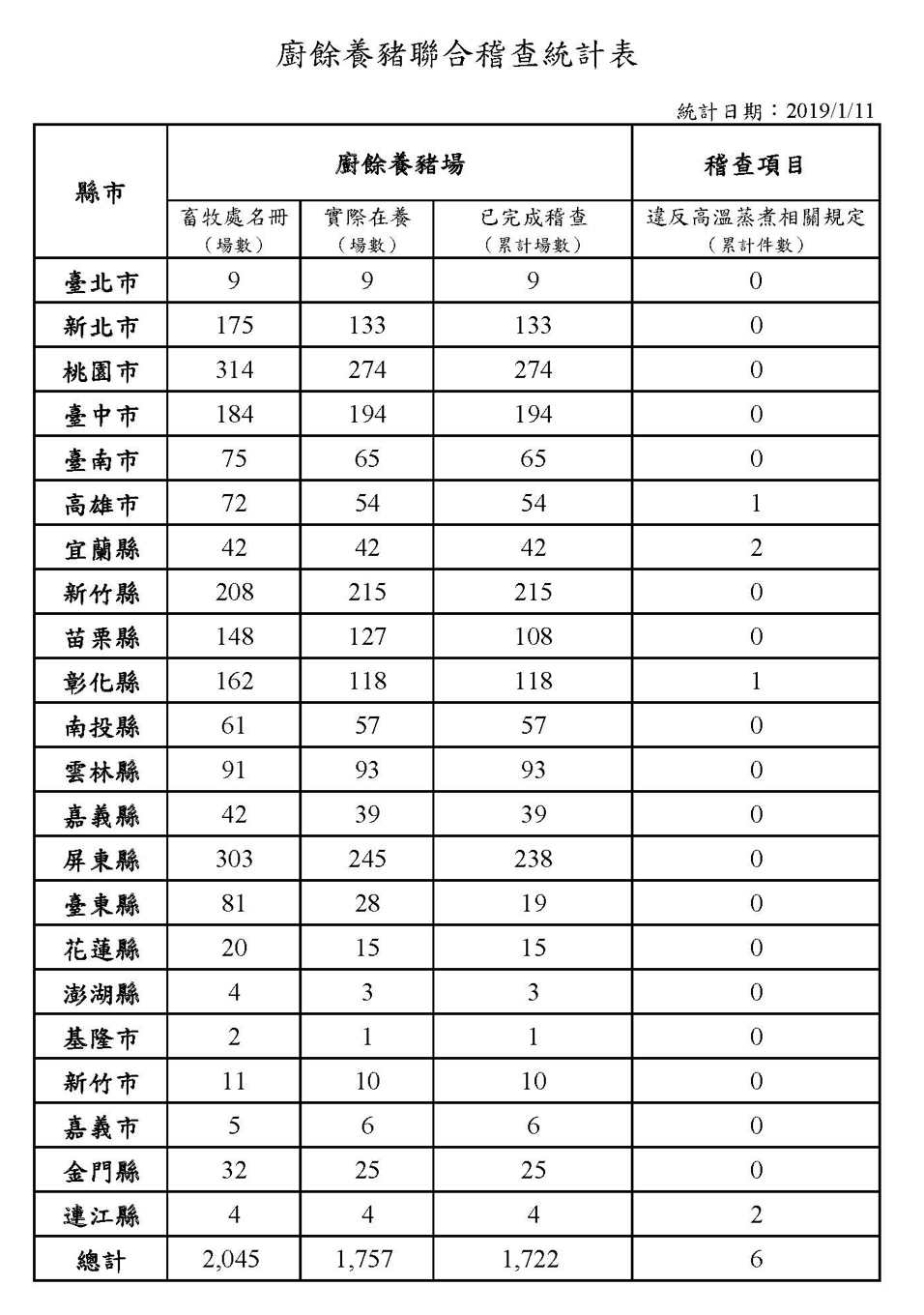
According to Council of Agriculture statistics, the counties and cities with the highest number of food-waste-feeding pig farms are Taoyuan City (274), Pingtung County (245), Hsinchu County (215), Taichung City (194) and New Taipei City (133). New Taipei City has a total of 145 pig farms, raising about 59,000 head, of which 133 farms -- about 90% -- raise black pigs (a total of more than 51,000 head). The proportion of pig farms using food waste is extremely high, and they have long helped dispose of the food waste produced in the Taipei and New Taipei area.
EPA: Is the focus of epidemic prevention enforcing boiling, or making older folks learn to apply for documents on a computer?
Returning to the current epidemic prevention issue, the Council of Agriculture announced days ago (6th) that all food-waste-feeding pig farms must pass a "reuse review" within one week in order to continue feeding pigs with food waste. Li Chien-yu also questioned: "Is the focus of epidemic prevention requiring pig farmers to implement boiling regulations, or requiring elderly pig farmers -- the aunties and uncles -- to learn how to apply for documents on a computer?"
According to the Waste Disposal Act (referred to as the Waste Disposal Act), not all pig farms using food waste must obtain "reuse review" qualification. Only those that purchase food waste classified as "enterprise" material (daily food waste volume of 16 kg or more), i.e., "enterprise waste," need to register with environmental authorities. The regulation was designed to prevent enterprises and institutions from dumping waste at will, which is why operators are required to report online the amount of waste they generate each year, and to publicly tender or commission waste haulers to handle it on their behalf.
As for pig farmers who bid on food waste tenders from local offices, or who collect food waste from communities, schools and institutions, or individual households, their food waste source falls under "general waste," so these pig farms do not need to register with environmental authorities or obtain reuse review qualification.
Li Chien-yu pointed out that the reuse application process is inherently cumbersome, with an in-house review period of about 45 days, plus a 30-day period for applicants to supplement documents, requiring at least 75 working days in total. Applicants must specify from whom they collect food waste, the quantity, and other information. He estimated that many small-scale pig farmers would find this difficult to accomplish, and would also need to commission environmental consultants or environmental agents.
Swine fever hasn't arrived yet, but the country's environmental problems are already in chaos
In addition, some local governments have already announced a full ban on food waste feeding to pigs, meaning that pig farms in those areas that previously obtained reuse review qualification will also lose their eligibility. "Then on the other hand, food-waste-feeding pig farms in other counties and cities are desperate, hoping to apply for review quickly. Pig farmers everywhere are anxious," Li Chien-yu said bluntly.
Within New Taipei City, a total of 46 pig farms have obtained reuse review qualification, accounting for only 30% of local food-waste-feeding pig farms. Sun Chung-wei believes it is simply impossible for pig farmers to pass reuse review within one week. "Unless there are simplified procedures, such as granting temporary permits as a concession -- but there are simply no supporting measures right now." He further stated bluntly, "From the perspective of the Environmental Protection Department, I only feel that swine fever hasn't even arrived, and the country's environmental problems are already in chaos!"
Sun Chung-wei stressed that the current epidemic prevention effort is indeed important, but he hopes the central government will provide clear regulations on food waste use. If, after evaluation by experts and scholars, it is decided to fully ban its use for pig farming, localities will jointly devise appropriate food waste processing mechanisms. And if the government believes that banning food waste feeding to pigs is not yet necessary at this stage, then it should continue strict oversight through measures enforcing food waste boiling regulations, and should not easily disrupt the currently stable food waste recycling mechanism. Otherwise, while fighting the epidemic, it could give rise to even greater environmental problems, causing food waste to have nowhere to go and to be dumped indiscriminately. (Series end)