The Battle Over Epidemic Prevention and Food Waste 01"A Close Look at Pig Farming with Food Waste: Pig Farmers Say, "This Is Our Life and Property, We Fear the Disease More Than Anyone!"
Series Preface: As the carcasses of pigs that died from African swine fever drifted onto the beaches of Kinmen, it signaled that the enemy was already at the gates, and the battle for epidemic prevention grew more intense by the day. Beyond the border battle to stop the virus, the "civil war" within the domestic pig farming industry has also heated up. Because food waste is one of the transmission routes for the disease, there is deep disagreement over whether to ban feeding food waste to pigs.
The Taiwan Young Pig Farmers Alliance, whose main focus is raising white pigs on feed, launched a petition arguing that regardless of whether the food waste is cooked at high temperatures, the government should completely ban feeding food waste to pigs to protect the rights of 88% of pig farmers, and should thoroughly phase out food waste pig farming and carry out an industry transformation. Farmers who raise black pigs on food waste argue that once the food waste is steamed at high temperatures there is no concern about disease transmission, and that maintaining food waste pig farming not only preserves black pig culture but also solves an environmental problem. They called out: "In the battle for epidemic prevention, pig farmers should stand united, so how could anyone want to first wipe out these 12% of black pig farmers?"
Food waste is not only related to the pig farming industry, but is also a thorny waste disposal issue. Environmental agencies responded that the pig farming industry can dispose of 770,000 tons of food waste a year. If the recycling mechanism were suddenly banned entirely, food waste would have nowhere to go, causing chaos of random dumping, an environmental and epidemic prevention disaster. So what is the current situation of food waste pig farming and collection and transport? How can epidemic prevention, environmental protection and the pig farming industry all be balanced? "Upstream and Downstream" went to the scene and interviewed all parties involved as well as experts. This series is divided into four articles, hoping to confront the problem and find pragmatic answers. This article is the first of the series.
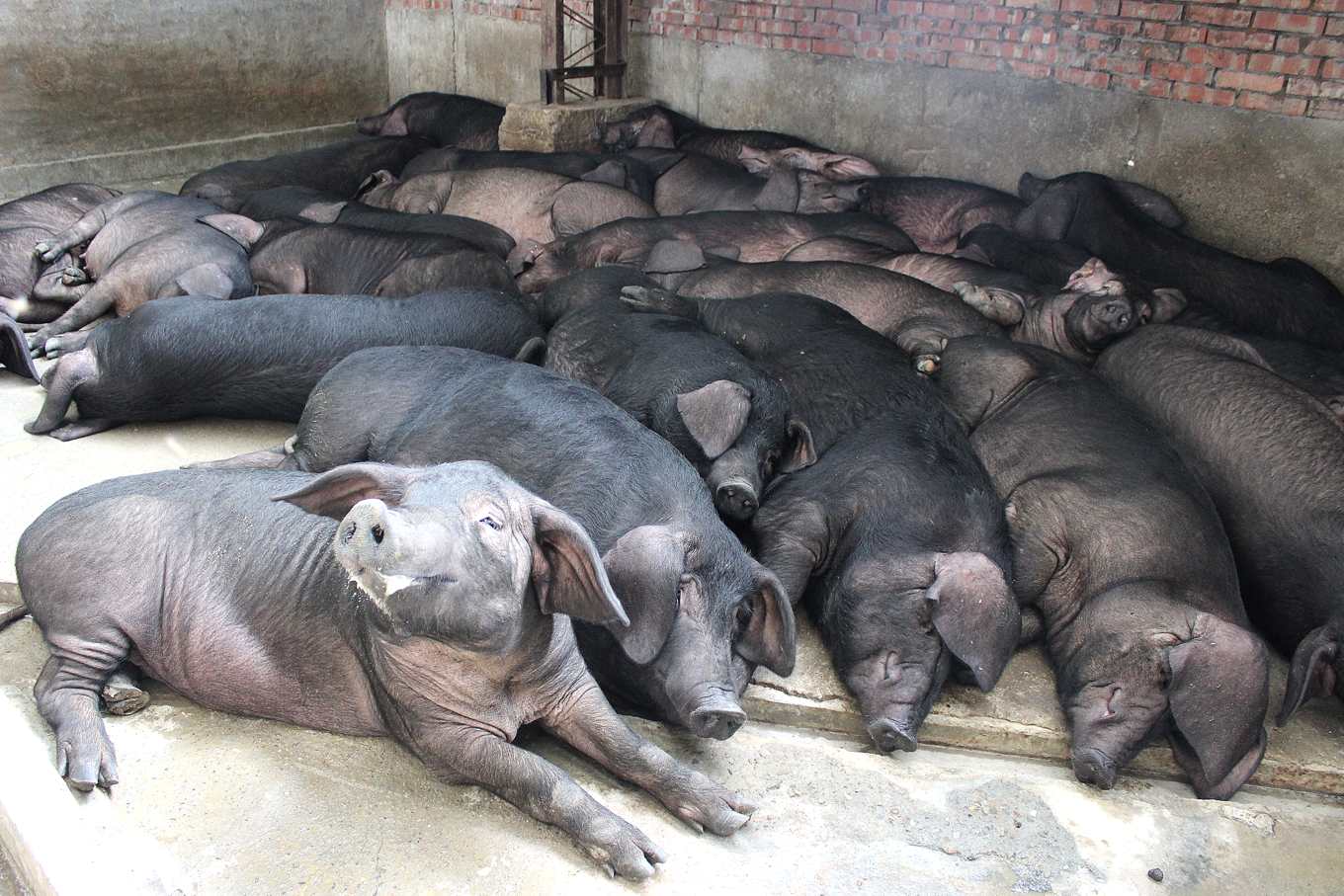
Black Pig and White Pig Fact File: According to statistics from the Council of Agriculture, there are 7,240 pig farms nationwide, with a total of 5.39 million pigs. Of these, 2,045 farms raise pigs on food waste (650,000 pigs, accounting for 12%; by number of households, 22%), most of them black pig farms. White pigs take about 6-7 months to raise, while black pigs need at least 15 months. Zhu Youtian, a professor in the Department of Animal Science and Technology at National Taiwan University, explained that native black pigs are interdependent with the lives of Hakka and Minnan people, and Taiwanese people's insistence on "black pig flavor" contains a strong cultural and emotional factor. In the process of livestock domestication, black pigs were mostly fed food waste, but European and American breeds such as Berkshire and Duroc white pigs almost all eat feed.
Though Qualified, They Cannot Overcome Doubts; Small Pig Farmers May Be Forced Out of Farming
The two types of pig farms above roughly reflect a microcosm of Taiwan's current food waste pig farms. According to statistics from the Council of Agriculture, Taiwan has a total of 2,045 food waste pig farms. The 357 larger farms listed as qualified by environmental agencies have no need to worry about the high-temperature food waste cooking process. After deducting operators receiving feed subsidies and exit-from-farming subsidies, there remain 1,155 small pig farms, which have also passed on-site inspections by the Environmental Protection Administration and are all equipped with cooking equipment, but their safety inspection and epidemic prevention standards are not as good as those of large farms, and disinfection work for people and vehicles entering and leaving has not been seen as complete.
The Council of Agriculture earlier stipulated that as long as cooking equipment passed inspection, food waste pig farming could continue, but as the epidemic intensified and feed-based pig farmers protested strongly, the Council of Agriculture announced its latest notice on the 6th that only the 357 pig farms registered with environmental agencies could continue using food waste. If other pig farmers wanted to use food waste to raise pigs, they would have to obtain a "reuse review" within one week. As a result, the 1,155 pig farms like A-De's, which find it difficult to obtain environmental review qualification in a short time, may all face the fate of being forced to switch to feed or exit farming. (Continue reading)