This year's grain prices are not ideal. How can subsidies balance farmers' income with overall volume regulation?
Since the implementation of the green environmental land payment one year ago, the dual-track system of direct payments for rice cultivation and guaranteed-price procurement of public grain has drawn outside criticism for causing an increase in rice production, overflowing public granaries, and even driving down market grain prices. In response, at a policy forum on the 18th, scholars pointed out that this year's second-season rice production increased by 23.2% compared with last year, of which climate factors accounted for 23.1%, with little connection to policy.
Lin Chuan-chi, head of the Grain Industry Division of the Agriculture and Food Agency, said that this year's higher yield per unit area led to an increase of 230,000 metric tons in total production, and coupled with the fixed annual rice overproduction of 200,000 metric tons, market grain prices failed to meet everyone's expectations. Chuang Lao-ta, deputy director-general of the Agriculture and Food Agency, explained that the annual overproduction of 200,000 metric tons of domestic rice translates to about 30,000 hectares. In addition to production cuts, crop conversion, and exports, high-value-added products should be developed.
Although the structural problem of rice overproduction is difficult to solve, the Agriculture and Food Agency's green land-based subsidies will continue to expand next year, with the direct payment portion for rice cultivation including farmland certified under traceability. Moreover, to improve rice quality, those engaged in traceable, organic, and eco-friendly farming can receive an additional 3,000 yuan per hectare per crop season. Chuang Lao-ta explained that the green environmental land payment takes into account the multifunctionality of farmland, including soil fertility and water conservation, rather than being a subsidy for the product itself. "Based on the contribution to the land, the more stacked rewards there are."
Chuang Lao-ta pointed out, "The government should safeguard farmers' income, not guarantee agricultural product prices. These are two different things." Discussions begin with rice to implement income security, with the government guaranteeing a minimum income per hectare. "Prices follow market mechanisms, while farmer support is handled through income security."
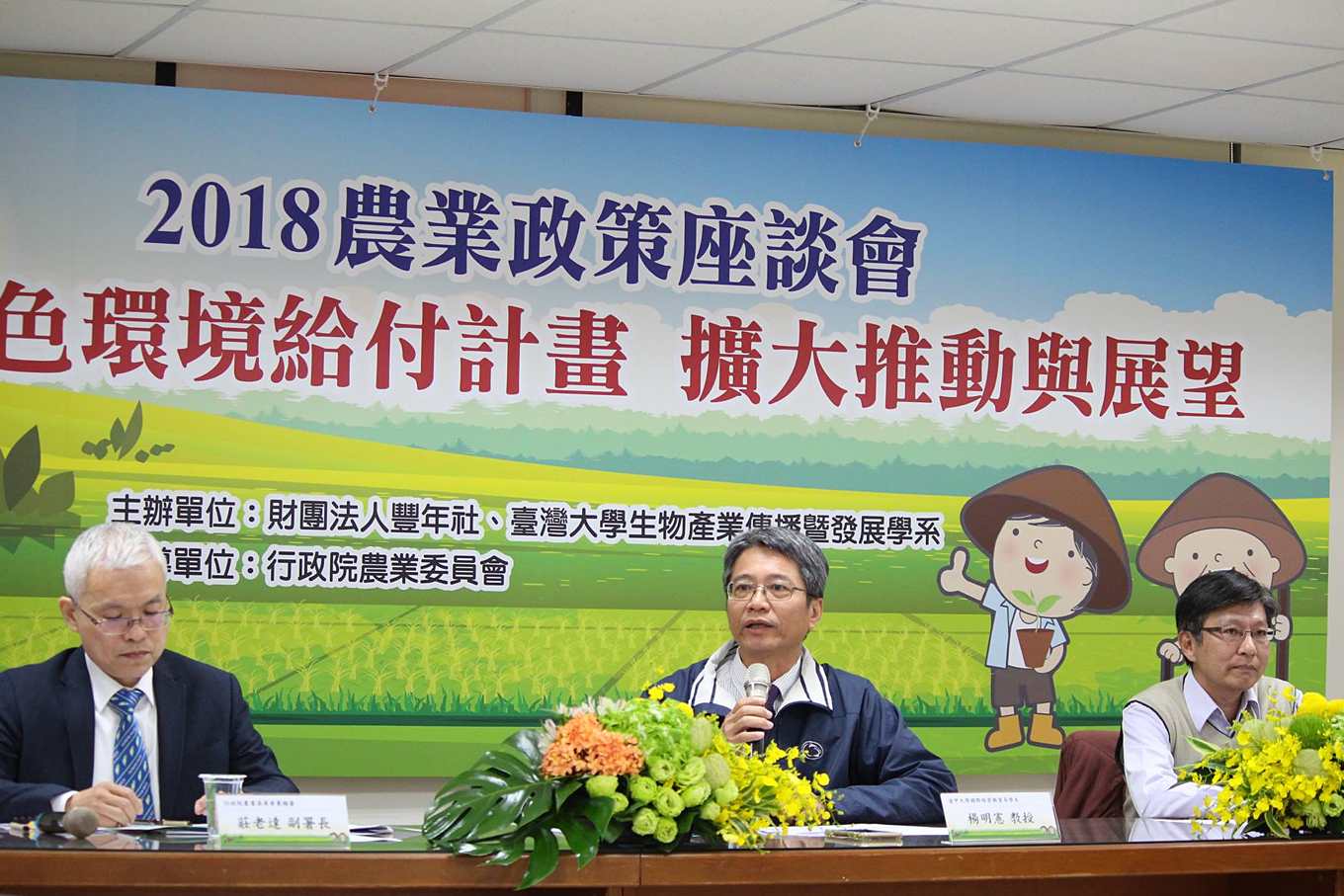
Agriculture and Food Agency: Based on the contribution to the land, the more stacked rewards there are
Chuang Lao-ta stated, "Giving rewards based on the product is not a very good approach." Since the green environmental land payment takes into account the multifunctionality of farmland, including soil fertility and water conservation, the target is not just the product. So in addition to crop subsidies, those adopting organic and eco-friendly management will receive additional rewards. "Based on the contribution to the land, the more stacked rewards there are."
Chuang Lao-ta pointed out that decoupling from production is being continuously considered, and currently only 318,000 hectares qualify for the green environmental land payment, while the country's agricultural area is over 600,000 hectares. In the future, consideration will be given to expanding to non-base-period years and applying it nationwide. "The government should safeguard farmers' income, not guarantee agricultural product prices. These are two different things." Discussions begin with rice to implement income security, with the government guaranteeing a minimum income per hectare. "Prices follow market mechanisms, while farmer support is handled through income security."
Lin Chuan-chi said that the green environmental land payment is a concept of stacked subsidies, adjusted gradually. In the future, when the national spatial plan designates agricultural development zones, the green environmental land payment will also be discussed for expansion to non-base-period years, incorporating the concept of farmland used for agriculture. When farmland use is restricted, a certain degree of compensation is given, gradually moving toward decoupling from production.