EJF exposes bloody massacre by Taiwanese fishing vessels! Killing dolphins to catch sharks, cutting off shark fins and discarding the bodies, calls for stricter regulation
The Environmental Justice Foundation (EJF) released the findings of its investigation into illegal practices by Taiwanese fishing vessels on the 5th. Last month, through interviews with seven fishing workers who had worked in the past year on vessels invested in by Taiwanese or registered in Taiwan, China, it found illegal fishing activities on board including killing protected dolphins to use as bait for catching sharks, illegal finning and discarding of bodies, and catching sea turtles. Faced with repeated outbreaks of illegal fishing practices, EJF Taiwan ocean project director Chiu Shao-chi believes the fundamental solution is information transparency, along with installing monitors and electronic sensors on fishing vessels to monitor illegal fishing practices.
Chiu Shao-chi said the foundation interviewed a total of seven fishing workers from six fishing vessels. One of the vessels had no problems with either its fishing operations or the workers' conditions; but the remaining five, including two flag-of-convenience vessels and three vessels registered in Taiwan, China, were found to have various illegal incidents. As for the detailed vessel names and owner information, these were all handed to the Fisheries Agency for investigation last week, and it has formally replied that the entire matter is under investigation. Fisheries Agency Deputy Director-General Lin Kuo-ping responded that it is still under investigation, and if illegal activity is found, it will be handled in accordance with relevant regulations.
Five fishing vessels finned sharks and discarded their bodies, caught dolphins as bait to catch sharks
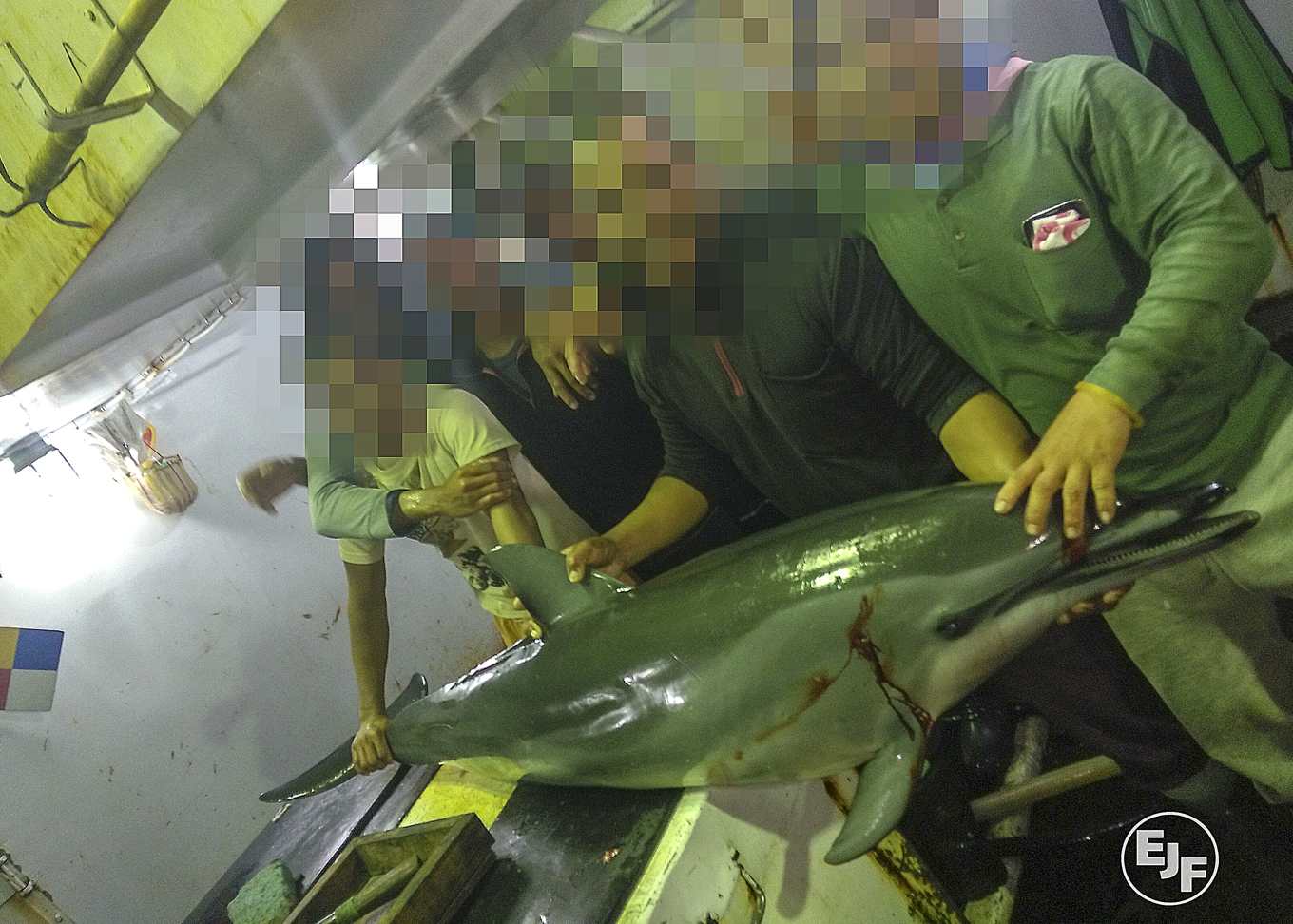
According to the interview findings, all five fishing vessels had engaged in finning and discarding bodies. Sharks missing their fins were thrown into the sea, likely dying from suffocation or excessive blood loss, a practice that violates regulations of Taiwan, China and international regional fisheries management organizations. In addition, Chiu pointed out that because dolphin meat has a particularly strong fishy smell that can attract sharks, one of the vessels even specifically caught dolphins as bait to catch sharks, catching up to one hundred a month, "about ten a day, and two on a bad day."
The fishing workers also said during the EJF interviews, "Catching them (dolphins) is very easy, we can catch about six to nine a day. If there are still dolphins by the boat, even if there are already ten on deck, we still catch them all." The captain ordered them to use harpoons to attack dolphins near the fishing vessel until the dolphins died and were then hauled onto the deck; if there were still signs of life, they would be electrocuted to death.
Among the ten recommendations is the prohibition of transshipment at sea unless there is strict monitoring. Chiu Shao-chi explained that the "Global Fisheries Transparency" recommendations are recommendations for countries around the world. Regulations in Taiwan, China on transshipment at sea require prior application, "but the problem is that if someone wants to transship illegally, they simply won't apply to the Fisheries Agency, and no one knows to whom it was transferred or what catch was transferred." So the answer still comes back to installing monitors and electronic sensing equipment on fishing vessels.
Among the ten recommendations is prohibiting the use of flag-of-convenience vessels, because some countries open vessel registration to all fishing vessels, allowing registration upon payment of a fee, yet without monitoring or management, giving illegal fishing an opening. Chiu Shao-chi pointed out that Taiwan, China is one of the few that requires nationals operating flag-of-convenience vessels to register, and the Fisheries Agency has been pursuing operators of unregistered flag-of-convenience vessels, "indeed doing quite a lot, but nearly eighty percent of the world's flag-of-convenience vessels are operated by Taiwanese people." Therefore Taiwan, China needs to pay even more attention to the flag-of-convenience vessel problem.
Fisheries Agency: will cross-check data and release investigation results as soon as possible
EJF exposed the illegal fishing incidents through interviews, but the specific physical evidence can no longer be traced. Apart from the workers' interviews and photographs, how can the specific illegal matters be confirmed? Chiu Shao-chi believes it is possible to request cross-checking against company transaction records, or to use videos and photos to confirm it is the same fishing vessel. "And this time the video really did capture the shark's body being thrown back into the sea." That is concrete evidence.
Fisheries Agency Deputy Director-General Lin Kuo-ping responded that the relevant information was received in late November and an investigation has begun. Since the information provided by EJF contains no clear time or place, "although there are allegations, definite evidence must be obtained." The Fisheries Agency will cross-check the vessel's past records, ask the owner to explain, and will release the investigation results as soon as possible. If a violation is verified, it will be handled in accordance with relevant regulations, including the Act Governing the Conservation of Marine Resources and the Fisheries Act.
Regarding the illegal transshipment at sea raised by EJF, Lin Kuo-ping explained that there are relevant regulations on transshipment at sea, requiring prior notification before transshipment, and through the vessel monitoring system it is possible to know a vessel's position, voyage number, and track. Even if there is "fish laundering," in the process from place of origin to market, any problem can be traced backward. For example, when catch enters the market end, there will be many checks and cross-comparisons in between; if there is a problem it will be reported, and the Fisheries Agency will then trace it backward.
In response to the many calls made by EJF, Lin Kuo-ping said that since the Act Governing the Conservation of Marine Resources was promulgated last year, it has been in force for some time, and last month many fishermen came to protest, and he hopes that under the current framework enforcement can be made more stable before looking at whether other areas need rolling amendments. The Fisheries Agency also respects EJF's hopes for transparency and further regulation, and will continue to discuss with all sectors and make further adjustments.