Post-election review: COA Minister Lin Tsung-hsien steps down, Chen Chi-chung takes over as acting minister: strengthen production and marketing adjustment, review administrative attitude, and make farmers feel it more
By upstream and downstream reporters Lin Pei-chun, Lin Yu-pu
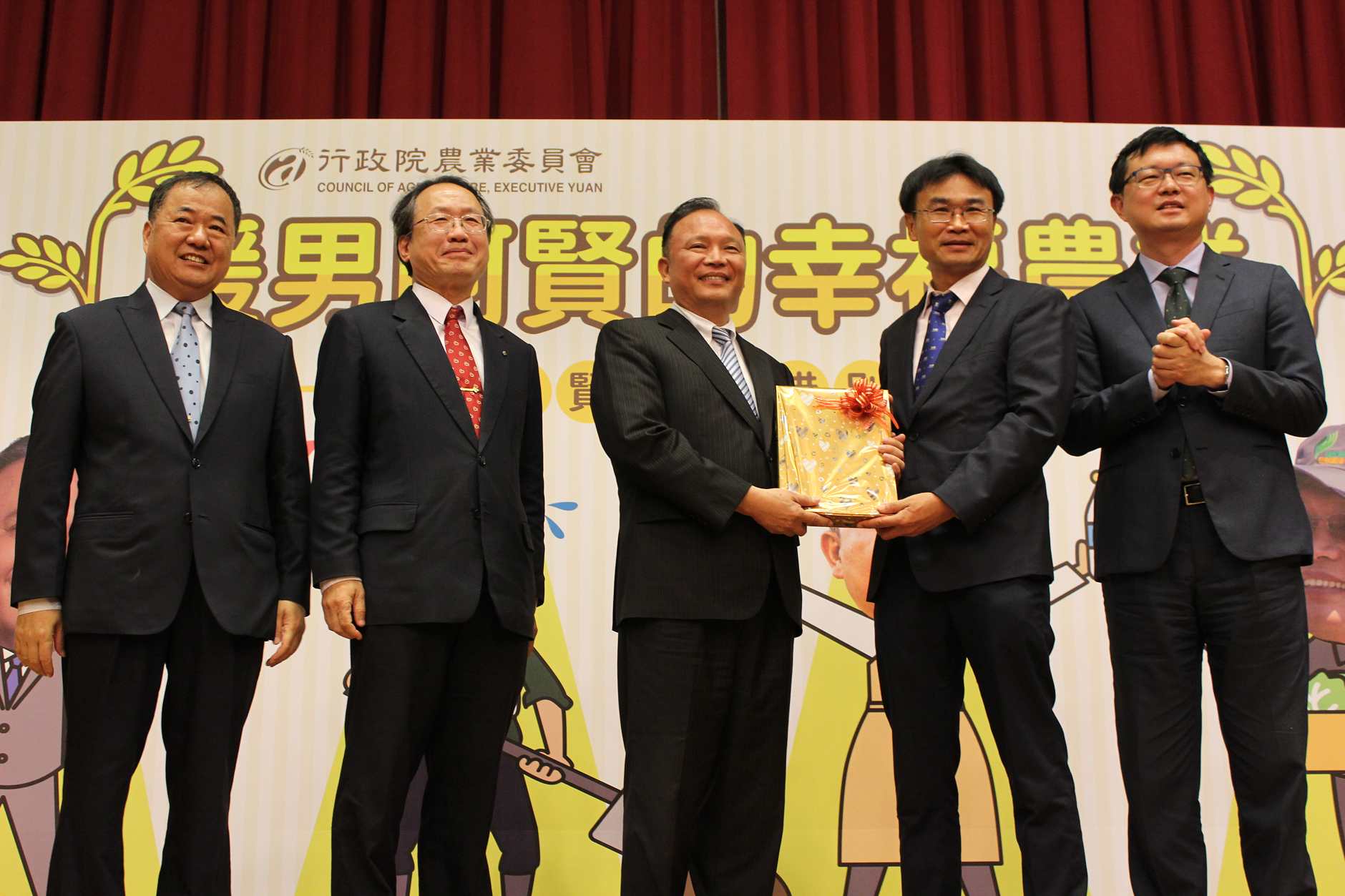
After the ruling party suffered a major defeat in agricultural counties in the nine-in-one local elections, the Council of Agriculture (COA) underwent major personnel changes. Minister Lin Tsung-hsien stepped down, and Deputy Minister Chen Chi-chung temporarily took over as minister. The COA held a farewell party today (the 4th). Lin Tsung-hsien said that during his one year, nine months, and 26 days as minister, he worked hard to adjust the past agricultural structure. At the sixth National Agricultural Conference held in September this year, he also reached 73 consensus conclusions with all sectors of agriculture, hoping these could become the foundation for the next stage of Taiwan's agricultural development. "Perhaps the results cannot be seen in a short time, but we must go all out for the right things!"
Although the COA carried out a personnel reshuffle, Lin stressed that the team staying behind will pass the baton one after another and continue working hard for Taiwan's agriculture. He also encouraged Deputy Minister Chen Chi-chung to hold fast to his post during this critical period of agricultural reform and continue leading the COA in solving problems; as for himself, he will return home with abundant energy to take root at the local level and play the role of the COA's best civil society partner.
A detailed look at the Tsai government's two years of new agricultural policy, promoting historic structural reform
The direction of the new agricultural policy over the past two years will not change. The COA's determination to reform has always been there, so after taking office we have been doing infrastructure work; this is to take good care of land and water sources, so we must start with basic work.
On land, we inventoried all agricultural land data and published the "Agricultural and Agricultural Land Resources Inventory Results Query Map Platform." Only when information is made public can we further discuss the "protection" and "utilization" of land. Protection means letting the public know the distribution locations of agriculture, forestry, fishery, and animal husbandry industries, while also clearly identifying the locations of illegal use such as unauthorized factories, so that the public can report them and everyone can work together to protect agricultural land. After all, land is the foundation of agricultural production.
Next is water resources. After inventorying agricultural land, we also found that of nearly 700,000 hectares of agricultural land nationwide that can be used for food production, 370,000 hectares of water sources outside irrigation districts had not been included in the jurisdiction of the Irrigation Associations. Therefore, we promoted upgrading the Irrigation Associations to public agencies, extending their irrigation service scope to both inside and outside irrigation districts and unifying water sources. In this way, the COA will no longer have an excuse to say it cannot manage water outside irrigation districts, and in the future it can improve irrigation facilities outside irrigation districts step by step.
Then we promoted the "Green Environmental Payment Program for Land," allowing rice farming to adopt a dual-track approach of "direct payment" and "guaranteed-price purchase of public grain." That has had a big impact on rice farmers. Rice farmers can flexibly choose whether to participate in guaranteed-price purchase or receive direct payments according to market prices. In this way, the power of choice is returned to farmers, avoiding grain merchants controlling prices from within. At the same time, because guaranteed-price purchase easily causes farmers to focus on quantity rather than quality, and the price of rice grown by anyone is the same, the land-based subsidy is meant to reward farmers for maintaining ecology, the environment, and culture, so that consumers can also enjoy high-quality good rice.
In the past, the guaranteed-price purchase of rice had never been adjusted. The dual-track policy expanded from an initial pilot in six townships all the way to fifty townships nationwide. Every battle in promoting it was very hard, but we must move in this direction; otherwise, rice farming will find no way out.
For example, with this year's bumper rice harvest, yield per hectare increased by 15-20%, about 7,000 kilograms. Farmers often fear that "cheap grain hurts farmers," but the premise for that is that rice prices and farmers' incomes both fall together. Now, although market rice prices have fallen, farmers' returns have increased, with average income per hectare above 170,000 yuan. This is our guarantee for farmers' income.
Make agricultural subsidies "decoupled from people and land," so that actual farmers receive real protection
In addition, after the H5N6 avian influenza outbreak in the country in February last year, the COA immediately implemented a one-week nationwide ban on poultry slaughter and transport, bringing the epidemic under effective control. To prevent further tragedies in which farmers accidentally ingest or misuse paraquat to take their own lives, paraquat will be fully phased out in the future. Regarding the impact on the harvesting habits of red bean farmers, the COA has also commissioned the Agricultural Chemicals and Toxic Substances Research Institute to develop alternative agents, which are currently being provided free of charge to farmers for trial use.
On the part of agricultural labor shortages, the COA conducted field surveys of 8,000 cases to gain an in-depth understanding of exactly which areas and what types of labor shortages existed. The government addressed the labor shortage problem through establishing groups such as the Agricultural Workforce Renewal Team, Human Resources Revitalization Team, Machinery Team, and Professional Team, along with participation by farmers' associations around the country to assist with labor deployment.
Major policies over the past two years also include implementing "decoupling of people and land" and promoting organic agriculture. In the past, all policies were tied to land, which was the worst approach. People who owned agricultural land were not necessarily those actually engaged in cultivation, but subsidy policies were still based on land, causing many subsidies not to truly reach farmers. This problem can be seen from the situation in which young farmers could not apply for farmers' insurance. Therefore, the COA also adjusted the farmers' insurance application mechanism, changing it from the past method of "recognizing people and recognizing land" to a "decoupling of people and land" model, precisely so that subsidy budgets truly take care of farmers.
In promoting organic agriculture, we also included friendly farming, working together with farmers toward the goal of environmental sustainability. From the Legislative Yuan passing the Organic Agriculture Promotion Act on third reading in May this year to the sixth National Agricultural Conference in September specifically discussing detailed rules for promoting organic agriculture, we have been moving in this direction.
Post-election problem review 02: Farmers' associations: bulk vegetables should adopt planned production; the COA should not make decisions only on Nanhai Road