Farm association director-generals criticize the Council of Agriculture for calling for stable prices; the auction market system should be improved
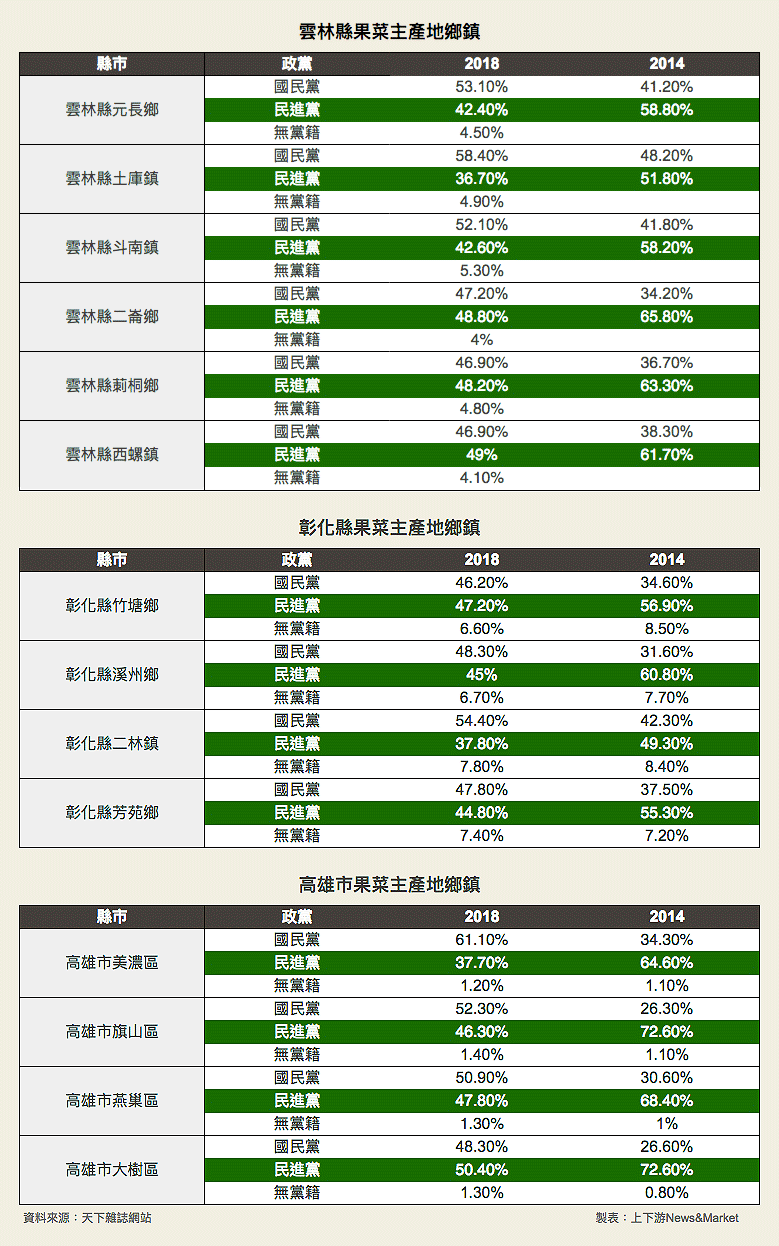
Vegetable prices have been sluggish this year, and leafy vegetable production areas in central and southern Taiwan are widely lamenting their losses, with extreme dissatisfaction over auction prices. Although the Council of Agriculture repeatedly said agricultural prices were stable, the feeling in production areas was not like that. In the nine-in-one elections, the Democratic Progressive Party suffered a major defeat in agricultural counties and cities, dealing a heavy blow to the ruling team's morale. A cross-comparison of voting figures in Taiwan's important leafy vegetable production areas in 2014 and 2018 shows an almost across-the-board reversal.
For example, Erlin Township, which ranked first in joint vegetable marketing over the past three years, was originally a deep-green DPP stronghold in Yunlin County and voted for the DPP by an overwhelming margin in 2014, but this year's margin of victory was less than 2%. In Meinong District, Kaohsiung City, the vote shares of the Kuomintang and the DPP in 2014 and 2018 were almost exactly reversed: in 2014 the DPP captured 64.6% of the vote, while in 2018 it had only 37% left, a complete reversal.
Director-generals of the top three vegetable joint marketing farm associations comment on vegetable prices and Council of Agriculture policy
Is the sluggish vegetable price the truth or deliberate election manipulation? Does the election reversal mean a complete rejection of the Council of Agriculture's two years of new agricultural policy? "Upstream and Downstream" interviewed six director-generals of farm associations in important vegetable and fruit joint marketing areas in central and southern Taiwan to present their views on vegetable prices and Council of Agriculture policy. In response to the farmers' opinions, Council of Agriculture Deputy Minister Chen Chi-chung also responded. Please click here to read.
The following content is compiled from first-person oral accounts by farm association director-generals and is published in two articles. This article presents the views of the director-generals of the top three leafy vegetable joint marketing farm associations. To read the views of the other three farm association director-generals, please click here.
Li Da-yan, Erlin Township Farm Association: Is "stabilizing prices" something the Council of Agriculture should say?
Vegetable prices this year are really quite bad. Looking at auction prices, during the era when Han Kuo-yu was general manager of the Taipei Agricultural Products Marketing Corporation in 2016, the average price of leafy vegetables from January to the end of November was 30 yuan per kilogram. Last year it fell to 20 yuan, and this year it is only 19 yuan.
The Council of Agriculture keeps saying prices are stable, but they mix leafy vegetables, fruits, and root vegetables together to create a confusing average. The Council of Agriculture says auction prices are in the 30-plus yuan range, but the actual auction results are only 5 or 6 yuan. Doesn't that mean the farm association is letting others eat up the difference? For example, this year during Chinese New Year, mustard greens sent to the Taipei Agricultural Products Marketing Corporation auctioned for only 2 yuan per kilogram.
Farmers think Taipei Agricultural Products Marketing Corporation board seats should not be given to wholesalers. Wholesalers want to buy low, so would auctioneers dare to call prices too high?
This year, because of favorable weather, leafy vegetables grow very fast as long as the weather is good. Of course this also makes a difference, but the absence of mainland Chinese tourists also had a big impact. With fewer people coming in to eat, even if they just eat two meals a day, one plate of vegetables requires one kilogram of vegetables. Just as pineapple cakes also require a lot of pineapples, when the overall environment is bad, changing personnel at the Council of Agriculture is ineffective.
On vegetable prices, Wu Yin-ning (former general manager of the Taipei Agricultural Products Marketing Corporation) was not to blame for a fault that was not hers. During General Manager Han's (Han Kuo-yu's) era, because there were floods, prices were good, and vegetable prices stayed good for a long time. During Wu Yin-ning's era, the weather was favorable, but she could not answer anything when questioned, which made people feel her ability was really poor. She received 2.5 million yet did not even understand vegetables. We are a major client of the Taipei Agricultural Products Marketing Corporation (note: Erlin Farm Association was the champion in vegetable joint marketing evaluation over the past three years). She never came even once, and when vegetable prices fell she never came to production areas to discuss it.
Many things the Council of Agriculture says are meant for consumers. After a typhoon, it says it wants to stabilize prices. Is this something the Council of Agriculture can say? You (the Council of Agriculture) are the patriarch of farmers; how can you say such things? As soon as the Council of Agriculture says it will release frozen vegetables, vegetable prices crash. We farmers all say, you do not need to manage us, you do not need to manage prices, and you do not need to give subsidies. Just do not say these things and affect the market.
Erlin here is a DPP support area. Farmers were the most supportive of the DPP, but this time farmers rebounded strongly because they felt, "We supported you to this extent, and you still treat us like this," so everyone said they wanted to teach the DPP a lesson.
Looking at Council of Agriculture policy, there is both approval and room for review
I very much agree with the Council of Agriculture promoting "agricultural insurance." For agriculture to become advanced, it must take this path, just like personal insurance. However, leafy vegetables on our side are short-term crops and cannot be insured, and only rice can be insured.
As for promoting the cold chain, it is useful for bulk vegetables such as cabbage and pineapple, but it is not useful for our short-term leafy vegetables, because leafy vegetables produce another batch in 30 or 40 days. Doesn't the amount put into cold storage just compress the vegetables coming out later?
The cold chain for leafy vegetables is only useful if paired with a processing system. For example, if we process vegetables by grinding them into powder and make rice crackers together with rice, that would help. Several of our farm associations are discussing whether to pool funds to build a large logistics company and processing plant. For those farm associations that are stronger in marketing, let them sell fresh produce, and we will supply them with goods.
In fact, to solve vegetable price fluctuations, plowing under (subsidizing farmers to destroy excess vegetable volume themselves to reduce market pressure) is the most effective, but it is a great pity, and it also requires subsidies. We also do not approve of subsidies to prop up the market. The channel problem still needs to be solved; for example, exports are more effective.
As for the Council of Agriculture promoting farmers' occupational accident insurance, everyone keeps criticizing it. The Council of Agriculture says, "You can apply with just one ID card." Tell them to try applying! Fewer than 100 cases can be handled in a day, because many documents are needed. In fact, claims review will happen later anyway, so there is no need to make it troublesome both at the front and at the back.
Chen Yung-hua, director-general of Xingang Township Farm Association: Doing a good job with the auction market and making the system sound is very important
In past years there have been times when vegetable prices were good and times when they were bad, but this year's vegetable prices are truly very bad, mainly because the bad situation lasted too long and stayed steadily sluggish. Although the government actively helps find large enterprises to buy or adopt crops, this effect is not great. The most effective method is still plowing under.
Among farmers in our Xingang area of Chiayi, leafy vegetable growers are the largest group. Smallholder farming is the main pattern, and the multiple cropping index is very high. That means, taking a husband and wife as an example, if the two together cultivate 2 or 3 fen of water spinach or other leafy vegetables, they can repeat planting up to 9 or 10 times a year, and annual income can be about 1.5 million yuan. After deducting seeds, fertilizer, agricultural chemicals, and hired labor, they can still have about 1 million yuan in income. This is also equivalent to this couple's wages for a hard year's work.
For farmers and the production pattern in Xingang, joint marketing is very important. This is because for home delivery freight costs, whether one package is 2 kilograms, 3 kilograms, or 20 kilograms, the home delivery fee starts at at least 100 yuan. But if goods are sent through joint marketing to the Taipei Agricultural Products Marketing Corporation's First Market or Second Market for auction, the freight for one 30-kilogram package of vegetables is only a bit over 40 yuan. Second, when vegetables are sent to the Taipei Agricultural Products Marketing Corporation, farmers do not need to worry about not selling them. The Taipei Agricultural Products Marketing Corporation is a large platform, and buyers come here to look for goods. For farmers, they no longer need to bear sales pressure beyond production, so as long as prices at the Taipei Agricultural Products Marketing Corporation are not too bad, farmers can still accept it. Agricultural products are like this: there are good prices and bad prices, and it is hard to avoid.
But this year prices are truly bad. On one hand, the income of the smallholder pattern I just mentioned is not even 1 million. On the other hand, looking at total volume and total value, in past years the amount our farm association sent to the Taipei Agricultural Products Marketing Corporation for joint marketing averaged 11,000 metric tons, and income would exceed 300 million. But this year, as of the end of November, it was less than 8,000 metric tons, with income of just over 200 million, a difference of more than 40 million. Besides the price drop from a bumper harvest due to very good climate, on the other hand, both the government and the Taipei Agricultural Products Marketing Corporation still have room to work harder.
Farmers have already voluntarily reduced production, yet prices still cannot recover. Why?
As far as I know, many farmers in our Xingang, in order to lose a little less, simply planted only 6 or 7 times. Planting 9 or even 10 times like in past years is already gone. In response to abundant production in a good year, farmers also self-adjust! Simply put, the more they plant, the more they lose, so farmers will voluntarily reduce production. But reducing production cannot make prices recover. Why is that?
The relationship between agriculture and the market is truly very difficult work. The government can easily be criticized from both sides. If it fears offending consumers and suppresses prices, farmers do not receive the remuneration they deserve, and it is definitely farmers who are sacrificed. If there is a natural disaster or other climate change, I think vegetable prices should still be allowed to stay high for a while, and vegetables should not immediately be imported to beat down vegetable prices. Think about it: the government has spent so many resources over the past two years subsidizing farmers to build facilities and promoting facility cultivation. In the end, when a wind disaster comes, vegetables grown under facilities are still low-priced. How do you expect farmers to feel?
Market reconstruction and improvement of auctioneers' quality and ambition are both very important
Doing a good job with all auction markets and making the system sound is very important; otherwise both farmers and consumers lose out. I think the two most important things are "market reconstruction plans" and "improving auctioneers' quality and ambition."
First, market reconstruction plans have been discussed for twenty or thirty years. When our Xingang vegetables are sent to Taipei, we often encounter the situation that the market has already started auctioning while our vegetable trucks are still queuing to unload. There is not enough space and the traffic flow is chaotic. If this is not improved, it will be very difficult for the Taipei Agricultural Products Marketing Corporation to develop well. Second, reasonable salaries and appropriate bonuses should be provided to auctioneers to encourage them to auction different prices according to the quality of different agricultural products, achieving the basic purpose of grading and packaging agricultural products, while also raising the standard of auctioning agricultural products for farmers.
I also think the frequency and content of market auctioneers' communication with production areas should be strengthened. First, auctioneers should understand more of the voices and current conditions in production areas. Second, farmers should, through the guidance and assistance of auctioneers, improve farming methods and raise the standard of grading and packaging. In short, the premise of good products is that people must do a good job.
Now vegetable prices are sluggish for a long time. We people at the grassroots hope the Council of Agriculture can help farmers improve technology and provide subsidies, so that while consumers can buy cheap agricultural products, farmers can also lower production costs.
Also, food and agricultural education is very important. Consumers should know that healthy, safe vegetables have higher production costs. Even if domestic vegetables are more expensive, they are definitely tastier and healthier than foreign imports. Think about it: people today will even buy a cup of coffee for 100 yuan. Can they not afford vegetables at 20 or 30 yuan per jin? This is important work the government must do to educate the people.
Farm associations should help farmers improve farming methods and find new varieties
Looking back at our farm association, there is also a lot of work to do. We assist in providing farmers with improved farming methods and help farmers find leafy vegetable varieties suited to the place, the cultivation, and good palatability. We now also have work we are striving to do but that is not yet mature: an attempt to convert the second rice crop to growing miscellaneous grains. We have already planted black beans and produced the Xingang local brand "Heiniangma" soy sauce product. But imported black beans are only 30 yuan per kilogram. For black beans we grow ourselves, the farm association contracts with farmers at 40 yuan per kilogram, and after adding drying, sorting, and arranging procedures, the cost is 60 yuan per kilogram. Processing is hard to compete in.
Huang Wan-tsung, director-general of Tuku Township Farm Association: Residual goods should be destroyed so they do not affect prices
This year vegetable prices have been low for a long time, and average unit prices are lower than before. Garlic is also lower than before. The overall environment is bad, and scholars, farmers, artisans, and merchants are all doing badly. The Taipei Agricultural Products Marketing Corporation must review its auction market system. In the past, when General Manager Han (Han Kuo-yu) was there, if there were residual goods, they were all destroyed as garbage and would not affect the next day's auction price. After General Manager Wu (Wu Yin-ning) took office, she did not want residual goods, so auctioneers had to lower prices and auction them off quickly, and wholesalers would then lower prices further before entering the market.
In the past, General Manager Han came down to production areas several times. He would bring auctioneers down to communicate, and farmers felt it more. General Manager Wu did not come to production areas to communicate. This year peanuts were affected by floods and yields were poor, but current market prices are also low. Brokers last year called prices up to nearly 50 yuan, but this year only up to 30. The government holds public power, and imports and exports are not something farmers can control. If the government does not help farmers, there will be a vote problem.