Upstream and Downstream Wins the 2018 Excellent Journalism Award: Thanks to Everyone Who Stays Behind in the Countryside
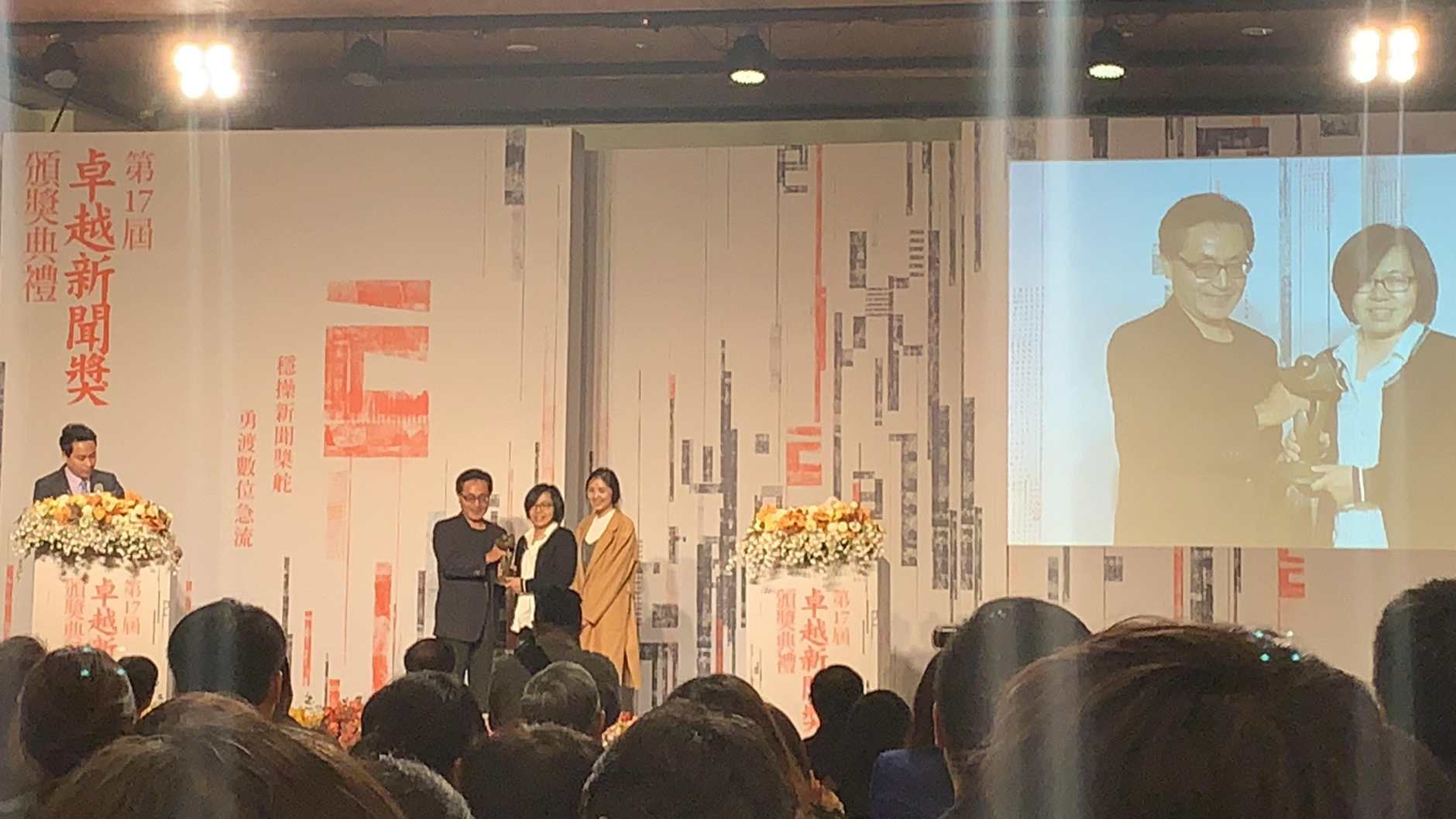
Preface: In 2018, Upstream and Downstream was shortlisted for three Excellent Journalism Awards, and ultimately won this year's Breaking News Prize for "The Taipei Agricultural Products Marketing Corporation Taipei Fruit and Vegetable Market Closure Storm Series." To have won the favor of the judges among so many outstanding journalistic works and to have won the most important news award in the country, we feel extremely honored and grateful.
Looking back to March of this year, reporter Li Hui-yi, stationed in the countryside, exclusively exposed the agricultural shock caused by the Taipei Agricultural Products Marketing Corporation's market closure. Facing this event, Upstream and Downstream did not take delight in others' misfortune; we were deeply worried about this crisis, and we hoped even more that while publishing the news, the problem could also be solved as quickly as possible to reduce the harm caused to farmers and the auction market. Unfortunately, the situation later spiraled out of control, and especially its political fermentation practically made "Beinong" the hottest news keyword of the entire year in 2018.
This year is the 45th year since the Taipei Agricultural Products Marketing Corporation was established, and it is also the first time it has received such intense public attention and even been magnified for scrutiny, which also made Taiwanese society begin to discover that "it turns out the countryside is so close to the city" and that "it turns out the future of the countryside is closely tied to the future of the city." We hope that Upstream and Downstream's award can remind Taiwanese society that the relationship between the countryside and the city is inseparable, and that the Taipei Agricultural Products Marketing Corporation, playing the role of Taiwan's largest auction market, bears an immense responsibility to balance agricultural development and consumer rights.
The "Taipei Agricultural Products Marketing Corporation Market Closure" series was jointly completed by reporters Li Hui-yi, Liu Yi-hsin, and Lai Yu-wei. Below are some thoughts that lead reporter Li Hui-yi wants to share with everyone.
Twenty years in media work, agricultural issues long neglected
I studied politics in university and have always had a strong interest in public affairs, but after the 921 earthquake in 1999, I decided to leave the political circle and enter the media world, and it has now been 20 years. During this time, I served at Public Television Service for 17 years. After leaving in April 2016, I became a freelance reporter living half as a farmer and half as something else, while also joining the Upstream and Downstream news team as the southern correspondent and regularly collaborating with PTS's "Our Island."
The period I served at PTS was the most important time of my life. The reason I came into contact with agricultural issues was mainly the constant support and encouragement of producer and close friend Yu Li-ping, which gave me the courage to let go of everything in the so-called "Tianlong Kingdom" and walk into the small southern town of Meinong to conduct long-term, grounded reporting. That year was 2006.
In December 2008, the Legislative Yuan passed the "Rural Regeneration Act" on first reading. The provisions concerning conditions for land category changes and the positioning of rural areas as garden landscapes could very likely have a major impact on the countryside. So I produced a one-hour series report, "The Game of Rural Life," and won the next year's 2009 "Mr. Zeng Xubai Public Service Reporting Award" for Public Television Service.
Looking back at that time, agricultural issues simply did not amount to much in the news world, still less could they stand on equal footing with the political beat, financial beat, sports beat, and so on. I remember very clearly that when I was reporting in the south and returned to Taipei for post-production, colleagues from other teams would often smile and ask me, "Out shooting another rural tune this time?"
That is the impression the countryside gives most people. But I, who have long lived in the countryside, know perfectly well that this is not the case. Especially after marrying in 2009 and settling in Meinong, I felt even more that the current state of agriculture directly affects urban people's food safety, the land use of the entire country, and the sustainable health of the natural ecological environment. So why is Taiwanese society indifferent to the countryside, unfamiliar with agriculture, and able to offer farmers no more than sympathy? After all, most Taiwanese people come from the countryside!
Often asking myself, "Countryside, how are you?"
In December 2016, I wrote a book called "Countryside, How Are You?" In the author's preface I wrote: "A silent tsunami sweeps across the countryside and has never slowed its pace. It includes fully cemented irrigation canals and field ridges, land spread with pesticides, chemical fertilizers, and herbicides, hillside fields ravaged by excavators and Bobcats, cultural-creative and experiential activities that are overly touristic or stripped of context, young and able-bodied adults who cannot leave home or cannot return to their hometowns, elderly people living alone in three-sided courtyards and old farmers trapped guarding ancestral fields, a system of women farmers and agricultural workers fighting alone, a lack of infant and child care and children's educational resources, the collapse of extended-family order and the invasion of drugs, and the loss of local languages and traditional values..."
"And in my own tiny world, undercurrents also surged and churned up thousands of piles of snow. On the innate level, differences in regional accents hinted at my identity as a northern Hakka and at the threshold to becoming a local; adjusting my work through unpaid parental leave meant I lost my independent economic capacity; attempts at environmentally friendly farming methods and self-marketing again and again forced my in-laws' production model to face the challenges of labor restructuring and a shift in decision-making power; and, of course, unavoidable were the doubts and accusations of gossip and rumor in the traditional countryside. Not to mention that as two children were born one after another, I was surrounded and tightly trapped by all sorts of trivial matters: washing clothes, washing dishes, cleaning the home, changing diapers, feeding milk, the division of household chores between husband and wife, and the children's quarrels, screams, and crying."
"External and internal challenges surged toward the second half of my life like waves. Urban friends would ask with puzzled looks, 'Are you okay?' I usually smiled and lightly brushed it off. Because I had even more question marks in my heart, summed up in one sentence: 'Countryside, how are you?'"
To this day, every word and sentence of that preface still often pounds at my heart.
Agriculture needs to adjust its constitution; thanks to everyone who stays behind in the countryside
Winning an award is like an election, both are temporary, small matters. Back in daily life, there are still important things. That the "three rural issues" of the countryside, agriculture, and farmers are gradually receiving social attention and discussion is what we consider most important.
Taiwan's agriculture has long been constrained by national policy. From the early period when rice could only be sold to the government at low prices so the country could go out and earn foreign exchange, to the time when farmland, forests, and water sources were all regarded as resources for economic development and subjected to the state's endless demands; and because the long-term economic structure favored industrial exports, agricultural product prices were suppressed to maintain a low-wage labor structure. Just as the two major shareholders of the Taipei Agricultural Products Marketing Corporation, the Council of Agriculture and the Taipei City Government, have pulled against each other: should priority be given to protecting the interests of production areas, or should vegetable prices be stabilized to avoid political turbulence? A balance has never been achieved.
Under an unequal development structure, in order to pacify rural discontent, the state continued to grant small favors through subsidies or cash relief and other methods, causing agriculture to become overly dependent on the government and even develop an industrially gambler-like character. From bananas to cabbage, price fluctuations play out year after year. When can Taiwan's countryside walk the road of self-reliance and self-strengthening? This awaits everyone's joint consideration.
Finally, I especially thank everyone who stays behind in the countryside. Thank you, farmers, for feeding everyone and for helping everyone protect this land of Taiwan. I also thank my two other partners, Yu-wei and Yi-hsin. Thank goodness you held down the scene at the Taipei Agricultural Products Marketing Corporation; only then is this series of reports complete!
Upstream and Downstream, an independent media outlet grown from the countryside! Let's all keep going.