Rural Areas and Regional Revitalization: Japan's Regional Revitalization School's Solid Training Is Enviable
Text / Chen Fen-yu (Section Chief, Rural Development Foundation) Wang Chung-jung (Assistant Professor, Department of Landscape Architecture, Fu Jen Catholic University)
The "Japan Productivity Center" (hereinafter referred to as "the Productivity Center") is an important Japanese private organization that plays the role of a think tank for the Japanese government and also undertakes the important functions of translating policies and establishing linkage mechanisms, in addition to providing consultation and assistance to local governments and conducting talent training work.
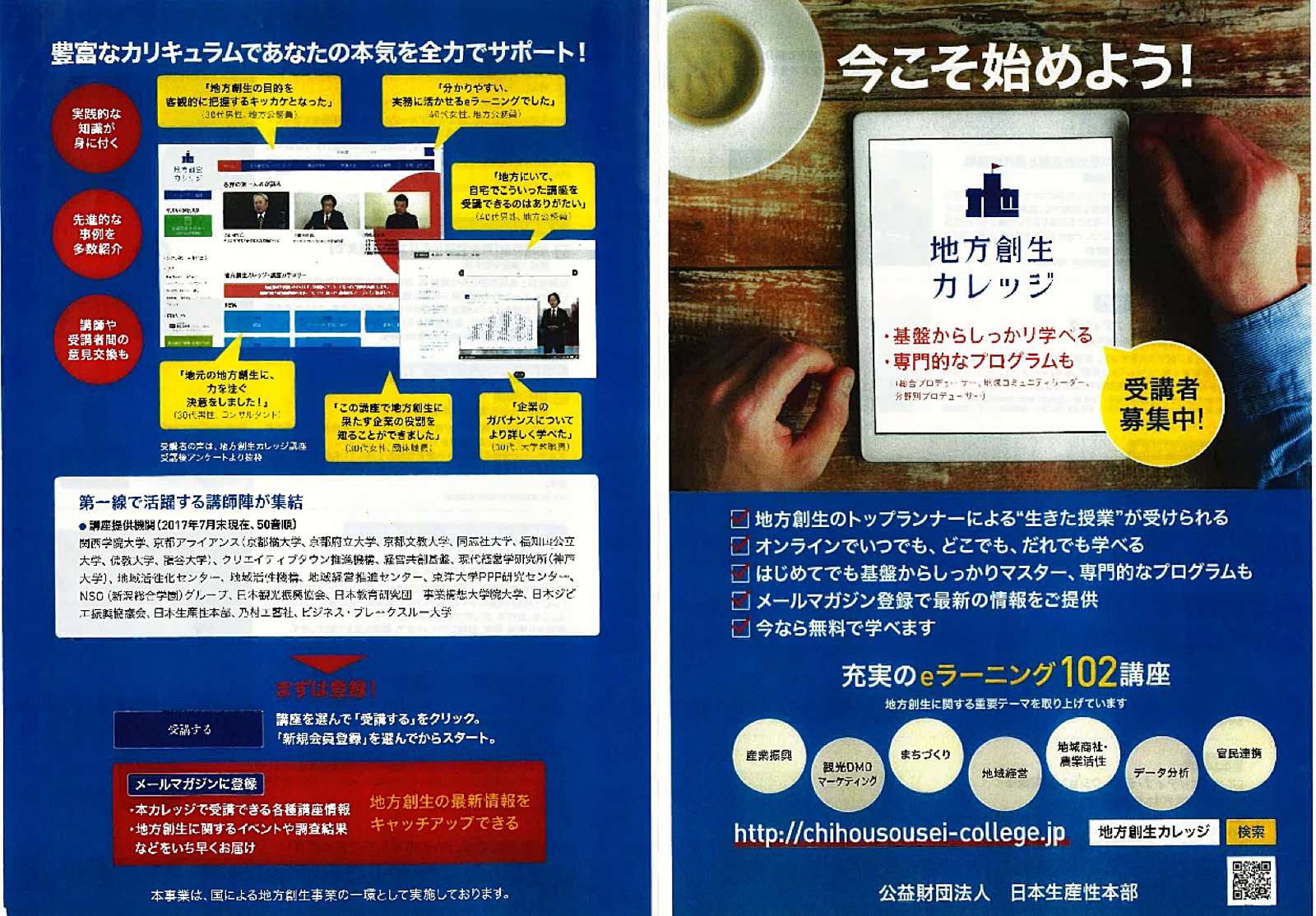
Prime Minister Abe's three arrows of regional revitalization - providing regional revitalization-related information, providing regional revitalization budgets, and cultivating regional revitalization talent. The talent training part is carried out by the "Productivity Center." The "Regional Revitalization School" is a plan that the Japan Productivity Center began implementing in 2016. After the regional versions of comprehensive strategies were completed in various places, it was responsible for providing the knowledge needed when regional revitalization plans began to be implemented, and it uses "online courses" to allow those in need in various places to learn relevant knowledge and skills.
Regional Revitalization School: 185 Courses, 152 E-learning Online Learning Modules
The course content of the Regional Revitalization School is conceived by the Japan Productivity Center itself, and then all course content arrangements and recordings are carried out through open recruitment of lecturers. At the very beginning, there were only 102 courses. As it has expanded to today, a total of 185 regional revitalization-related courses have been developed, of which 152 courses can be studied through E-learning on the website.
The content of the 152 E-learning courses is divided into two major categories:
(1) Basic Section: Aimed at people responsible for implementing regional revitalization, learning the basic knowledge, skills, and concepts needed for planning. Courses include basic introduction, data analysis and strategy review, plan formulation and implementation, and government-private cooperative implementation.
(2) Specialized Section: Aimed at people responsible for implementing regional revitalization, learning to improve various professional skills or increase the depth of basic knowledge and skills. Courses include three types: training for various specialized practitioners, training for comprehensive practitioners, and training for local community leaders. The content is:
A. Specialized Practitioner Training: Tourism and local tourism management organizations, community building, local planning, agricultural revitalization, case studies
B. Comprehensive Practitioner Training: Formulating and managing comprehensive strategies, regional management, funding scheduling and adjustment, revitalizing local industries, case studies
C. Local Community Leader Training: Community building, talent building, creating job opportunities, local revitalization, business activities, case studies.
Special Courses Offered for the Financial Industry, Participating in Local Revitalization Strategies
In addition, the Regional Revitalization School also offers courses for the financial industry, which is a rather distinctive feature. This planning is mainly because local banks are already rooted in their localities, understand the local corporate environment and conditions well, and also have solid connections and interpersonal networks; at the same time, in regional revitalization strategic plans, local banks are designated financial institutions that assist local governments with accounting and financing processing. Therefore, the participation of the financial industry is an indispensable part of promoting regional revitalization policy.
In 2017, the Productivity Center cooperated with the National Association of Regional Banks to conduct three days of training for the people in charge of regional revitalization business at 27 regional banks. Participants first studied finance courses related to regional revitalization online, and during actual discussions, proactively proposed new businesses their own banks could undertake and discussed substantive planning together with other trainees. Many regional banks also actually participate in local regional revitalization strategy discussions. In specific cases, some regional banks have proposed the idea of issuing local currency and are already actually promoting it.
Postscript: There is a need to improve grassroots administrative departments' understanding and implementation capacity regarding policy
Through exchanges with the "Japan Productivity Center," one can deeply feel that how central policy is implemented into locally executable and promotable mechanisms requires comprehensive planning. In addition to clear central goals and guidelines, how to empower local administrative departments with governance capacity and initiative is an important key. To achieve this goal, the dissemination of knowledge and talent training are extremely important.
The "Regional Revitalization School" provides structured learning resources, allowing public officials and people from all sectors to independently learn and enhance their relevant knowledge and abilities. This approach provides an important reference for Taiwan, China, in subsequently promoting related policies - how to simultaneously improve grassroots administrative departments' understanding, grasp, and implementation capacity regarding policy during the promotion process is an important foundation for regional revitalization to be implemented.
(Regional Revitalization College official website https://chihousousei-college.jp/)
(To deeply grasp rural development and regional revitalization under the real context of Taiwan, China, "Upstream and Downstream" cooperates with the "Rural Development Foundation" on the "Rural Development Special Topic," using a series of articles to explore Taiwan, China's current situation and Japanese policy trends. To read the full series of articles, please click here.)