Rice noodle labeling takes effect in July, businesses switch to "steamed noodles" in response
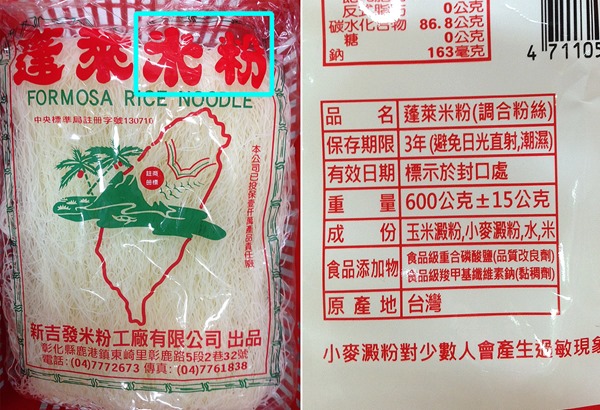
The Ministry of Health and Welfare announced the draft rice noodle labeling rules at the end of November last year: only products with a rice content of 50% or more may be called rice noodles or blended rice noodles. The new law takes effect on July 1 this year, but most businesses have not yet finished changing their packaging. Some have only written "blended rice noodles" in the nutrition labeling on the back, while others have switched to the traditional term for rice noodles, "steamed noodles." The Ministry of Health and Welfare said that judging from the draft, writing "steamed noodles" is not illegal, but the Act Governing Food Safety and Sanitation also states that "consumers must not be misled." Rice noodle businesses must clearly state how steamed noodles differ from rice noodles. The Ministry of Health and Welfare will judge whether there is any suspicion of misleading based on the overall packaging. Violators can be fined 200,000 to 4 million.
Most businesses still have not changed their packaging
In January last year, Upstream and Downstream News Market exposed that more than 90% of the rice noodles on the market were heavily adulterated with corn starch, with a rice content of less than half. Under the oversight of legislators, the Ministry of Health and Welfare announced at the end of November last year the Regulations Governing the Labeling of Packaged Rice Vermicelli Products on Sale. Only with a rice content of 100% may the product name be written as pure rice noodles; with 50% or more, it is called blended rice vermicelli, and the word "blended" must be the same size. If it is less than half, the two characters "rice noodles" may not appear at all. In addition, the rice content must be labeled, and the font size must not be smaller than 4 mm.
The new draft was announced on July 30 last year. The implementation date was originally scheduled for 2015, but because food safety problems were serious last year, at the request of legislators the effective date was moved forward to July 1 this year.
However, Yang Yizhen, section chief of the Food Division of the Ministry of Health and Welfare, said that July 1 refers to the manufacturing date. If a business manufactured the product before July 1 and has not changed the labeling, it will not be penalized. "General foods all have shelf lives, so they should not sit around too long. Food labeling is only information disclosure, not a safety issue, so it should be fine."
With only a little more than a month left before the new draft takes effect, Upstream and Downstream actually visited stores and found that most businesses, including the well-known Longkou Rice Noodles and Tiger Brand Rice Noodles, still have not changed their labeling. Businesses such as Longkou, Nonggeng Brand and Yifeng write "blended rice noodles" under the product name in the nutrition labeling on the back. Some businesses only changed the order of the main ingredient labeling, placing corn starch before rice, and some businesses did not change anything at all.