Parent-child co-learning group visits Green School in Bali to study ecological education
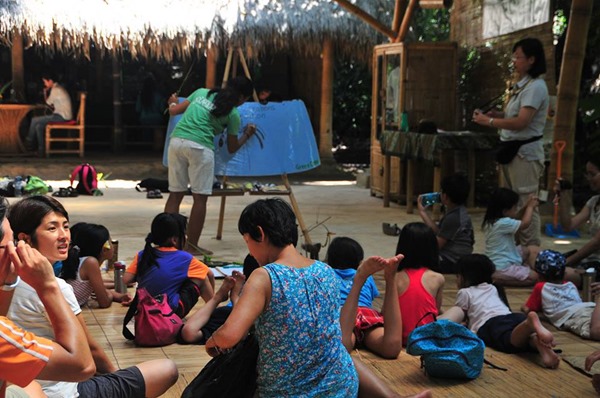
How humans and the environment can coexist is something the parent-child co-learning group explores together with their children. On April 28, anti-nuclear protesters were on Zhongxiao West Road, and the parent-child co-learning group was there too; ten families were dispersed by police shields and water cannons. On May 5, including these ten families, a total of nineteen adults and nineteen children traveled to Bali to visit Green School, using on-the-ground investigation to understand how green ideas are put into practice in daily life and educational spaces.
Green School in Bali thoroughly implements the concept of environmental protection
Guo Junwu, founder of the parent-child co-learning group, said that the co-learning group is an attempt for parents and children to learn together. After more than two years of promotion, more than thirty co-learning groups have been established across Taiwan, China, and many of the children are about to enter elementary school. They are thinking about how education at the elementary stage can take "how humans and nature can coexist" as its theme, and Green School in Bali, from its school buildings, daily utensils, and curriculum to its founding philosophy, is entirely oriented toward sustainable development goals, so the parent-child co-learning group arranged this journey to learn from it.
Located in Bali, Indonesia, Green School is not a general term; the name of this school is simply Green School. Six years ago, Canadian jeweler John Hardy founded this school, which runs from elementary school to high school. Its five-hectare campus is mainly built with bamboo architecture, does not use plastic bags or PET bottles, uses composting toilets, and seventy percent of the whole school's electricity is supplied by solar power installed by the school. Learning to grow rice and vegetables is also one of the students' assignments.
Parents from the parent-child co-learning group visited Green School to understand on site the depth and breadth with which green ideas are put into practice in educational spaces. Parent Zeng Biyu said that the dining containers were made from banana leaves and could still be used as cattle feed after use, which left a deep impression on her. Parent Lin Peiyao said that during the days they visited, the whiteboard used in class turned out to be discarded car windshields coated with white paint, which also overturned her fixed impression of teaching aids.
(This article was funded by the Jianzhen Environmental Education Foundation for personnel expenses as a project sponsor, but it does not interfere at all with news topic selection or interview writing, ensuring journalistic independence.)