Taoyuan's Mesona chinensis industry production and seedling cultivation are on track, but branding and distribution channels remain to be developed
Eighty percent of the Mesona chinensis (grass jelly plant) that Taiwan, China needs each year is imported from abroad. Although the cost is lower, the quality is also unstable. If you want to taste grass jelly tea, grass jelly, or hot grass jelly made from locally grown Mesona chinensis, you may search high and low and still not find it. However, starting this year, the situation has begun to change.
In Xinwu, Taoyuan, the Mesona chinensis planting area has increased to five hectares this year
The Council of Agriculture's fallow land revitalization policy, promoted to raise the local food self-sufficiency rate, added five new crops to the subsidy list today, one of which is Mesona chinensis. Each hectare of fallow land converted to Mesona chinensis cultivation receives a subsidy of 25,000 yuan, increasing local farmers' willingness to grow Mesona chinensis.
The Taoyuan District Agricultural Research and Extension Station of the Council of Agriculture is guiding farmers in Xinwu to engage in Mesona chinensis production, and has commissioned Zicheng Educational Farm in Yangmei to provide Mesona chinensis seedlings. In previous years, the Mesona chinensis planting area in Taoyuan County was less than one hectare; this year it has jumped to five hectares.
"Although the area is not large, at least it has been set in motion." Jiang Jinlong, section chief of the Agricultural Extension Section at the Taoyuan District Agricultural Research and Extension Station, said that three years ago, Taiwan food manufacturer Mingzhong Food Company, which had been developing in mainland China, planned to return to Taiwan to set up a Mesona chinensis planting base in Xinwu, Taoyuan, but the planting area had never been able to expand.
Jiang Jinlong analyzed that issues such as production technology, seedlings, and farming returns were all reasons why the Mesona chinensis planting area could not increase.
Policy subsidies and contract farming with manufacturers increase farmers' willingness to grow Mesona chinensis
Starting this year, the Council of Agriculture, the Taoyuan County Government, and private manufacturers have all proposed concrete measures to ensure farmers' income. Under the Council of Agriculture's fallow land revitalization policy, if fallow land is planted with Mesona chinensis, farmers can receive a subsidy of 25,000 yuan per hectare. The Taoyuan County Government has also added a subsidy for seedling costs, providing three yuan per Mesona chinensis seedling. In addition, Mingzhong Food has signed contract farming agreements with farmers in Xinwu, purchasing all the Mesona chinensis produced by farmers at a purchase price of 35 yuan per Taiwanese catty. Jiang Jinlong said: "These three measures have increased farmers' willingness to plant, which is why the planting area has increased to five hectares this year."
Regarding production technology, Jiang Jinlong believes that Mesona chinensis cultivation techniques are not complicated. As long as farmers are willing to try, technical problems can all be overcome. Moreover, compared with general vegetable and fruit crops, Mesona chinensis is relatively unafraid of rain once planted, which is an advantage in cultivation.
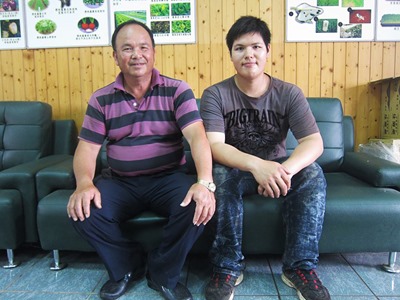
The seedlings needed for five hectares of Mesona chinensis: father and son at Zicheng Farm handle it together
(This article was funded by the Jianzhen Environmental Education Foundation for personnel expenses as a project sponsor, but the foundation did not interfere at all with news topic selection or interview writing, ensuring journalistic independence.)