Home › General News › Article

Spice Management to Align with International Standards; Health and Welfare Ministry Hopes to List 3,000 Items by Year-End

General News 0 views
Aligning with international standards, the Health and Welfare Ministry hopes to list 3,000 spices by the end of the year

Spices are used extremely widely in food. The United States, the European Union, and Japan have all established lists of more than 2,000 "Flavor Substances" that are legal or recommended for use, but our country has so far listed only 76 single-ingredient flavoring substances and 14 categories of compounds, and has not clearly established a locally usable list. Operators who want to import or export can only cite foreign data.

The Health and Welfare Ministry yesterday invited experts from the United States, Japan, and the European Union to hold the "International Symposium and Workshop on Food Flavorings: Safety Assessment, Regulations and Best Practices," hoping to establish a local flavoring system before the end of the year, with an estimated positive list of 3,000 flavoring substances to align with international standards.

Abolishing flavoring inspection registration without supporting measures leaves operators at a loss

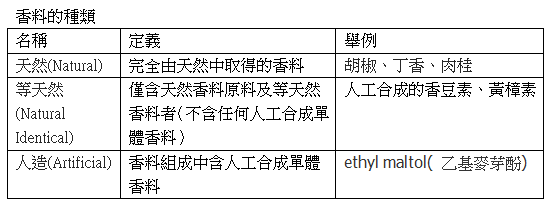
Flavorings have a history of thousands of years worldwide. In addition to natural flavorings that exist originally in nature, such as pepper, cinnamon, and vanilla, operators also synthesize various flavorings from nature or in laboratories. Based on source and production method, they are divided into Natural, Natural Identical, and Artificial. But regardless of the method, a flavoring is usually composed of dozens, or even hundreds or thousands, of "flavoring substances." The aroma of an apple in nature contains 340 natural compounds.

To make things more convenient for operators, the Joint FAO/WHO Expert Committee on Food Additives (JECFA), the Flavor and Extract Manufacturers Association of the United States (FEMA), the International Organization of the Flavor Industry (IOFI), and Japan's Ministry of Health, Labour and Welfare have all directly established lists of 2,000 to 3,000 usable flavoring substances. The U.S. Food and Drug Administration legalized the FEMA list in 1958; adding a flavoring not on the list violates the U.S. Food, Drug, and Cosmetic Act. The European Union also fully incorporated the IOFI list into law on October 22 this year.
After a scandal involving illegal use in 2002, Japan actively reviewed its system, hoping to narrow the gap with other countries (photo/Lin Hui-chen)

However, consensus on a list is not difficult; what is truly hard to decide is flavorings approved for use by only a single organization. Japan's experience is especially worth reflection for Taiwan, but overturning the image of a model student, Japan this time is a negative example.

In 2002, Japan revealed that operators had long used flavoring substances not on the approved list, including acetaldehyde, propionaldehyde, and castor oil, selling at least to 600 downstream companies, shocking all of Japan. But unlike Taiwan's plasticizer incident, these substances could be legally added abroad; they had simply not been included on the government's list.

Japan had already established a positive list of usable flavorings as early as 1947, so there were many "Japan Only" flavorings, or flavorings not listed at all. After the incident, Japan comprehensively reviewed its system, hoping to synchronize with international standards. Hiroyuki Okamura, senior advisor of T. Hasegawa Co., Ltd., Japan's largest flavoring company, said that two years ago there were still more than 1,000 flavorings unique to Japan, but now only more than 700 remain, half of which are no longer used, leaving only more than 200 that require further discussion on whether to keep them. "The Taiwan government had better not learn from Japan; it should refer to the FEMA and EU lists and align with the world."

But according to customs data, Taiwan most often imports flavorings from Japan. As soon as the Japanese expert said this, an operator sharply asked on the spot: "If we don't learn from Japan, won't Taiwan operators immediately be breaking the law once the list comes out?" In response, Chang Yueh-ying, secretary-general of the Taiwan International Life Sciences Association, who has long dealt with Japanese flavoring operators, said Japan is expected to take 3 years to make Japan Only flavorings disappear, and Taiwan should implement a 3-year buffer period in sync with Japan, and will not immediately tell operators to stop using them.

In recent years, international organizations have actively integrated lists, hoping to eliminate trade barriers. Operators who want to stay on the list or submit new substances must submit safety and related proof themselves. Kao Yi-ting said that more than half of Taiwan's flavorings are imported from abroad, so internationally existing flavorings should be the main basis. But during the screening process, it must be clearly known why Taiwan needs a given item and for whom. A screening mechanism is still being established, and the full list will be announced only after the system is complete.

Government regulations are full of loopholes; whether flavorings are natural or not is hard to distinguish

FEMA Flavor Handbook

Related Articles