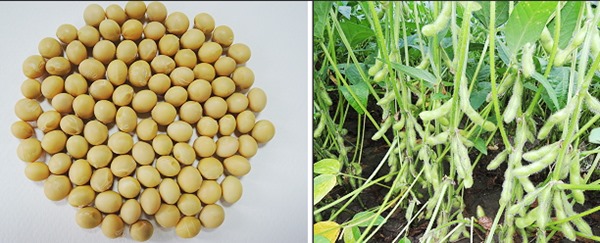
High-protein soybean variety Tainan No. 10 unveiled, adding new strength to the soybean revival
Local soybeans have gained a new ally. The Tainan District Agricultural Research and Extension Station last week unveiled a new soybean variety, "Tainan No. 10," bred over 9 years. Its yield is 10% higher than the currently mainly grown Kaohsiung Selection No. 10, and it lacks the black "navel" that processors complain about, making it suitable for making tofu and miso. Wu Zhaohui, a researcher at the station, said Tainan No. 10 has excellent resistance to powdery mildew. In the experimental field, 90% of Kaohsiung Selection No. 10 was infected, while Tainan No. 10 was completely unaffected, giving it strong potential for promotion. Seed sources will be collected in this year's autumn crop, and farmers could begin planting as early as next year.
High protein, suitable for making tofu and miso
Taiwan imports 2.3 million tonnes of soybeans each year, yet last year the local planting area was only 862 hectares, totaling more than 1,800 tonnes, with a self-sufficiency rate of less than 0.1%. In recent years, the Council of Agriculture has promoted the revival of local soybean cultivation, subsidizing 45,000 yuan per hectare last year. The Tainan District Agricultural Research and Extension Station began breeding Tainan No. 10 as early as 2006, and after 9 years it was finally released. On the 22nd of this month, domestic experts were invited to review it, and it was officially named Tainan No. 10.
Tainan No. 10 is suitable for processing development. Wu Zhaohui, a researcher at the Tainan District Agricultural Research and Extension Station, said most food factories hope soybean protein will exceed 40%, and Tainan No. 10's protein is about 41%. Also, some soybeans have a black "hilum," and when processing plants make miso, if it is not ground up, black spots appear, and processors may worry consumers will mistake it for mold. Tainan No. 10's hilum is yellow, making it a favorite of miso factories, and it is also very suitable for making tofu, soy milk, and soy-wheat soy sauce.
Currently, 90% of Taiwan's imported soybeans are genetically modified, and the time from harvest to transport is as long as half a year, so freshness and protein are inferior to local ones. Wang Shixian, director of the Tainan District Agricultural Research and Extension Station, said in an earlier interview that imported GM soybeans are mainly intended for oil extraction, so their oil content is higher, and calculated on a dry basis, their protein is about 36%.