Stroll through a farm produce direct sales shop and take your pick of goodies sold straight by the farmers
A while ago, I went to a direct sales shop for the first time as a producer, together with Nami.
Direct farm produce shops are all over Japan, outnumbering even 7-Eleven
Almost everywhere in Japan you can find "direct sales shops" selling locally grown fresh vegetables, fruit and processed goods. Ever since I came to Japan, I have been fascinated by browsing these direct sales shops. The best thing about them is that you can buy vegetables picked the same day by neighboring farmers, plus handmade processed farm products such as sake buns or rice balls made by the mothers and grandmothers themselves. Most items also list the producer's name, the village they live in and the cultivation method, and you can see the effort small farmers put into their vegetables, such as homemade recipe posters and samples for tasting. "Ah, so this shiso was grown by Mr. Watanabe from the neighboring village!" "These mugwort rice cakes made by Ms. Otsuki are so delicious!" "Someone around here actually grows rhubarb (Rheum)!" After browsing a few times, you start to take note of the producers who particularly stick in your memory.
At direct sales shops you also often see vegetables that farmers grew for their own household, which are too few in quantity to ship to the agricultural cooperative (JA), and you may be delighted to discover unusual kinds of mountain vegetables and heirloom vegetables. If there is also an explanation of how to eat them, you often feel obliged to buy them and try cooking them at home. This is a pleasure rarely found in supermarkets.
Unlike the farmers' markets that are popular in Taiwan, China, producers at direct sales shops mostly bring their packaged vegetables to the shop in the morning, set them out and then go back to their own busy work. The idea of putting producers and consumers face to face is a good one, but for farm households in the middle of the busy farming season, they would love to go yet simply cannot spare the manpower. Also, the Japanese countryside is vast and sparsely populated, and regular farmers' markets are mostly held in big cities like Tokyo, so the direct sales shops found everywhere in the countryside, as well as fresh produce sold directly at highway rest stops like "Michi-no-Eki," let consumers buy locally grown vegetables picked the same day with short food miles, while giving producers a place to ship to every day. It kills two birds with one stone.
The total number of direct sales shops across Japan is said to be more than that of 7-Eleven. According to a survey report for fiscal year Heisei 21 by the Ministry of Agriculture, Forestry and Fisheries, there were more than 16,800 direct sales shops in Japan, while 7-Eleven that same year had more than 13,000. Of the direct sales shops, 1,900 were run by agricultural cooperatives (= farmers' associations), more than 10,600 were run independently by producers or producer groups, and a small number of others were run by local public bodies or other organizations.
From a survey in Heisei 24, it can be seen that about 60 percent or more of Japanese people have experience shopping at direct sales shops, and the older the age group, the higher the proportion. At the same time, the average annual revenue of a single direct sales shop can reach 52.14 million yuan, and direct sales shops run by agricultural cooperatives can reach an average revenue of 147.87 million yuan per store.
But the vegetables at direct sales shops are not expensive, becausethey are all priced and put on the shelves by the producers themselves. A pack of komatsuna is 100 yen, a pack of enoki mushrooms is 80 yen, a bag of beans is 350 yen, roughly these sorts of prices. The power of many small amounts adding up should not be underestimated.
Direct sales shops in Japan can be broadly divided into the following three types depending on the area where they are located: urban type, suburban type, and mid-mountain region type (Note 1).
At urban-type direct sales shops, the consumers are mostly local residents, and what matters is whether the variety of vegetables is complete, and ideally they also offer recipes and tastings. At suburban and mid-mountain region direct sales shops, the consumers are mostly tourists, and there is particular demand for the supply of vegetables on holiday afternoons, with many kinds and a full lineup, and ideally located in a place with a good view where you can also do some sightseeing.
Hata in Matsumoto City, Nagano Prefecture, where I live, belongs to the suburban type. It was originally an independent administrative unit called "Hata Town," but in recent years, because Matsumoto City kept merging with surrounding towns and villages, Hata was also merged in 2010. Hata has a small population of only about 15,000, and it is also a famous production area for watermelons, with most residents making a living from farming, so the direct sales shops here have to rely on customers from outside.
So Friday, Saturday and Sunday are our days for harvesting, packing and shipping.
The direct sales shop we ship to is a direct sales shop of the agricultural cooperative. As mentioned above, although there are not many direct sales shops run by agricultural cooperatives, their revenue is the highest of all types of direct sales shops, and they also have the largest number of shipping farm households, averaging 279 people per store. This is of course because many farm households join the agricultural cooperative, and many farm households means many kinds and a full lineup, but it also means fierce competition, so how to price and package, and putting effort into labeling and posters, becomes very important.
This year our main crops are large tomatoes of various colors, various beans, and pumpkins. Other leafy greens, melons, onions, potatoes and so on are mainly for our own use, and any extra is taken to the direct sales shop to sell.
Although prices at direct sales shops are not high, the threshold for putting items on the shelves is low, with no minimum quantity required and no restriction on type, so many elderly grandparents who grow a few vegetables in spare fields for their children to eat will also take them there to sell. For new farmers whose yields are still unstable and whose sales channels are not yet open, direct sales shops are also a good place to test the waters.
The producer system at direct sales shops
This time, stepping into a direct sales shop for the first time as a producer, the angle from which I browsed the vegetables was completely different from before, and it felt especially fresh.
Each direct sales shop may do things a little differently, but the operating model, rather like a grid of consignment stalls, is basically the same. Let's take a look at how the direct sales shop of Matsumoto Highland (Matsumoto Agricultural Cooperative) actually operates!
First, because it is run by the agricultural cooperative, you must become a member of the agricultural cooperative to put items on the shelves, and your monthly income is also paid into the agricultural cooperative's bank account. Although there are also farm households that operate independently without going through the agricultural cooperative, Nami told me that although becoming a member involves some troublesome aspects, if you ship to the agricultural cooperative, the agricultural cooperative absolutely cannot refuse to accept it (as required by law), and it will also help find new fields, offer interest-free installment payments when building greenhouses, and after you finish using the agricultural film bought from the agricultural cooperative you can haul it to the agricultural cooperative and they will dispose of it, so there are really many benefits, and it is better to join.
After that, you register as a member of the direct sales shop, and three days before the sales day, you submit in advance the information on the vegetables you want to put on the shelves, including type, price and so on, so that the barcode can be printed on the day itself, and that's all! Of course, this step is only needed the first time you put items on the shelves.
Incidentally, the agricultural cooperative direct sales shop uses an 80/20 split, with the producer getting 80 percent, which is very generous. Ordinary supermarkets mostly use a 70/30 split, and the supermarkets in Nagano that feature the "Shinshu Sodate" brand use a 75/25 split. Of course, this is also because direct sales shops save on storage space and also save on labor costs such as shelving and selling.
The receiving time at the direct sales shop is seven o'clock, but in order to grab a good spot where consumers can easily see our goods, on shipping days we often get up very early and report to the direct sales shop at 6:40.
There are usually already people at the direct sales shop. Small white farm trucks are parked one after another in the parking lot.
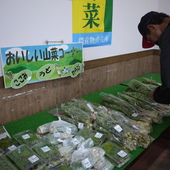
Carrying the vegetables into the sales area, you see that the sales area simply has rows of blue plastic baskets for harvested vegetables set out. Although it is a matter of grabbing a spot, the sales area is roughly divided into a fresh vegetable section, a mushroom section, a mountain vegetable section, a powdered and bean section, a prepared food section, a processed goods section, a fruit section, and depending on the season there are also different special sections (the first time I went it was asparagus, and the second time it had become lettuce).
This is today's sales amount. Because today I was busy building a greenhouse and did not take any vegetables over, only one bag of beans was sold
Often, in the middle of working together, Nami's iPhone makes the email notification sound: "Ah, the mizuna is all sold out, and there is still some daikon left, I'll go collect it in a bit."
You can clearly keep track of which vegetable was sold at which store, so even if you are not at the sales area, you can use spare moments during the busy farming season to tidy up or collect goods. It is a very thoughtful notification system.
If items are not sold out that day, the staff put the vegetables below the sales counter, and when you bring new vegetables the next morning, you can collect them at the same time. Of course, some farm households do not collect them, or the drive is too far, so the staff dispose of them as unsellable.
Those of us who live close by, of course, must collect them. That is our daily table fare. As the weather gradually warms, the vegetables keep pace with the weeds and grow fast, and our self-sufficiency rate is almost 100 percent every day. What happiness!
The fun of direct sales shops lies in the fact that they are full of local character, the unique personality of farm households, all kinds of creativity from the mothers and grandmothers, and local foods passed down through the generations. At direct sales shops, you will see croquettes made from new varieties of pink and purple potatoes, and baked buns wrapped with nozawana pickles made by marinating in soy sauce and sugar, and shiso picked in the early morning and casually tied into a bunch, as well as homemade jam, and soft-serve ice cream made with locally produced eggs…
If you have time, leave big cities like Tokyo and Osaka and head along the national highways into the countryside. If you see a sign for a "farm produce direct sales shop" along the way, why not stop and take a look? You are sure to make many interesting new discoveries.
Note 1: Mid-mountain region: refers to the transitional zone between plains and high mountains, accounting for 73 percent of Japan's mountainous national land area, and also accounting for 40 percent of Japan's arable land, 44 percent of the total number of farm households, 35 percent of agricultural output value, and 52 percent of the number of agricultural settlements, holding a very important position in Japanese agriculture. In addition, mid-mountain regions are mostly located in the upper reaches of rivers, and agricultural activities here also have multiple functions such as conserving water sources, flood control, and preventing soil erosion and collapse.