New food self-inspection rules take effect next year, industry players are not optimistic about the prospects
To strengthen food safety, the Food and Drug Administration (FDA) of the Ministry of Health and Welfare announced a new draft last week, introducing a "three-tier management" system that requires operators in seafood, meat processing, dairy processing, and food additives to self-inspect product raw materials quarterly or per batch. However, relevant operators believe this move merely increases costs, that those who truly intend to break the law will not send problematic products for testing, and that the added costs may be passed on to consumers, or even lead to the use of cheaper, lower-quality raw materials, doing nothing to improve food safety.
First wave targets seafood, meat, dairy, food additives, and special nutritional foods
In recent years, food safety incidents in Taiwan have been incessant. When the Ministry of Health and Welfare amended the Act Governing Food Safety and Sanitation last year, it required specific operators to regularly submit raw materials to third-party testing, namely the "three-tier management system": the first tier is operator self-management, the second tier is third-party laboratory verification, and the third tier is government inspection. The accompanying measures were released last Wednesday and are expected to take effect on December 31, with relevant opinions to be submitted to the FDA within one month.
According to the draft "Food Operators Required to Conduct Testing, Minimum Testing Cycle and Other Related Matters," food operators in seafood, meat processed foods, and dairy processed foods holding factory registration certificates must test for veterinary drug residues in their products; all manufacturers and importers of food additives must test for heavy metal content in finished additive products; and operators of special nutritional foods that have obtained inspection and registration permits must test for microbial and nutrient content in finished products.
The testing frequency is at least once per quarter or per batch. Operators may conduct testing themselves or commission private testing institutions, but must use testing methods recognized by the competent authority or internationally; operators must retain testing records until 6 months after the food's expiration date.
Wu Hsi-wen, section chief of the FDA's Food Division, said these are all food categories with relatively higher risks. Theoretically, operators should test once every three months, but given the different characteristics of products, batch-by-batch testing is conducted only when quarterly testing is not possible. Violators can be fined from 30,000 to 3 million yuan, in the hope of curbing unscrupulous manufacturers at the source.
Operators: Does nothing to improve food safety
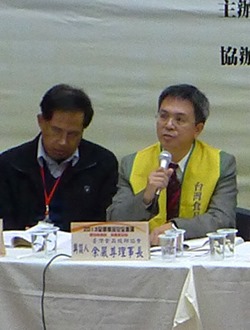
But this law increases operators' costs, and it encountered considerable backlash even before it was passed last year. Wu Yu-hsin, R&D manager of Hsieh Cheng Chemical Industry Co., Ltd., which specializes in food additives, felt helpless upon hearing the draft announcement. Although the company will certainly follow the law, he said doing so "has no substantive meaning," because food additives imported from abroad must already undergo inspection and registration with the Ministry of Health and Welfare and meet specifications before a sales permit can be obtained.
Wu Yu-hsin believes that food additives may contain other ingredients besides heavy metals, and each product has different synthesis and production methods that may pose different hazards. The Ministry of Health and Welfare merely applies heavy metal testing to all additives across the board, which does little to help food safety, and operators may pass the costs on to consumers.
Yu Yen-tsun, chairman of the Food Technician Association, is also not optimistic about this measure. "Quality is not something that can be tested out," he said. Operators who truly intend to break the law will cheat by sending problem-free raw materials for testing; consumers see the test report and feel reassured, but the food safety problem is not actually solved at all. The worst part is that when operators' costs rise, if distributors also drive prices down, operators can only cut labor costs, or even substitute lower-quality raw materials, and ultimately it is consumers who are harmed.
Yu Yen-tsun said earnestly that this move wastes too many social resources, is not a good approach, and puts smaller-scale operators in a difficult position. The Ministry of Health and Welfare should follow the example of the accountant system and establish "certified food technicians," letting outside technicians check the data and materials reported by in-house technicians, plus irregular spot checks of end products, which would be more efficient than self-inspection.
FDA: Higher-risk foods require high-standard management
However, some operators believe the new measure will not add too much cost. Tsai Tso-hung, special assistant to the general manager of Szu Fang Fresh Milk, said the new law merely formalizes what dairy operators do every day. A tanker of raw milk may come from 3 or 4 different dairy farmers, and larger-scale dairy operators test for veterinary drugs batch by batch every day. If requirements are not met, the dairy farmers must bear responsibility themselves. Moreover, Szu Fang Fresh Milk is a GMP-certified manufacturer, and all test reports must already be retained for half a year, so the new law has little impact.
Wu Hsi-wen said that for certificates provided by suppliers, operators must reconfirm responsibility; quarterly testing is already the minimum. This move is only the first step in food safety gatekeeping, and operators must still have internal quality control measures. The FDA will also conduct irregular market spot checks, and violations of the Act Governing Food Safety and Sanitation are still subject to penalties.
Wu Hsi-wen emphasized that higher-risk foods require high-standard management, so testing is mandatory regardless of scale, and those with factory registration already have a certain scale. In the future, it will be further evaluated whether other categories should be included. For violators, in addition to fines, in serious cases the operator's registration license can be revoked, and they may not apply again within one year.