Abandoned dormitory converted into a kitchen: National Taipei University of Education students cook all-you-can-eat meals themselves
"Don't carrots have seeds?" "It's not a fruit, it's a root vegetable, how could it have seeds!" During dinner time at the "Wolong 29" base near National Taipei University of Education, such a hilarious conversation broke out. A group of third-year students who rarely enter the kitchen were clumsily picking out the old stems from sweet potato leaves while debating whether to shred or slice the carrots. Six years ago, this place was still a dusty teachers' dormitory. Students and faculty from the Cultural and Creative Industries Department of National Taipei University of Education renovated it by hand into an exhibition space and live house. Their juniors carried on the creative spirit, and this year, in conjunction with their coursework, established the "Stove Studio," challenging the school's rule against cooking on campus: "Indefinitely supporting all-you-can-eat cook-it-yourself."
A century-old Japanese-style dormitory becomes a new venue for agricultural and food education
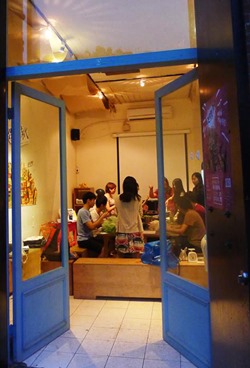
In a school where lighting fires for cooking is prohibited, Wolong 29 has become a fortress for students to showcase their culinary skills. But limited by the space, there is only a simple counter and rice cooker, with no gas or range hood. Students have to bring their own portable gas stoves. They are well aware that they are currently skirting the edge of school regulations, and the school is just turning a blind eye. Therefore, for their graduation project next semester, they are determined to build a truly "proper kitchen" on campus, and will start preparing during summer vacation.
Chang Yu-hsin said that last semester, when she went to China as an exchange student, she found that their dormitories all had kitchens equipped with induction cookers. Exchange students from different cultures took turns cooking dishes characteristic of their own countries, and the distance between them instantly shrank. This shows that a kitchen is an excellent space for exchange. Cooking is not just for eating; learning to make simple dishes is the only way to know where food comes from, and further to raise awareness of the culture and agriculture behind it.
The Cultural and Creative Industries Department team also planted cucumbers, tomatoes, basil, and more on the balcony and open space next to the old dormitory. Only by being farmers themselves did they realize that the cucumbers on the market have all been sorted to meet specifications, very uniform and petite. The "off-grade" ones grown on the balcony were twice as big as those on the market. Next semester, they will specially design a course to teach everyone how to cook off-grade produce.
Most practically, shared meals are a great help to poor students' wallets. On average, each person spends 60 to 70 yuan per meal and gets 6 dishes, 1 dessert, plus fruit. Every participating student ate until their belly showed, and couldn't help but shout, "Indefinitely supporting all-you-can-eat cook-it-yourself." Liao Xuan-ya said that eating with so many classmates from the department is much more fun than eating alone. Currently, the ingredients are still mainly from conventional farming, but in the future, they hope to add environmentally friendly agricultural products, buying directly from farmers.