Ministry of Health and Welfare requires disclosure of testing institutions; Consumers' Foundation criticizes move as interference with testing
Last year's Business Weekly "milk incident" used a self-developed testing method, sparking controversy from all sides. At the end of last month, the Ministry of Health and Welfare announced the draft enforcement rules for the Act Governing Food Safety and Sanitation, requiring that when private parties release test results, they attach the testing method, laboratory address, person in charge, etc. But the Consumers' Foundation believes this is overcorrecting. The releasing party would naturally take responsibility for the testing anyway, but requiring disclosure of the testing institution's information could create a chilling effect: "After this, no laboratory will dare help with testing."
Fearing a chilling effect, no laboratory will dare help with testing
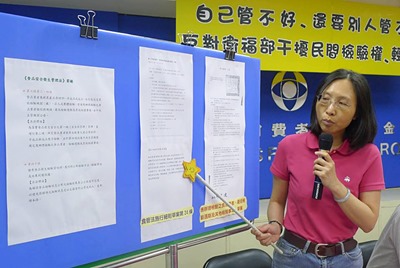
In addition, Consumers' Foundation honorary chairperson Hsieh Tien-jen also criticized that the draft on self-testing by food businesses announced by the Food and Drug Administration on the 28th of last month uniquely favors large manufacturers.
This draft stipulates that aquatic product food businesses, meat processing food businesses and dairy processing food businesses with factory registration certificates must test for veterinary drug residues in their products; all manufacturers and importers of food additives must test for heavy metal content in finished additive products; and special nutritional food businesses that have obtained inspection and registration permits must test for microorganism and nutrient content in finished products.
The testing frequency is at least once per quarter or per batch, and businesses must keep testing records until 6 months after the food's expiration date.
Hsieh Tien-jen said the draft looks only at categories and not at the scale of businesses. "Is it appropriate to require a small operator selling plain noodles to conduct testing?" He sharply criticized that the new draft simply cannot regulate large manufacturers such as Uni-President, I-Mei, Ting Hsin and Taishan. During the plasticizer case, large manufacturers sought compensation from upstream suppliers on one hand while saying they were innocent victims on the other, and in the end the ones who suffered most were consumers. The Food and Drug Administration should consider the characteristics of each category, judge scale by capital amount, and set out which businesses should submit for testing.
Wu Hsi-wen, section chief of the Food Division of the Food and Drug Administration, said that the categories announced in the draft are all higher-risk ones. For example, veterinary drugs and heavy metals both come from the source and will not disappear during the manufacturing process, so regulation must start from raw materials. There is absolutely no unique favoritism toward large manufacturers, and as long as there is factory registration, there is usually a certain scale.
Wu Hsi-wen said that self-testing is only one step in gatekeeping. Even if a business is not in an announced category, every business must comply with GHP good food regulations to ensure raw material safety. During the plasticizer case, large manufacturers seeking compensation from upstream suppliers was based on contracts between the two parties, but in administrative penalties, manufacturers cannot use "not knowing" to shirk responsibility. Businesses that violate GHP can be fined 3 to 3 million,