Can Hsinchu rice noodles still be called rice noodles without rice? Scholar suggests renaming them Hsinchu starch
The Food and Drug Administration's rice noodle labeling regulations take effect in July. Products with a rice content of 50% or more may only be called "blended rice noodles," and only those made with 100% rice may be called pure rice noodles. But the Hsinchu City Government wants to register "Hsinchu rice noodles" as a brand name, and has recently been actively lobbying the Ministry of Economic Affairs and the FDA so that regardless of rice content, as long as the product is made by a Hsinchu manufacturer, the packaging can say "Hsinchu rice noodles," with the rice content, blended rice noodles or steamed noodles noted separately. "Hsinchu rice noodles have great cultural significance to Hsinchu, and these four characters absolutely must not disappear."
However, Zhang Weiqi, a professor at National Hsinchu University of Education who has long studied food culture, refuted this: "If the rice noodles contain only 1% rice, you might as well just call them Hsinchu starch!" Japan also has local food certification, but it requires following traditional methods, or having ingredients tied to the local culture. The four characters "Hsinchu rice noodles" can be kept, but the rice content must be at least 50%, otherwise the city government is shooting itself in the foot, "ruining the Hsinchu rice noodle brand."
Hsinchu mayor: "Hsinchu rice noodles" have local cultural significance and must be preserved
In early last year, the news outlet Shangxiayou revealed that 90% of the rice noodles on the market used large amounts of cornstarch, with a rice content of less than half. In November last year, the Ministry of Health and Welfare's Food and Drug Administration announced the Regulations Governing the Labeling of Packaged Rice Noodle Products on the Market: only products with 100% rice content may be labeled pure rice noodles (vermicelli), those with 50% or more may be called blended rice noodles (vermicelli), and if the content is less than half, the two characters "rice noodles" may not appear at all. It also requires the rice content to be labeled in font no smaller than 4 mm, effective July 1 this year.
But as soon as the new law was announced, rice noodle makers pushed back immediately, criticizing the move as destroying the century-old Hsinchu rice noodle industry in one stroke. With only half a month left before the regulations take effect, the Hsinchu City Government released a Hsinchu rice noodle micro-film the day before yesterday. According to print media reports, Mayor Xu Mingcai said that Hsinchu rice noodles are a Hsinchu brand, and for the central government to insist on renaming them is as unreasonable as when the Hsinchu Science Park was renamed "Northern Science Park." The city government's press release even stated, "The Hsinchu City Government will not only fully assist the Hsinchu rice noodle family in upholding tradition," and "vows that the four characters 'Hsinchu rice noodles' will never disappear."
In an interview with Shangxiayou yesterday, Xu Mingcai confirmed that he had already raised the matter with the Bureau of Standards, Metrology and Inspection under the Ministry of Economic Affairs and the Ministry of Health and Welfare, hoping to treat the four characters "Hsinchu rice noodles" as a "brand," with manufacturers separately labeling the rice content, ingredients, blended rice noodles or cornstarch in accordance with FDA regulations, because Hsinchu rice noodles carry deep local cultural significance and are a kind of "goodwill" that absolutely must be well preserved. "Otherwise, should rice noodles made in Hsinchu be called Taipei rice noodles?" He said that after communicating with the Ministry of Economic Affairs and the Ministry of Health and Welfare, neither agency objected.
Guo Wenming, chairman of the Hsinchu Rice Noodle Commerce and Industry Association, supports the city government's position and reiterated: "'Hsinchu rice noodles' is not a product name, it is a local specialty." Manufacturers can label their products Hsinchu rice noodles and then write on the packaging rice noodle strips, blended rice noodles, or Hsinchu steamed noodles, boiled noodles. Manufacturers worked hard to build recognition for Hsinchu rice noodles in China and the Philippines, and if these four characters are removed, the impact on them would be huge.
After July, manufacturers will first switch to Hsinchu steamed noodles and boiled noodles
In addition, the Hsinchu City Rice Noodle Association decided at a meeting at the end of last month that products with a rice content below 50% would first be renamed "Hsinchu steamed noodles" or "Hsinchu boiled noodles." But why are manufacturers unwilling to increase the rice content? Guo Wenming said it is not that they cannot make it, and many factories also produce both starch noodles and pure rice noodles at the same time, but the cost is too high and the noodles turn soft and mushy when cooked, so consumers may not necessarily accept them. Cornstarch is used to improve the texture, and currently more than 90% of products on the market have a rice content of less than half.
Guo Wenming believes that manufacturers are working hard to pass on rice noodle culture, but consumer preferences should be taken into account, and as long as the labeling is clear there is no problem. He asked in response, some people oppose them calling their products Hsinchu rice noodles, "then what are we supposed to call them?" Alcohol with an alcohol concentration of 5% or 3% is still called alcohol, so why does the government not say the alcohol content is too low to be called alcohol? The government cannot single out "Hsinchu rice noodles" and slander these four characters.
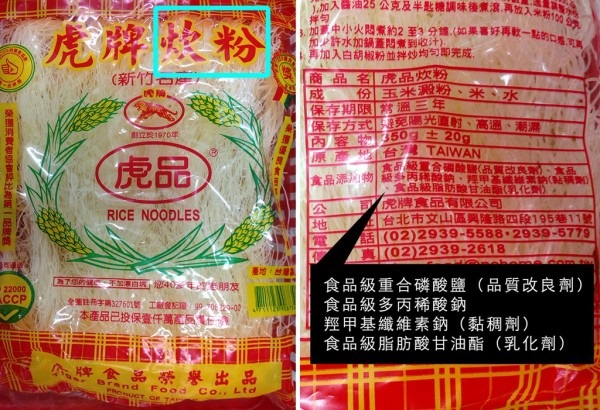
But Zhang Weiqi, associate professor in the Department of Environmental and Cultural Resources at National Hsinchu University of Education, who has long studied food culture, does not agree with the manufacturers and the city government. She said the Hsinchu City Government's goal is very similar to Japan's "regional food certification system," but Japan's regional food system takes into account "ingredients" and "production methods," for example whether the ingredients are connected to the local environment, and whether traditional methods are followed and no additives are used in production. Simply put, it is "grandma's taste."
But the Hsinchu City Government now wants products with a rice content of less than 50% to also be called "Hsinchu rice noodles," which is like shooting itself in the foot. "If the rice noodles contain only 1% rice, you might as well just call them Hsinchu starch!"
Zhang Weiqi is a native of Hsinchu and has deep feelings for Hsinchu rice noodles. She pointed out that Hsinchu has a deep rice noodle culture, and only Hsinchu carefully distinguishes between boiled noodles and steamed noodles. The biggest difference lies in the production process. When making boiled noodles, the strands are extruded and then boiled directly in water, making the structure shorter and thicker. Steamed noodles are steamed in a steamer basket, and the Taiwanese word for steaming is "chui." They are much thinner than boiled noodles. Almost all the Hsinchu rice noodles seen today are steamed noodles. What has not changed is that the rice content must exceed 50%. By changing the name to steamed noodles and lumping everything together, manufacturers distort the culture and distort local knowledge.
Ye Anyi, a contract professor at the Graduate Institute of Food Science and Technology at National Taiwan University, was a wheat starch salesman more than 30 years ago. He pointed out that at the time some rice noodle makers also used wheat starch, but some still insisted on using 100% pure rice and refused his sales pitch, which clearly shows that pure rice noodles are not impossible to make. The Hsinchu City Government interprets "Hsinchu rice noodles" as a brand, similar to the concept of sun cakes or wives' cakes, but the key lies in consumer perception. "People do not think there is a sun in a sun cake, but they generally believe rice noodles should contain rice. The logic of the two is different, and the city government's argument is too far-fetched."
Ironically, many scenes in the rice noodle micro-film promoted by the Hsinchu City Government the day before yesterday featured the few local pure rice noodle makers, praising their hard work in passing on and upholding the culture of their predecessors.
Zhang Weiqi stressed that this is not about attacking the golden signboard of Hsinchu rice noodles. On the contrary, requiring a rice content of 50% is intended to protect the brand, to prevent uneven product quality from stigmatizing Hsinchu rice noodles, and only then can exports last. "The city government says it wants to pass on rice noodle culture. Is Hsinchu rice noodle culture a culture of fakery? From now on, will everything called Hsinchu rice noodles be fake?"
FDA: If the rice content is less than 50%, the two characters "rice noodles" absolutely must not appear
Guo Wenming pointed out that after the press conference the day before yesterday, the city government met again with the Ministry of Health and Welfare and the Ministry of Economic Affairs yesterday afternoon to coordinate on the labeling issue. However, Yang Yizhen, a section chief at the FDA, said no information had been received yet, but the regulations clearly require that as long as the rice content is less than 50%, the two characters "rice noodles" absolutely must not appear on the packaging. The association may register a "Hsinchu rice noodles" trademark, but the FDA does not encourage it. Whether there is a risk of misleading consumers depends on the overall packaging, such as the labeling position and font size. If "Hsinchu rice noodles" is written in very large characters, there may be concern about misleading consumers, and the FDA will communicate further with the city government.