How can we keep the red bean fields that are friendly to eagles?
This spring we spent a truly wonderful evening at Dadaocheng 259 Farming Garden, where Hui-Shan, a researcher from National Pingtung University of Science and Technology, shared with us the records she has kept over the years from long-term observation of black kite ecology in Pingtung, Kaohsiung and other places. It was thanks to her sharing that we came to understand that the relationship between crops and the environment, people and ecology has never been something that happens only at the dining table. In the process of growing red beans, the eagles soaring in the sky, the small birds and the red bean industry are all tightly linked to one another.
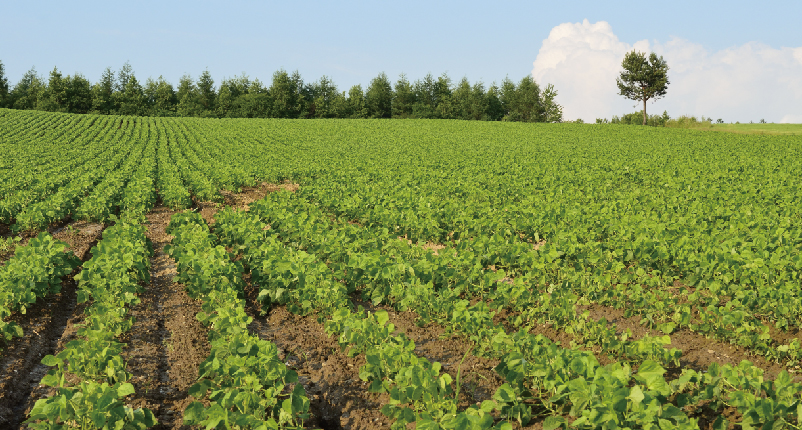
What exactly does red bean have to do with eagles? It mainly comes down to the abuse of chemical pesticides (Carbofuran). Every year in mid-October, during the period when rice paddies are converted to miscellaneous grains, farmers use large amounts of pesticides. In the case of red beans, when the seedlings are between germination and 10 cm, turtle doves and sparrows pull them up and peck at them, so farmers use Carbofuran not only to kill insects but also to poison birds in order to prevent the red bean seedlings from being pecked. As a result, the small birds that originally lived on that land and the black kite, known as the "environmental scavenger," could not escape the death trap.
Researchers from National Pingtung University of Science and Technology once surveyed an 18-hectare red bean field in Kanding Township, and after inspecting only half of it they collected 2,500 small bird carcasses, including sparrows, red turtle doves, spotted-neck doves, small skylarks and scaly-breasted munias, and the black kite also died of poisoning after eating the carcasses of these birds laden with excessive pesticides. Thus the black kite, once a gregarious bird of prey that could be seen year-round in Taiwan, has now become a rare raptor on the conservation list. Carbofuran is a neurotoxic pesticide, yet Taiwan can consume over a thousand tons of it a year, and it is widely used in paddy fields, fruit trees and vegetables, making it a resource farmers rely on heavily. The same situation has occurred abroad; over the past few years it has poisoned millions of wild birds there, so Canada and the European Union banned it as early as 2008, and the US Environmental Protection Agency also resolved to prohibit any Carbofuran residue on food starting in 2009. But Taiwan still uses it, and the amount used is even growing larger and larger. Cheng Cheng-Yung, a professor in the Department of Horticulture at National Taiwan University, said that Carbofuran is a "systemic" pesticide: after entering the plant body, it gradually penetrates the fruit and stem down to the root, making the whole plant insect-resistant, and its toxicity is fierce, so neither heating nor washing can easily remove Furadan completely.
“The black kite is an ambassador. It does not represent only itself, this population; it represents all our future descendants. Everyone wants to eat healthy food and to have a good quality of life, so protecting the black kite is the same as protecting ourselves.” - Sun Yuan-Hsun, Professor at the Institute of Wildlife Conservation, National Pingtung University of Science and Technology
Producers' attitudes toward the environment affect not only whether the crops they grow are safe, but also the field ecology of that land. More and more small farmers are promoting friendly farming, and the goal is precisely this balanced mutual good. However, changing the current situation cannot rely only on the goodwill of farming friends; it also needs the support of consumers' actions. Friendly farming requires double the labor and time, and the quality is often better too, so there is bound to be no way to sell it through the traditional production and marketing system. That is why platforms like 248 Farming Market, Hepu Farming Market or News&Market are all working hard to create a platform where farming friends can reach consumers without being exploited by middlemen and obtain more reasonable profits.
Three years ago, Green Vine began promoting friendly-farmed red beans, supporting farming friends who use only a small amount of pesticide during the flowering period, use no insecticides or defoliants after flowering or at harvest, and rely on themselves to weed on ordinary days. This lets the reassuring red beans they grow with dedicated persistence be sold through reasonable channels at reasonable prices, without worrying that the good things they grow will be undersold or simply not sell. We believe that this kind of red bean is the red bean that should appear on the dining table. Later we also introduced it to Ru-Men of 248, who now use kiln-braised red bean soup to let more consumers participate in this gentle revolution in a simpler way. Please join us in supporting friendly red beans that use no herbicides and are not waxed. They are not only delicious, but also a kind-hearted way to let the land, the ecology and people all live together happily.
Public Television Service - "Our Island" feature introducing the plight the black kite faces because of pesticide abuse