Don't use paraquat to harvest adzuki beans; the new desiccant from the Agricultural Chemicals and Toxic Substances Research Institute costs 3,000 yuan per hectare
The adzuki bean (Vigna angularis) is an important winter cash crop, with production concentrated in Pingtung County and Kaohsiung City; the national planting area is nearly 6,200 hectares, and annual output exceeds 11,000 metric tons. As the herbicide paraquat, commonly used to desiccate adzuki beans, is about to be phased out, one of the alternative agents, sodium chlorate, is generally not well accepted by farmers because of its high cost and relatively slow effect, creating an urgent need to find another defoliant alternative.
The Agricultural Chemicals and Toxic Substances Research Institute (abbreviated as "the Institute") has developed a new adzuki bean plant desiccant, "NA-yci1 adzuki bean plant drying treatment agent," whose effect is comparable to paraquat, drying the plants in only one week. At present, the Agriculture and Food Agency has planned a 2,000-hectare trial area, providing the agent to farmers free of charge, and has also offered a subsidy of 3,000 yuan per hectare, hoping to give farmers more diverse options for promoting the drying of adzuki bean plants.
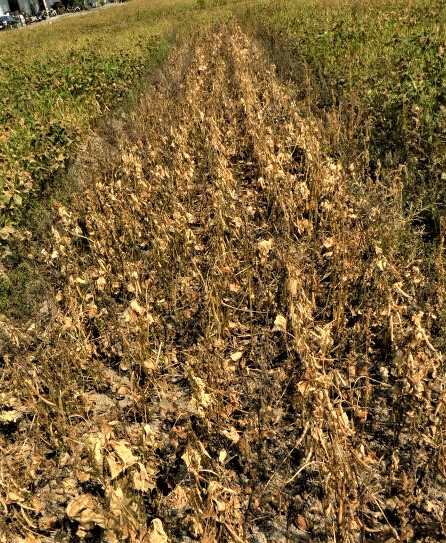
COA: Carry out variety purification to unify the ripening time
In addition, the Council of Agriculture (COA) also calls on farmers to carry out adzuki bean variety purification. Chen Chi-chung stated that different adzuki bean varieties have different growth days, and mixed planting will make the maturity period of adzuki beans inconsistent, causing difficulties at harvest; farmers are advised to unify the adzuki bean varieties in their fields.
Tseng Min-nan, associate researcher in the Crop Environment Section of the Kaohsiung District Agricultural Research and Extension Station, further explained that at present domestic adzuki bean cultivation is dominated by Kaohsiung No. 9, accounting for 70 percent, with the remainder being Kaohsiung No. 8 (22%) and Kaohsiung No. 10 (8%). "Kaohsiung No. 8 has an earlier maturity period, nearly ten days earlier, so farmers can use the maturity period of Kaohsiung No. 9 as the baseline, which makes it easier to unify the degree of ripening."