Organic Bacillus thuringiensis product Suli Bao tested positive for diphenylamine; pesticide and toxic substances research institute traces contamination to lubricating oil
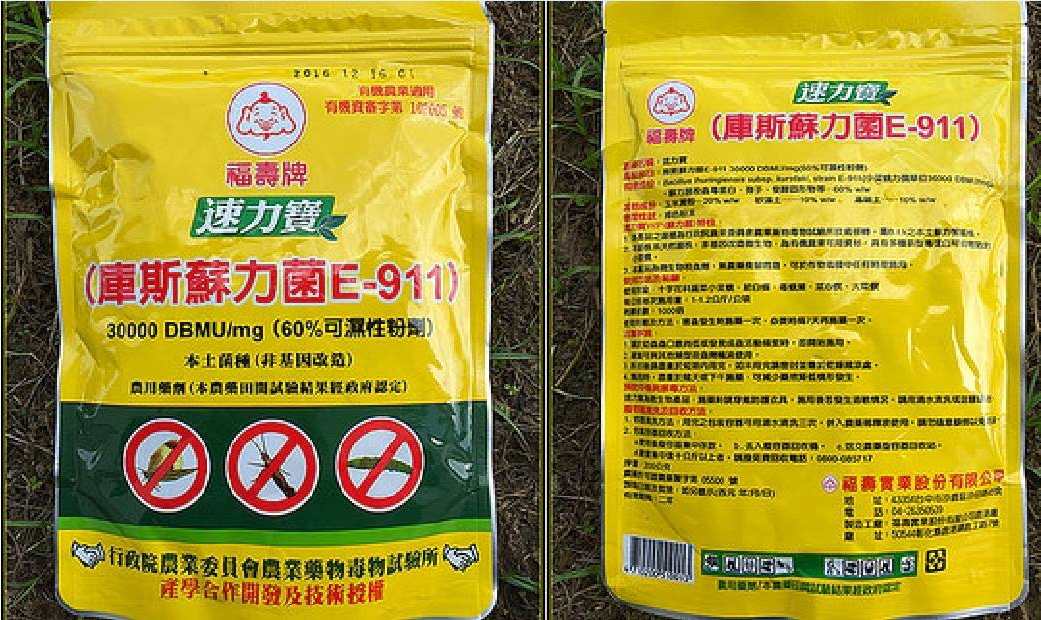
Fushou's Bacillus thuringiensis product "Suli Bao" was found to contain the chemical agent "diphenylamine" at 0.19ppm, failing to meet organic material regulations. The pesticide and toxic substances research institute today (the 13th) announced the latest investigation results, tracing the source of diphenylamine to process contamination, concluding that lubricating oil containing diphenylamine in aeration equipment was not properly filtered and accidentally entered the manufacturing process. It recommended that Fushou promptly improve its pipelines and replace filters, and reapply for organic material registration after adjusting the product.
In response, Fushou Enterprise stated that it absolutely did not intentionally add diphenylamine, and would further confirm whether it is a contamination issue in the manufacturing process. However, out of caution, it has fully recalled all "Suli Bao" produced after August 6, 2018 (ROC year 107) (batch number 2018.08.06). It also emphasized that "Suli Bao" must be diluted 1000 times with water before use, and remains safe for field application.
No diphenylamine found in other Bacillus thuringiensis products on the market or early Suli Bao products
Pesticides are mainly divided into chemical pesticides and biological pesticides. Biological pesticides carry lower residue and environmental pollution risks than chemical pesticides and are considered relatively friendly pesticide materials. Bacillus thuringiensis is safe, non-toxic, and does not have pesticide residue issues, making it a commonly used biological pesticide among organic farmers. Fushou's "Suli Bao" is the first domestic Bacillus thuringiensis biological insecticide and currently the only Bacillus thuringiensis product that has passed organic material review. The detection of the chemical agent "diphenylamine" this time has left organic farmers anxious and raised outside concerns about biological pesticides.
Pesticide and toxic substances research institute director Fei Wenqi said in an interview last week that most Bacillus thuringiensis strains in products currently on the market come from abroad, with imported raw materials manufactured in Taiwan, while Fushou is the only company that manufactures a domestic strain. That strain (Bacillus thuringiensis kurstaki E-911) was transferred to Fushou by the pesticide and toxic substances research institute in ROC year 96 (2007). Bacillus thuringiensis materials are used for insect repellence and pest prevention; there is no reason for the manufacturer to add diphenylamine, and no domestic manufacturer has registered the use of diphenylamine, so the reason why needs to be investigated.
Last week, the pesticide and toxic substances research institute launched sampling and testing of Bacillus thuringiensis products. The test results were released today (the 13th). Fei stated that after sampling other Bacillus thuringiensis products on the market and early "Suli Bao" products from Fushou, "no diphenylamine was found in any of them," thereby ruling out the possibility that the strain naturally produces diphenylamine as a biological characteristic.
Pesticide and toxic substances research institute investigation: alkylated diphenylamine detected in lubricating oil, filtration process accidentally caused contamination
On the other hand, biological pesticides require specialized equipment in production. If a chemical agent is mixed in, it is most likely a pipeline contamination issue. About 30% of diphenylamine is used for preservation purposes, while the remaining 70% is used in lubricants. Therefore, the pesticide and toxic substances research institute further sampled the lubricating oil in Fushou's equipment and pipelines, and ultimately detected alkylated diphenylamine in the lubricating oil. It inferred that there was a problem with the filter, which did not filter properly, allowing lubricating oil components to accidentally enter the manufacturing process. "Bacillus thuringiensis fermentation requires aeration equipment, and lubricant is applied to the pipelines. It may be that Fushou did not set up the filter properly, so the diphenylamine in it entered the product. This counts as contamination in the manufacturing process," Fei Wenqi explained.
She further pointed out that there is currently no domestic diphenylamine standard reagent, and purchasing from abroad would take more than half a month. Therefore, the pesticide and toxic substances research institute could not obtain quantitative measurements this time (i.e., the numerical content of the substance), and could only obtain qualitative measurements (i.e., the presence or absence of the substance). The problematic "Suli Bao" products were produced after ROC year 104 (2015). "The 'Suli Bao' from ROC years 100-103 (2011-2014) had no problems. Only the products from ROC years 104 (2015) and 107 (2018) tested positive for diphenylamine. Products from other years were not tested because there were no samples." She recommended that Fushou promptly improve its pipelines and replace filters, and reapply for organic material registration after adjusting the product.
Fushou: Will further confirm the manufacturing process; using food pesticide residue standards to test agricultural materials is inappropriate
In response, Fushou Enterprise vice president Cai Jiaguang stated that last week it individually tested every batch of raw materials and ingredients in "Suli Bao," and none were found to contain the chemical agent. Regarding the pesticide and toxic substances research institute tracing the source of diphenylamine to lubricating oil on the air compressor, he responded: "We still need to further confirm the related negligence in the manufacturing process and verify the cause. We will take responsibility." He emphasized that diphenylamine was absolutely not intentionally added.
Regarding the affected products, he stated that last week the company had contacted domestic distributors to fully recall all "Suli Bao" produced after August 6, 2018 (ROC year 107) (batch number 2018.08.06), and semi-finished products still in warehouses would no longer be sold. "Before we find the cause and improve the product, we will no longer use the organic material permit batch number."
Cai Jiaguang stated frankly that agricultural materials are mainly used in the crop cultivation process and are not meant for direct human consumption. He considered it inappropriate for the competent authority to use the 374-item pesticide residue standard for testing food to test agricultural materials. He also noted that among Bacillus thuringiensis products currently on the market, only "Suli Bao" is registered as an organic material, "so it will inevitably be scrutinized more closely, while those not registered (as organic materials) are not regulated." He also emphasized that "Suli Bao" must be diluted 1000 times with water before use and remains safe in application.
Pesticide and toxic substances research institute: Suli Bao remains a qualified biological pesticide material and can be used by non-organic farmers
Fei Wenqi explained that in the annual sampling and testing operations, biological pesticide products are not subjected to chemical pesticide testing; only whether the registered biological species and potency (i.e., the effectiveness in controlling pests and diseases) match the label are tested. Fushou's "Suli Bao" was found to contain the chemical agent "diphenylamine" at 0.19ppm this time (ppm is a unit of one part per million) because it does not comply with the organic material regulation that "no chemical agent may be detected," which is why there is a question of violation. "Different biological pesticides allow different chemical agent content, but generally a residue concentration below one-thousandth is considered negligible." Therefore, "Suli Bao" remains a qualified biological pesticide material, and non-organic farmers have no concerns about using it.