Avian Influenza Prevention and Control Research Center Officially Unveiled! Big Data Monitors High-Risk Areas, Establishes Epidemic Prevention Model
Facing a continuous outbreak of avian influenza crises domestically, the Bureau of Animal and Plant Health Inspection and Quarantine of the Council of Agriculture established the "Avian Influenza Prevention and Control Research Center," hoping to use big data analysis models to strengthen monitoring of high-risk areas and establish an avian influenza epidemic prevention model. Council of Agriculture Deputy Minister Huang Chin-cheng stated that after two years of effort, Taiwan has eliminated the avian influenza viruses H5N3, H5N8, and H5N6, with only H5N2 remaining in the environment. However, he also emphasized that H5N6, which carries a risk of avian-to-human transmission, still exists in China, Japan, South Korea, and other places, and could be brought into Taiwan through migratory bird migration and human movement, so it must not be taken lightly.
The Bureau of Animal and Plant Health Inspection and Quarantine of the Council of Agriculture held an unveiling ceremony for the "Avian Influenza Prevention and Control Research Center" on the 12th. The center combines cross-agency cooperation with the Centers for Disease Control of the Ministry of Health and Welfare, the Department of Animal Industry of the Council of Agriculture, the Animal Health Research Institute, and the Taiwan Agricultural Research Institute. Its main goals are "strengthening industry fundamentals to facilitate the elimination of avian influenza viruses," "avian influenza virus monitoring and analysis," "strengthening avian influenza response technology and epidemiological analysis," and "prevention and control of avian-to-human transmission of avian influenza."
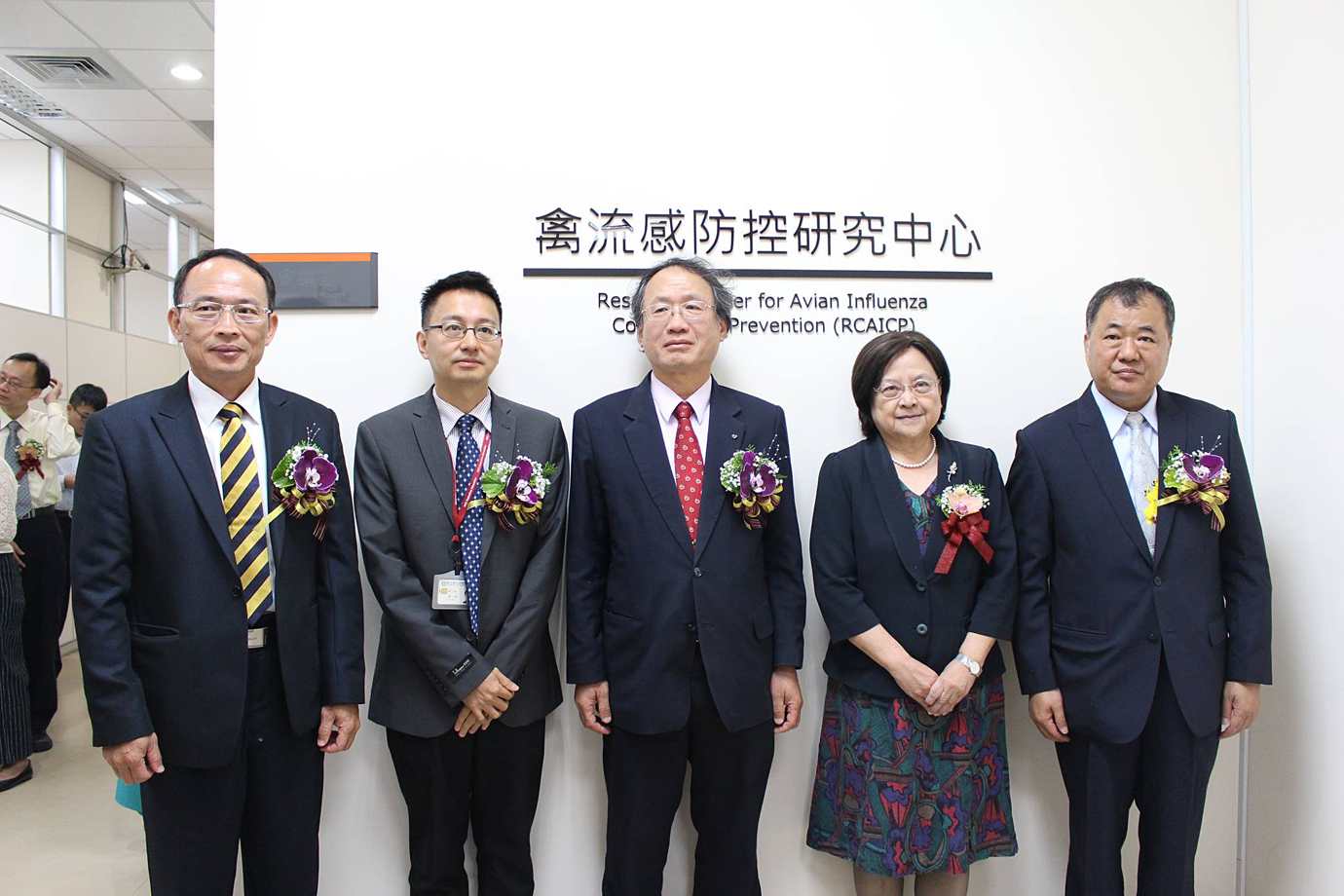
Huang Chin-cheng: Only H5N2 Remains in Taiwan's Environment, Only 89 Avian Influenza Cases This Year
Huang Chin-cheng pointed out that Taiwan has currently eliminated the avian influenza viruses H5N3, H5N8, and H5N6, but H5N2 still remains in the environment. "After two years, H5N2 still cannot be eradicated, because the low-pathogenic strain that came in 2003 and the highly pathogenic strain that came in 2015 coexist in the environment." After the low-pathogenic strain infects poultry, no abnormalities can be seen, making the epidemic difficult to control.
However, Huang also emphasized that from the beginning of this year until last week, only 89 avian influenza cases had appeared. "The measures implemented over the past two years have been effective in bringing the epidemic under control."
Avian Influenza Prevention and Control Research Center Uses Big Data to Analyze High-Risk Areas
To further accurately and preemptively prevent avian influenza epidemics, the "Avian Influenza Prevention and Control Research Center" uses a visual information system to integrate past avian influenza epidemic conditions in Taiwan, international epidemic trends, and estimates of high-risk avian influenza areas. Tsai Ching-ping, associate researcher at the Taiwan Agricultural Research Institute and representative of the Avian Influenza Prevention and Control Research Center, explained that the data includes "dynamic distribution of avian influenza epidemics," which provides real-time monitoring of the scope of epidemic spread; and "avian influenza case data statistics," including rankings of outbreak case numbers by different poultry species, different counties and cities, and townships, as well as the rise and fall of outbreak numbers by region in different years and months.
In addition, the "avian influenza risk analysis warning map" uses past avian influenza case data, combines it with a geographic information system, and adds indicators such as registered poultry farm density, unregistered waterfowl farm density, the heterogeneity ratio of waterfowl farm and land fowl farm breeding numbers, and non-rice crop coverage rate, to determine high-risk avian influenza areas and strengthen monitoring operations. From this, it can be estimated that Taiwan's high-risk areas are concentrated in 22 townships and districts across the five counties and cities of Pingtung, Kaohsiung, Yunlin, Changhua, and Tainan.
Huang Chin-cheng pointed out that through the prevention and control center's risk analysis, high-risk areas can be accurately identified. In the face of winter, the peak season for avian influenza, different methods from previous years will be adopted this year to handle the epidemic. For waterfowl, breeding chickens, laying hens, and free-range chickens, monitoring will be strengthened in high-risk areas. In particular, laying hen farms and breeding chicken farms often raise old, middle-aged, and young birds together, which has become an industry model, and it is hoped that monitoring this part will be strengthened to effectively reduce the epidemic.
Huang further explained that although in the past high-risk blocks could be estimated based on breeding density and outbreak frequency, "roughly in areas such as Kouhu and Dongshi in Yunlin County," this year, through the prevention and control center's aggregation of past data and big data analysis of the epidemic, it is possible to be more accurate and detailed and to establish a set of handling models for high-risk area stages.
Migratory Bird Migration and Human Movement May Bring in Overseas Avian Influenza Viruses
As the peak season for avian influenza approaches, Huang Chin-cheng explained that different avian influenza viruses still exist in countries around Taiwan, including H5N6, H7N9, and H5N1. These viruses may still enter Taiwan along with migratory birds and human movement, and special attention will be paid to this part.
As for whether the risk of avian-to-human transmission still exists this year, Huang responded that H7N9 is the most likely to cause avian-to-human transmission. Last year, there was also a case in which Taiwanese personnel were infected in China and returned home. However, H7N9 has not yet evolved to spread directly from person to person, and the risk is limited to personnel in direct contact with poultry.
In addition, H5N6 also carries a risk of avian-to-human transmission. Although Taiwan eliminated the virus long ago and has had no cases for more than a year, the virus still exists in China, Japan, and South Korea and may spread through migratory bird migration. Due to factors such as frequent cross-strait personnel movement and migratory bird migration, the risk of avian-to-human transmission has always existed.
Lo Yi-chun, deputy director-general of the Centers for Disease Control of the Ministry of Health and Welfare, pointed out that the Ministry of Health and Welfare participates in the prevention and control center mainly to grasp the issue of human and avian infection. The greatest sources of risk are poultry farmers, transport personnel, and market operators. For personnel who have been infected with avian influenza, serum antibody research is conducted.
In addition, testing units must be established to avoid delaying epidemic prevention operations when an avian-to-human transmission incident occurs because all specimens are concentrated in the central laboratory. Through the cooperation of the prevention and control center, the epidemic can be grasped in real time, and the industry's operating model can be better understood to identify potentially infected personnel.
As the peak season for avian influenza approaches, the "Avian Influenza Prevention and Control Research Center," based on the results of historical data analysis, recommends that in addition to annual routine monitoring, strengthened measures must be established for high-risk poultry species and areas. These include strengthening monitoring of duck farms before market slaughter, collecting samples from at least 60 free-range chicken farms in high-risk counties and cities, actively monitoring 360 laying hen farms with annual sampling, and prioritizing testing of breeding chicken farms that are antibody-positive.