Bacillus thuringiensis product "Fushou Sulibao," the only locally produced organic input, tests positive for diphenylamine, cause under investigation
The Agriculture and Food Agency conducted routine commodity inspections of organic agricultural inputs, and Fushou Enterprise's "Sulibao" (Bacillus thuringiensis kurstaki E-911) (manufacturing date August 6, 2018 [ROC year 107], batch number 2018.08.06) was found to contain the chemical pesticide diphenylamine. The Agriculture and Food Agency removed the product from its recommended list of organic inputs on the 5th of this month and reminded organic farmers not to use it.
Bacillus thuringiensis is an entomopathogenic bacterium that is safe and non-toxic to humans. Diphenylamine (DPA) is a chemical pesticide that is also used for freshness preservation, anti-corrosion and anti-oxidation, for example as a waxing ingredient on apple peels. Because diphenylamine can break down into the carcinogen nitrosamine, it is considered to carry a certain risk.
Fei Wen-chi, director of the Agricultural Chemicals and Toxic Substances Research Institute, said that Bacillus thuringiensis inputs are used for pest repellence and pest prevention, and there is no reason for manufacturers to add diphenylamine. Moreover, no domestic manufacturer has registered the use of diphenylamine. Why did it appear in this product? This needs to be clarified. A spokesperson surnamed Wang from Fushou Enterprise said the company has tested every batch of raw materials for the product one by one and will find the cause of contamination as soon as possible.
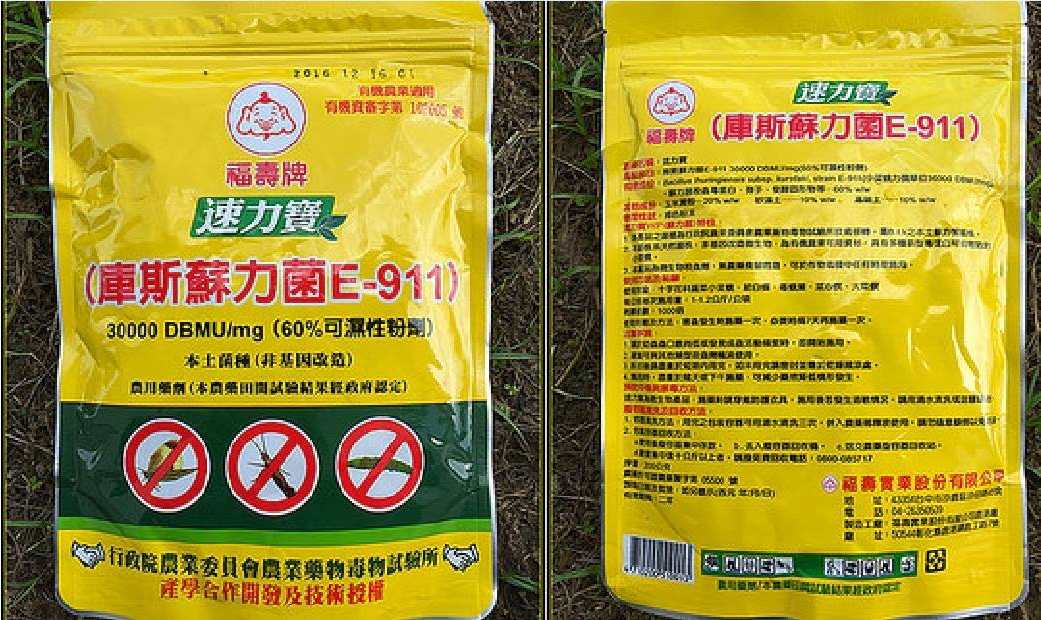
Fushou: Sulibao's ingredients are bacterial strains, corn starch, diatomaceous earth, etc., with no use of diphenylamine
In response, a spokesperson surnamed Wang from Fushou Enterprise said that "Bacillus thuringiensis kurstaki E-911" was transferred (non-exclusively) to Fushou by the Agricultural Chemicals and Toxic Substances Research Institute in 2007 [ROC year 96], and Fushou has manufactured and sold the "Sulibao" product for nearly ten years. It is the first domestically produced Bacillus thuringiensis bio-insecticide in the country, used in large quantities, and is a biological pesticide commonly used by organic farmers.
Regarding this product being found to contain a chemical pesticide, he explained that in the past pesticide testing only covered 311 items, but now it has been increased to 374 items, which is why the presence of diphenylamine was detected. As for which ingredient contains diphenylamine, he said it is still under investigation, and the company has tested every batch of raw materials for the product one by one and will find the cause of contamination as soon as possible.
Wang said, "'Sulibao's' ingredients are simply bacterial strains, corn starch, diatomaceous earth, kaolin, etc. From the past until now, the product ingredients have always been the same and have never changed, and diphenylamine is not used in the manufacturing and fermentation processes either." He emphasized that the company enforces strict controls in its manufacturing process and rigorously prevents contamination problems arising from shared production lines in the factory.
Wang pointed out that distributors have already been notified to take the product off the shelves first. Follow-up handling may involve a full recall or changing the packaging so that it no longer bears the words "usable input for organic agriculture." At the same time, the source of the chemical agent will be confirmed as soon as possible, and the raw material formula for the next batch of products will be readjusted.
Trivia: The Ministry of Health and Welfare announced in August last year that the pesticide testing items under the pesticide residue testing method "Method of Test for Pesticide Residues in Foods - Multiresidue Analysis (V)" would be increased from the original 311 items to 374 items, and this officially took effect on January 1 this year. Among them, diphenylamine is one of the newly added testing items.
Agricultural Chemicals and Toxic Substances Research Institute: Diphenylamine is used for freshness preservation and anti-corrosion; why did it appear in a Bacillus thuringiensis product? Investigation needed
Fei Wen-chi, director of the Agricultural Chemicals and Toxic Substances Research Institute, said that diphenylamine (DPA) is a pesticide that is also used for freshness preservation, anti-corrosion and anti-oxidation, for example in the waxing ingredient on apple peels. Internationally, it has been pointed out that diphenylamine carries a certain risk because it can break down into the carcinogen nitrosamine. But she pointed out that Bacillus thuringiensis inputs are used for pest repellence and pest prevention, and there is no reason for manufacturers to add diphenylamine. "Moreover, currently no manufacturer in the country has registered the use of diphenylamine. How exactly did diphenylamine get there? Where did it come from? All of this still needs time to clarify."
At present, diphenylamine is not approved for use as a pesticide domestically; in the pesticide testing standards for imported agricultural products, the residue tolerance for diphenylamine is 5 ppm for pears, 10 ppm for apples, and 0.05 ppm for apple juice.
Diphenylamine is not approved for use as a pesticide domestically. Is there any concern about using the "Sulibao" product found to contain diphenylamine? Fei Wen-chi explained that the Food and Drug Administration has launched sampling inspections of Bacillus thuringiensis products on the market (including imported and domestic ones), including the adjuvants used in Fushou's product, in order to clarify the reason why current Bacillus thuringiensis products contain a chemical agent, and also to confirm whether Bacillus thuringiensis strains have the biological characteristic of automatically producing diphenylamine. The test results are expected to come out next Monday.
Fei Wen-chi said that all pesticides must obtain a pesticide registration certificate before going on the market, their product raw materials must pass government inspection and approval, and all ingredients and formulas must be disclosed to the Agricultural Chemicals and Toxic Substances Research Institute. "For anything involving commercial know-how, we will sign confidentiality agreements and cannot disclose it, but the key is to control the manufacturer's product from the start and confirm that the ingredients are not problematic." In addition, she also pointed out that the management standards for downstream agricultural products and upstream pesticide use should be separated. Using the trace-level standards for agricultural products to examine upstream pesticide use is not very appropriate, and management still requires two-way communication.
Farmers: Sulibao is trusted by farmers and is the only domestically produced organic Bacillus thuringiensis product
Regarding the incident of an organic input being contaminated by a chemical pesticide, farmer Chen Feng-yi responded that Taiwan's testing standards for organic farmers are extremely high, and all chemical pesticides must be absent. This often keeps farmers on edge, so they only dare to use organic inputs recommended by the government. Fushou "Sulibao" was originally the only domestically produced Bacillus thuringiensis product that had passed organic input review, so it gained farmers' trust and was mostly used on cruciferous leafy vegetables and melon vegetables. Now that news of the problem has come out, organic farmers may lack a trusted Bacillus thuringiensis product to use.
Chen Feng-yi's vegetable garden also used "Sulibao." He said that although the product must be diluted 1000 times before use after purchase, and the diphenylamine it contains may be difficult to detect, once it is detected, a fine of 30,000 yuan is imposed across the board, the product may not go on the market, and brand image is further damaged. "This hurts farmers the most and will leave us at a loss, because even after choosing an organic input recommended by the government, problems still occur. Who will absorb this loss?" He called on the government and manufacturers to find the cause of contamination as soon as possible so that organic agricultural products are not innocently dragged into it.