The era of small-scale farmers' primary processing arrives, and the COA's workshop registration certificate is equivalent to factory registration
To promote unified management of agricultural products from production to primary processing, the COA amended the "Agricultural Production and Certification Management Act" and plans to bring primary processing of agricultural products under its jurisdiction. In the future, those using domestic traceable agricultural products as raw materials to engage in four major categories of processed items - drying, grinding, milling, and roasting - or those who have obtained traceability processing certification or organic processing certification, will be able to apply for registration as an "agricultural product primary processing workshop," with the agricultural authorities serving as the governing body, to meet the processing needs of small-scale farmers with small scale and relatively simple processing operations. The draft amendment is currently in the pre-announcement period, and the parent law and related sub-laws are expected to be revised by June next year.
Trivia: Food factories under the jurisdiction of the Ministry of Economic Affairs are larger in scale and are called "factories"; the COA has proposed the "Agricultural Product Primary Processing Workshop Management Regulations," bringing those of smaller scale that meet specific conditions under COA jurisdiction, using the name "workshop."
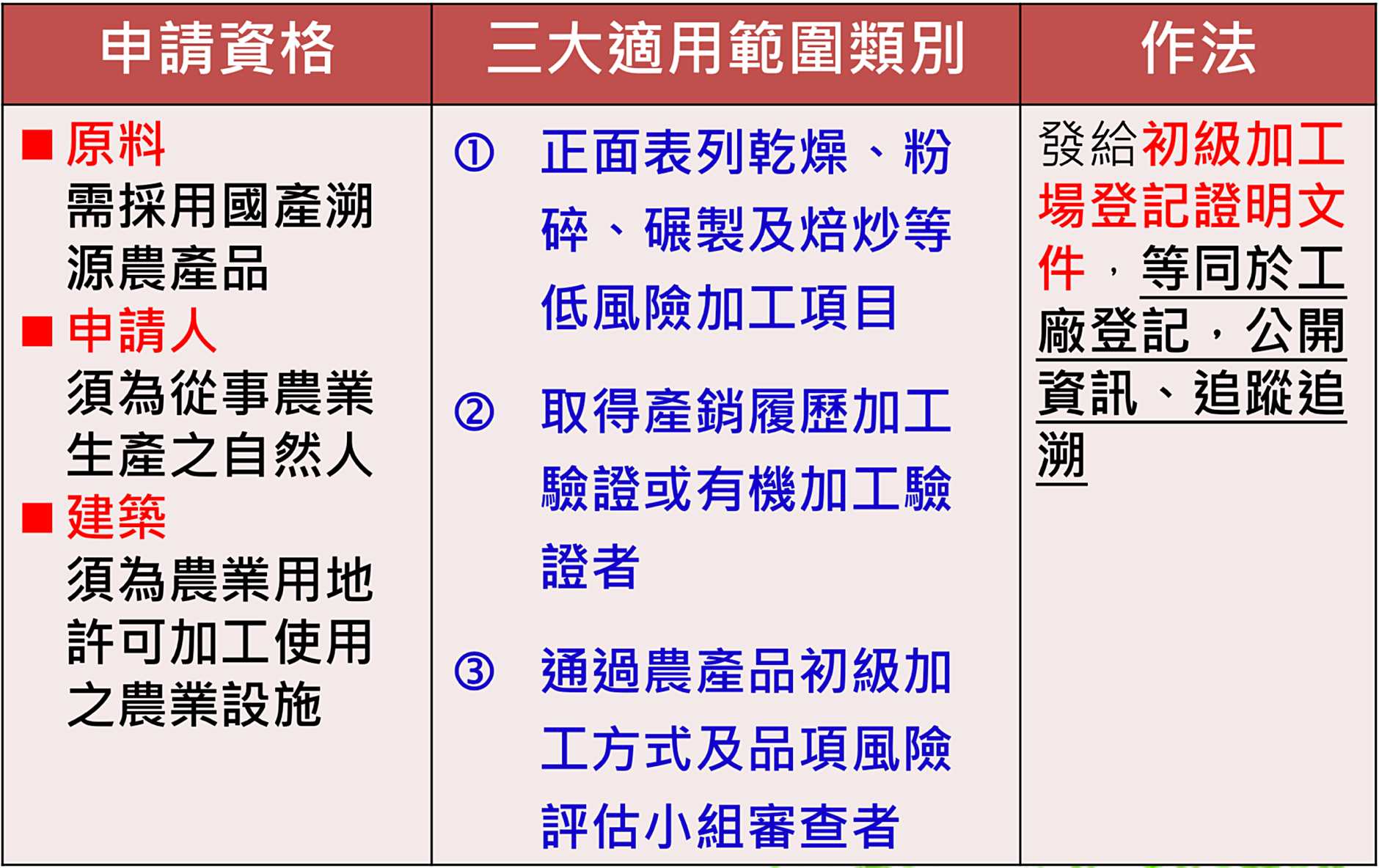
You Junren, section chief of the Marketing and Processing Division of the Agriculture and Food Agency, stated that the risk assessment team uses "water activity" and "pH value" as the two major parameters for distinguishing high and low food risk, opening up "low-risk food" processed items for small-scale farmers.
Trivia: The U.S. Food and Drug Administration uses "water activity" and "pH value" as the two major parameters for distinguishing high and low food risk. "Water activity above 0.85" and "pH above 4.6" are classified as high-risk foods.
COA: Expected to increase agricultural product processing volume by 75,000 metric tons per year
You pointed out that after the law amendment, it is expected to drive the development of 500 primary agricultural processing workshops, increase output value by approximately 2 billion yuan, and also increase annual agricultural product processing volume by 75,000 metric tons. However, why were jams and pickled products, which are major items in small-scale farmer processing, not included in the first batch of opened items? He explained that because production processes and preservation methods vary and variables are difficult to control, case-by-case assessment is needed. But he emphasized that as long as one has obtained traceability processing certification or organic processing certification, since they have undergone third-party verification and passed risk assessment, they are all on the list of applicable subjects, and processed items are not limited to these four major categories.
Draft amendment expected to be sent to the Executive Yuan in December
Chen Jizhong emphasized that after establishing a unified management model for primary processing of agricultural products next year, the "Department of Agricultural Product Safety and Marketing" will be responsible for issuing registration certification documents and numbers. The COA will use this to control producer data, workshop registration, and conduct product tracking, hoping to strengthen agricultural product safety and stabilize agricultural production and marketing.
The draft amendment to Article 7 of the "Agricultural Production and Certification Management Act," the parent law, is currently in the pre-announcement period and is estimated to be sent to the Executive Yuan by the end of December, with the hope of completing the amendment in the next session of the Legislative Yuan. Chen stated that there are still 3-6 months before submission to the Legislative Yuan for review, during which the COA will hold symposiums around the country to explain, and will also get related regulations in place as soon as possible.
Xie Shengyou: Recommends developing detailed operating instructions for different processed items
Xie Shengyou, founder of "Haoshiji" who has long focused on small-scale farmer processing issues, responded, "The general direction is correct, but the implementation measures still need revision and further discussion." He stated that "risk assessment" should not only look at the characteristics of the item itself; processing environment, production volume, distribution model, economic behavior and other factors all affect the risk value.
Xie stated that Taiwan's climate is hot and also prone to humidity. Once grains are ground into powder, the contact area with air greatly increases, and the probability of mold also greatly increases. If ordinary farmers' processing environments lack humidity and airflow pressure control, their risk would not be lower than ordinary farmers' home-made high-sugar jam. Some grain powders even have dust explosion occupational safety concerns. However, in the draft, "grinding into powder" is included as one of the four priority processed items, while jam products require case-by-case risk assessment. "The methodology of the entire draft regarding risk assessment still needs to be confirmed."
Xie pointed out that in assessing risk, besides product characteristics, production volume and sales model are another aspect that needs consideration. For example, Farmer A makes hundreds or even thousands of jars of jam on their own farm and sells them through the internet to unfamiliar consumers in the mainstream market. Farmer B uses a pre-order system on the farm, grinding limited quantities of rice and grain powder weekly to sell at farmers' markets to regular pre-ordering customers. The former is closer to general mainstream market economic behavior, while the latter is subsistence-type economic behavior. Therefore, the former will face greater risk than the latter in terms of production volume, distribution model, and potential consumer types.
He recommends that tiered management under regulations should establish detailed measures, especially clear behavioral guidelines on hygiene and safety principles, so that producers and inspectors can follow them. Detailed operating instructions should also be established based on the types of different processed items, so that management can get on track and help farmers ensure food safety in self-made processed items and gain market trust.