Over a thousand fishermen dissatisfied with overly strict enforcement, submit nine demands in protest; Fisheries Agency: If the EU issues a red card, things will not get better
Over a thousand fishermen are dissatisfied with the excessive fines under the three fisheries laws and overly strict government enforcement, and plan to head north next week to protest. The Fisheries Agency hastily held a press conference this morning (the 31st) in response. Lee Tui-chih, Deputy Minister of the Council of Agriculture, stressed that the Fisheries Agency issues fines in accordance with the law, and absolutely not arbitrarily or excessively, and that those fined are all repeat offenders and serious violators.
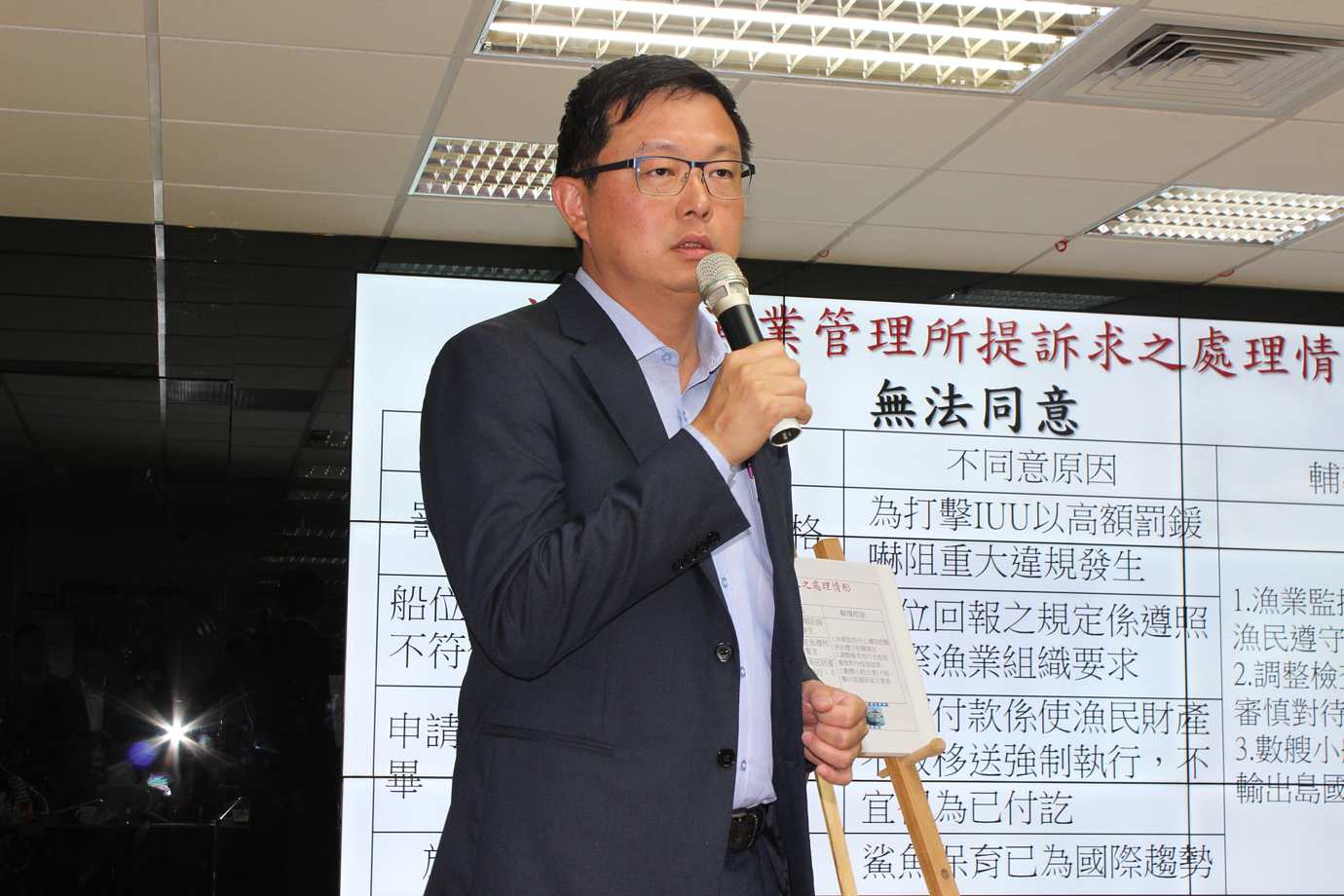
In response to the demands raised by fishermen, the Fisheries Agency stated that it has agreed to simplify the fish landing declaration and the reporting procedures for overseas-hired crew, reduce the waiting period for overseas crew to 3 months (down from 6 months), and exempt deep-sea small fishing boats under 10 tons from installing vessel position reporting devices, and promised to strengthen maritime patrols to ensure the safety of fishing vessel operations. As for the fishermen's demands to lower fine amounts and relax vessel position reporting management regulations, the Fisheries Agency said it cannot agree to relax them, stressing that Taiwan should comply with international conventions and align with international norms in order to help Taiwan's fishing industry achieve sustainable development.
Wang Hsin-chan, chairman of the self-rescue association: Regulations do not fit fishermen's operational needs
Wang Hsin-chan, chairman and secretary-general of the Fishermen's Self-Rescue Promotion Association, stressed that the protest action was launched to defend fishermen's work rights and interests, not as a political maneuver. He said the offshore working environment is extremely different from land, with many unexpected situations, and the government should not treat hardworking fishermen with harsh laws.
He directly criticized the regulations for not fitting fishermen's actual operational needs and expressed hope that the government would listen more to fishermen's voices. For example, he believes foreign fishing workers only need to work a few months a year, can rest the rest of the time, are not suited to the Labor Standards Act, and should instead have a separate offshore labor operations ordinance. He also stressed that most captains are very friendly to fishing workers, give them proper rest, and do not owe wages. In addition, considering that fish bodies and fish fins may have different sales channels and handling methods, fishermen usually store them separately after catching them, so he hopes the government can relax the measure requiring shark fins not to be separated from the body, but clarified that this absolutely does not mean permitting the act of "finning and discarding the body."
"The government gives no guidance and fines directly, and at one or two million per fine, who can bear it?" Wang Hsin-chan said the excessive penalties have already affected fishermen's livelihoods. Fining everything has left fishermen anxious, and he also stressed that fishermen are not refusing to cooperate with regulations, but that many current fishermen are elderly and need time to adapt to the new laws and, even more, need government guidance.
Will the EU's visit to Taiwan lead to removal of the yellow card? Fisheries Agency: No answer yet
An EU fisheries delegation recently sent personnel to Taiwan to show concern about our country's deep-sea fishing situation. Lin Kuo-ping, deputy director-general of the Fisheries Agency, said the EU representatives held meetings with the Fisheries Agency during this visit to discuss the overall fishing catch system. To demonstrate its determination to cooperate with international efforts to combat IUU fishing, the Fisheries Agency, in addition to saying it will more strictly implement the three fisheries laws, will also in the future prohibit the import into Taiwan of illegal foreign-caught seafood. "We ourselves cannot break the law, and at the same time we must resist IUU internationally." The amendment to Article 14-1 of the "Deep-Sea Fisheries Act," which involves regulatory content, has already been sent to the Legislative Yuan for review. Lin Kuo-ping pointed out that the EU affirmed Taiwan's move, but did not say whether the yellow card ban against Taiwan would be resolved.