Key Points and Methods of Yellow Guinea Pig Breeding Technology Explained
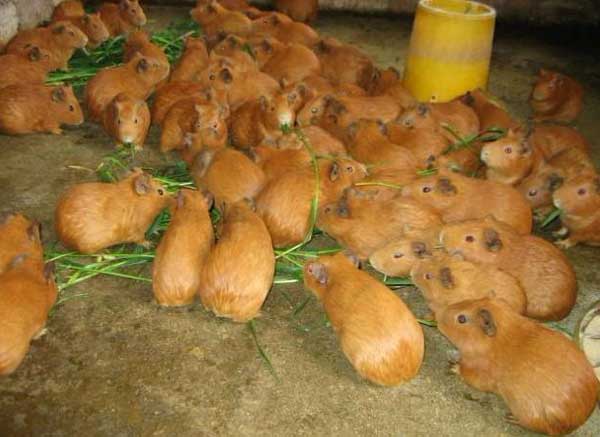
The yellow guinea pig is actually a type of guinea pig, native to South America, that has been developed into a special breed through selective breeding. Yellow guinea pig As a food source, the yellow guinea pig is a new type of specialty breeding novelty; its coat is golden yellow all over, its meat is tender and delicious, and when eaten it is fragrant on all sides. The meat is sweet in flavor and neutral in nature, nourishes the kidney and supplements yin, strengthens the spleen and warms the liver, brightens the eyes and invigorates the blood. It is an ideal natural food for the elderly, pregnant women, and children to nourish the body and build health. It is a high-protein, low-fat, low-cholesterol meat with a strong wild-game character. Its skin is rich in collagen, highly nutritious, and has beauty benefits. Long-term consumption of yellow guinea pig meat can steadily alleviate the condition of patients with stomach ailments and cardiovascular disease, and has an obvious therapeutic food effect on high blood pressure, coronary heart disease, and the like.
Advantages of Raising Yellow Guinea Pigs
1. During the raising process, yellow guinea pigs do not need vaccinations, no additives of any kind are used in the feed, and there are no drug residues. The individual size is moderate. High in one, low in two, free of three (high protein, low fat, low cholesterol, no pesticide residues, no hormones, no antibiotics) - it is a typical natural green food, meets international food consumption demands, conforms to people's dietary psychology of pursuing curiosity and returning to nature, and conforms to today's shift from a “subsistence type” to a “nutritional type” and “functional type”. The yellow guinea pig caters to people's psychology of returning to nature and is a typical, authentic natural green food.
2. The yellow guinea pig is a herbivorous animal; it eats wild grasses, wild vegetables, tree leaves, and plant stems and leaves. Feed it three meals a day, 1—2 liang per meal, supplemented with a small amount of cornmeal, bran, and the like.
3. Raising yellow guinea pigs requires little investment, shows quick results, and yields high returns. Under ordinary circumstances, they can be sold after 2—3 months of raising, being dual-purpose for both skin and meat, with a high utilization rate.
Yellow Guinea Pig Breeding Technology
Yellow guinea pigs reach sexual maturity early. Generally, female guinea pigs show signs of sexual characteristics 35—45 days after birth, and male guinea pigs 70 days after birth. However, the female guinea pig must still wait until after day 70 before being mated for breeding. The estrous cycle of the female guinea pig is 16 days.
1. Seed selection: full-bodied build, thick and strong bones, straight limb shape, bright eyes; good nutritional condition, glossy coat color; male guinea pigs with symmetrical testicles of uniform size, female guinea pigs with normal vulvar development, etc.; soft and elastic skin, no skin diseases such as hair loss.
2. Mating selection: The duration of estrus in yellow guinea pigs is 1—18 hours, averaging 9 hours, with estrus mostly occurring between 5 p.m. and 5 a.m. the next morning. During estrus, after mating, the female guinea pig has a gelatin-like plug at the vaginal opening; this is a mixture of the male guinea pig's semen and prostatic secretions. Based on the presence or absence of this plug, one can determine whether the yellow guinea pig has been successfully mated. In large-group raising, it is common to use 3 to 4 female guinea pigs and put in one male guinea pig for mating. Never put in 2 male guinea pigs to compete for mating at the same time, otherwise they will fight and grapple, affecting mating. If breeding as foundation stock, the one-female-to-one-male mating method can be used. Female guinea pigs should be allowed to cohabit and mate after the young have been weaned, or within half a day after the female guinea pig gives birth, put the male guinea pig in; at this time, postpartum mating can all succeed, and the reproduction rate is also high.
3. Reproduction: The gestation period of the female guinea pig is 56—68 days, and the litter size is generally 3—5 young, sometimes 6—8. The young guinea pigs are weaned at 15--20 days, and after weaning they are raised separately.
4. Pure breeding: When the yellow guinea pig does not need major improvement, purebred breeding can be adopted to consolidate the excellent qualities of the type, carry out yearly selection of the superior and elimination of the inferior, and continuously expand the population.
Feeding and Management of Yellow Guinea Pigs
For artificial raising, yellow guinea pigs are kept in pools; they can also be raised in cages, in three-dimensional systems, free-range, and so on. The pools are made with bricks, cement, and wooden boards, generally 35 cm high, 60 cm long, and 40 cm wide. Whether cage-raised or pool-raised, the indoor environmental hygiene must be well managed. The housing for raising yellow guinea pigs may be of any length, and facing north with a southern exposure is best. The housing should have fresh air, and the rearing room should be disinfected once a month; the feeding troughs and water pans should be washed and brushed clean frequently. This is the key to raising yellow guinea pigs well.