Does wall moss have leaves? A detailed explanation of its living environment, reproduction method and conducting tissue
Wall moss is a bryophyte, belonging to the family Pottiaceae among bryophytes, and is a clump-forming plant, mainly growing on soil under forests or on rocks at an altitude of about 1200 m. This moss is also very widely distributed; in China its main distribution areas are Xinjiang, the northern and southern
Wall moss is a bryophyte, belonging to the family Pottiaceae among bryophytes, and is a clump-forming plant, mainly growing on soil under forests or on rocks at an altitude of about 1200 m. This moss is also very widely distributed; in China its main distribution areas are Xinjiang, the northern and southern provinces, and the plains and mountainous areas.
Wall moss, as a bryophyte, has soft, short stems and leaves; it does not flower, has no seeds, has no roots, has no conducting tissue, and reproduces by spores. Its leaves are long-tongued in shape, with a strong midrib that protrudes beyond the leaf tip like a white hair point, or appears as a short yellow spine.
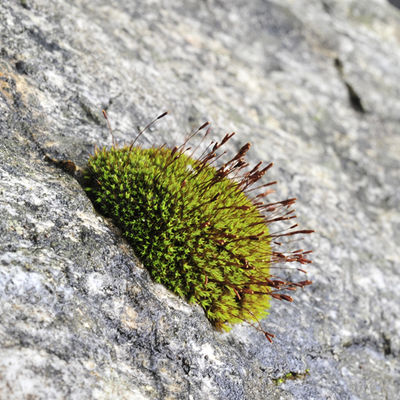
Wall moss, as a bryophyte, has soft, short stems and leaves; it does not flower, has no seeds, has no roots, has no conducting tissue, and reproduces by spores. Its leaves are long-tongued in shape, with a strong midrib that protrudes beyond the leaf tip like a white hair point, or appears as a short yellow spine.