Who won the 2018 Nobel Prize in Economics?
By DaDa
Winner of the 2018 Nobel Prize in Economics
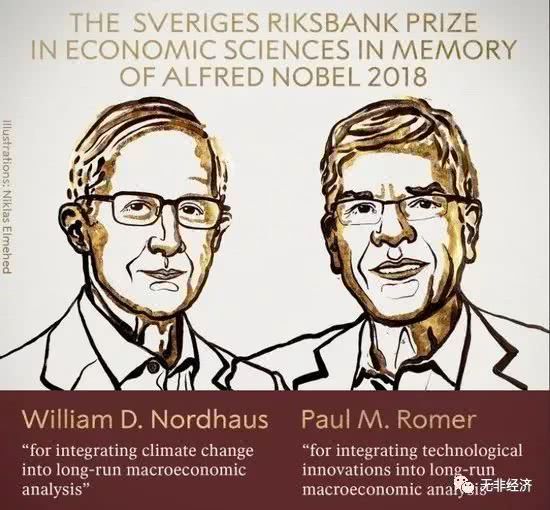
At around 17:50 Beijing time on October 8, the Royal Swedish Academy of Sciences announced that the 2018 Nobel Prize in Economics would be awarded to two American economists, William D. Nordhaus and Paul M. Romer, in recognition of their work integrating technological innovation and climate change with economic growth.
Nobel Economics Prize winners direct their criticism at Trump
The two American economists who won the 2018 Nobel Prize in Economics held press conferences on the 8th, openly and implicitly criticizing the Trump administration's policies. This shows the tense relationship between front-line American economists and the Trump administration.
William Nordhaus, widely known as an advocate of a "carbon tax," criticized the Trump administration, which doubts climate change science, as "stupid," and said "it is necessary to persist in pursuing (climate change measures) in difficult times."
The other winner, Paul Romer, who established a new theory on the impact of technological innovation on economic growth, pointed out that "what must be kept in mind is that globalization is not simply the exchange of goods, but the sharing of ideas." He expressed concern about the Trump administration's isolationist tendencies.
Getting to know Nordhaus
Nordhaus is a professor at Yale University. His main research field is the economics of climate change, and he showed how humanity ignores the disastrously high cost of inaction. The DICE (Dynamic Integrated Climate-Economy) proposed by Nordhaus (1994) is an optimization model used to calculate the costs and benefits of emission reduction measures and to determine the optimal amount of emission reduction.
William D. Nordhaus's economic research covers a wide range, including the environment, prices, energy, technological change, economic growth, profits, and trends in productivity growth. His main research fields are growth economics, wages and prices, ecological management economics, and transition economics. In addition, he is one of the 50 most influential economists in the United States and one of the world's top analysts in the economics of climate change.
In 1972, William D. Nordhaus and Tobin, who also won the Nobel Prize in Economics, proposed the Net Economic Welfare indicator. They argued that social costs generated by economic activities such as urban pollution should be deducted from GDP; at the same time, economic activities such as household work and social obligations, which had long been ignored, should be added. Nordhaus believes that the most effective way to address the greenhouse effect is to impose a carbon tax on all countries globally.
Getting to know Paul Romer
Members of the Nobel Prize committee explained: if DICE is put into practical application, scenario one is government inaction, with no change to existing policies, and one can see the relationship between the evolution of carbon dioxide emissions and global industrial emissions; scenario two is that the government has more policy inclinations, and then one can look at the impact on global carbon dioxide emissions. At this point, comparisons of advantages and disadvantages can be made.
Paul Romer is an American economist and a professor at Stanford University. He is considered an expert on economic growth and a strong candidate for the Nobel Prize in Economics. Romer received a bachelor's degree in physics from the University of Chicago in 1977 and a doctorate in economics from the same university in 1983. He was selected by Time magazine as one of the 25 most influential people in the United States in 1997.
Paul M. Romer
Romer said: One problem we face today is that people always feel that protecting the environment is so expensive and so difficult, so they just want to ignore this issue and pretend it does not exist. Humanity has the ability to achieve amazing things, as long as we are willing to do them. And in the long run, it will not come at the cost of economic growth. Once we start trying to reduce carbon emissions, we will be amazed that it is not nearly as difficult as imagined.
Members of the Nobel Prize main committee said: The main message conveyed this time is global collaboration to jointly address the issue of climate change. This requires a global solution, and every country needs to recognize the importance of addressing this difficult problem.
Should William Nordhaus's climate change research be put in the same basket as Paul Romer's research on healthy, sustainable economic growth? In response, the review committee of the Royal Swedish Academy of Sciences believes that the internal connection between the two macroeconomists' research fields is far greater than it appears. Per Krusell said that what the two scholars are thinking about is actually the same agenda, namely addressing long-term and international difficult problems.
They share the same views on economic policy and market failure, even though on the surface the two men's research does not appear to be the same.