The pricey succulents are actually quite nice
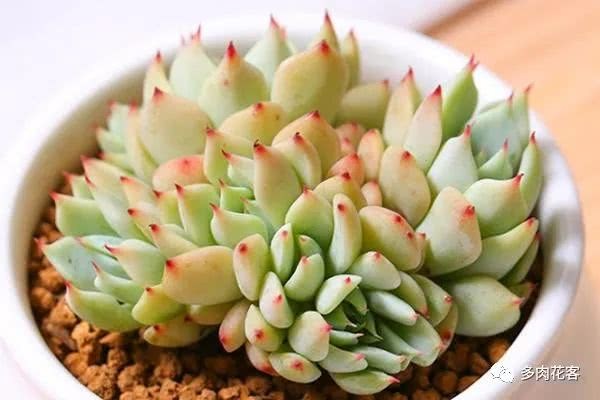
Pricey succulents are varieties that cost more than ordinary succulents and are also more troublesome to care for. Compared with ordinary succulents that can easily grow into a large pot, pricey succulents are harder to pamper. If you want to know which pricey succulents there are, here are 8 pricey succulents recommended for you. If you feel that growing ordinary succulents is no longer a challenge for you, why not try taking on the challenge of caring for pricey succulents.
Red Claw
Red Claw is an Echeveria succulent, and like Echeveria chihuahuaensis, its leaves have small red tips. Red Claw likes a warm, dry environment, is drought-tolerant, and can take full sun. So in summer and winter, when temperatures are extreme, be careful to reduce watering or even stop watering; in spring and autumn, watering 3 to 4 times a month is enough, no need for too much water, and watch out for dampness during the rainy season. The more sun it gets, the redder the leaves become.
Clara
Clara is an Echeveria succulent with small leaf tips; the leaves are plump, round and short, tightly arranged in a rosette. Clara likes a dry, cool environment and loves sunlight; the more light it gets, the tighter the rosette and the color will turn pink with purple or yellow. However, the leaves are thick and fleshy, so about 4 hours of sun a day is enough; too much sun may scorch the leaves. Clara cannot be kept damp when cared for and needs little water, so the planting soil can use a large proportion of coarse granular soil.
Angel's Tears
Angel's Tears is a Sedum succulent; its leaves are round like flat eggs, covered with a white bloom, and carry a fruity fragrance, making it a fragrant succulent variety. Angel's Tears is drought-tolerant but not moisture-tolerant; summer is the hardest time for care, and it easily drops leaves. Watering in spring and autumn also needs care, because with a little neglect it will grow taller and the gaps between leaves will stretch out. Angel's Tears easily grows side branches and forms clusters; if it becomes leggy, you can remove the loose lower leaves and try to cultivate side branches or grow it into an old stem. Angel's Tears likes light but cannot tolerate strong light; when there is enough light, the tender green leaves show a translucent touch of yellow.
Lotus
Lotus is an Echeveria succulent, resembling Echeveria pulidonis, but its leaves are thicker and shorter than those of Echeveria pulidonis. The leaf edges have red lines, like sunlight dyeing a halo onto the leaves. Lotus likes a cool, dry environment, can take full sun, can withstand high temperatures up to 30 degrees, and does not like cold. During the growing season, keep the soil slightly moist, watering about 4 times a month; too much water easily makes it leggy. It is suitable for leaf cuttings and beheading propagation, and after beheading it easily produces small offsets.
Apus
Apus, which carries a constellation name, is an Echeveria succulent and belongs to the large-sized succulents. Apus's leaves are slender and almost as wide as the leaf tip; the leaf edges are reddish, and the rest is blue-green. Apus likes dry, warm conditions and can take full sun; the more sufficient the light, the more vivid the red on the leaf edges. If the light is insufficient, the whole succulent will spread out flat like a pancake. Watering about 3 times a month is enough.
Christmas Echeveria
Christmas Echeveria is an Echeveria succulent; its leaves are shuttle-shaped and arranged in a rosette, and it belongs to the large-sized succulents. The leaf edges are reddish, the back of the leaf is red, and the color fades in summer. Christmas Echeveria has no obvious dormancy period and also needs a little water in summer; otherwise, lack of water will make the leaves wrinkled. With sufficient light, there will be more red on the leaves. Christmas Echeveria grows fast, so water about 4 times a month.
Rose Lotus
Rose Lotus is an Echeveria succulent, a hybrid. Rose Lotus is relatively small in plant form; its leaves are arranged in a rosette, thick and fleshy with red tips, and the surface has fine fuzz. Rose Lotus likes a warm, dry environment, can take full sun, is drought-tolerant, and tolerates partial shade; usually about 4 hours of light a day is enough. Rose Lotus cannot tolerate dampness, so watering needs attention; about 3 times a month is enough.
Debbie
Debbie is a relatively easy-to-grow pricey succulent variety; getting through summer is basically not difficult, only the color will turn back to green. Debbie's color develops well and can maintain a relatively pink color all year round. If there is enough light, the pink will become a vivid pink-purple, very beautiful. No need for too much water, otherwise it easily becomes leggy. Debbie easily grows side buds and forms clusters, and also very easily forms an old stem.