Moss Aquatic Plant Guide: Varieties and Characteristics
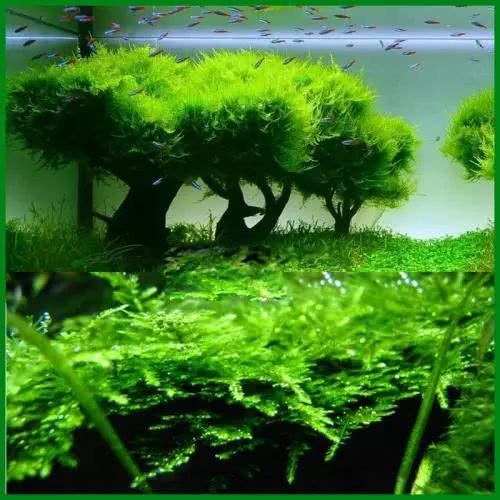
Scientific name: Vesicularia filicinum
English name: Willow Moss
Family: Mosses, Fontinalaceae
Distribution: Worldwide
Placement: Foreground, midground, or background, any position
Propagation: Rhizome division or side shoot propagation
Average height: 1-35 cm
pH:5.8-7.5
Water temperature: 18-30°C
Light intensity: 400-1000 Lux
Moss
The English pronunciation MOSS: bog, green moss, moss, bryophyte. Translated, it reads as "mosi," which is actually just moss.
Nowadays people keep species like Large Triangle, Small Triangle, Coral MOSS, Rose MOSS
Pearl MOSS, Crystal MOSS, Jade MOSS, Flame MOSS, Weeping MOSS, Willow MOSS, Dragon Whisker MOSS, Java MOSS, Money Moss
Because they are bryophytes, some are also called by moss names, such as: Staghorn Moss, Jade Pearl Moss, Phoenix Tail Moss, and so on...
Characteristics
There are about 12,000 species of moss worldwide. The Chinese translated name "mosi" comes from the English word "moss." There are three types: terrestrial, semi-aquatic, and aquatic. Aquatic species grow in a manner similar to Staghorn Moss, reproducing toward a flat plane by lateral bud division and growing in clusters, and they are often tied by aquascapers to driftwood or rocks. They are highly adaptable to their environment, though they cannot immediately get used to freshly changed water, and they can grow well without needing very strong light.
The main species of MOSS are classified according to the characteristics of the sporophyte containing spores. Not only that, MOSS can also be distinguished by the structure of their "stems" and "leaves." By observing MOSS leaves under a microscope, one can discover that the shapes and patterns of the leaf cells all have unique characteristics.
The reason MOSS plants are green is that their leaves contain large numbers of cells containing chloroplasts. MOSS leaves are very different from the leaves of higher plants. Higher plant leaves are composed of multiple layers of cells, have a thicker leaf structure, and possess conduits for transporting water and other minerals. MOSS leaves, however, are only one cell thick and have no conduits to transport water, although they may have a midrib formed by several thicker and longer cells.
Some types of MOSS are semi-aquatic, and they can grow in water. These aquatic MOSS species are very important for aquaculture, especially for planted tank aquascaping.
Aquascaping Uses
The main use of aquatic MOSS is to create a natural aquarium landscape by attaching it to driftwood or rocks. As an epiphyte, the rhizoids of MOSS can fix it to wood and rocks. MOSS
can also be used to create backgrounds in planted tanks. Moreover, MOSS is also very important for fish breeding, because aquatic MOSS can be widely used as a spawning bed, and at the same time, MOSS can also absorb excess waste produced by fry.
Planting MOSS in an aquarium is not very difficult. The growth requirements of many MOSS species are not demanding; they can tolerate low light, can grow well without supplemental carbon dioxide, and can survive on very small amounts of nutrients. But if there is suitable lighting, added carbon dioxide, and plenty of nutrients and trace elements, we can appreciate the true beauty of these aquatic MOSS species in the aquarium!
Living Habits
MOSS is a shade plant (those with a light requirement below 6500K are all called shade plants). It will also grow very well without lighting, but there must be light indoors; it will not live in a pitch-black cave, haha. With different light intensities, the growth shape also differs. Keeping MOSS alive is easy, but getting it to thrive is not easy; it is best to still regularly add strong light, CO2, and leaf fertilizer. This plant has no roots, no whiskers, no flowers, no fruit, and no seeds. It grows and reproduces through lateral leaves and can be tied or floated freely. MOSS grass is extremely versatile and can be said to be one of the essential aquatic plants in the tank of every fish lover. Whether you keep fish, shrimp, or snails, it is a plant source doted on by all aquarium hobbyists.
Planting MOSS in an aquarium is not very difficult. The growth requirements of many MOSS species are not demanding; they can tolerate low light, can grow well without supplemental carbon dioxide, and can survive on very small amounts of nutrients. But if there is suitable lighting, added carbon dioxide, and plenty of nutrients and trace elements, we can appreciate the true beauty of these aquatic MOSS species in the aquarium!
End
There is still a surprise here