The museum's environmental landscape and artistic displays complement each other beautifully.
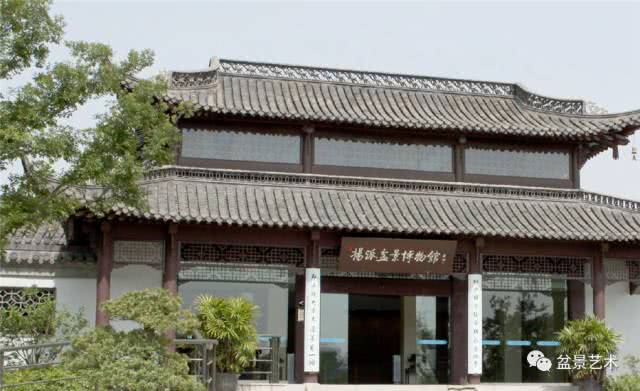
In 2005, the Yangzhou municipal landscaping department converted the former Yangzhou Bonsai Garden into theYangpai bonsaimuseum, but due to space constraints, many of its functions were affected.
In 2009, a new multifunctional bonsai museum was built in the northern part of the Slender West Lake Scenic Area in Yangzhou, and the original Yangpai Bonsai Museum was relocated there. The new bonsai museum integrates multiple functions such as collection, exhibition, public education and research, becoming an important showcase for Yangpai bonsai.
The small island beside the main entrance of the bonsai museum
In order to better present the cultural and historical value of Yangpai bonsai, the new museum drew on the experience of bonsai gardens and bonsai museums at home and abroad, highlighting the bonsai theme, clearly defining functional zones, equipping corresponding facilities and coordinating with the surrounding environment; its style combines the classical and the modern, fully taking into account the strong local character of Yangzhou gardens, which blend the elegance of the south with the grandeur of the north.
Outdoor exhibition area of the bonsai museum Photo / Shen Songsong
The Yangpai Bonsai Museum covers more than 40 mu, with a building area of 3,200 sq m. The museum houses a collection of bonsai works surviving from ancient times and also displays works that have won awards in exhibitions at home and abroad over the years. They are living artifacts; although some of these works have gone through several hundred years of change, they still have lush foliage and brim with vitality.
At present, the Yangpai Bonsai Museum has a total collection of more than 500 bonsai and more than 200 antique pots, and maintains around 280 bonsai on display year-round.
The museum is divided into three parts: the indoor exhibition area, the outdoor exhibition area and the production and maintenance area, and also includes venues and institutions such as a bonsai lecture hall, master studios and a bonsai research institute.
Indoor exhibition area of the bonsai museum Photo / Zhong Yafeng
The indoor exhibition area is divided into four parts: bonsai display, antique pot display, display stand display and graphic and textual display. The graphic and textual display further includes three parts: Chinese bonsai, Yangzhou bonsai and world bonsai. The indoor exhibition area is divided into four parts: bonsai display, antique pot display, display stand display and graphic and textual display. The graphic and textual display further includes three parts: Chinese bonsai, Yangzhou bonsai and world bonsai.
Entering the indoor bonsai exhibition area, the vivid and lively bonsai, the antique pots in a thousand shapes and forms, and the antique-style display stands tell the past and present and the complete appearance of the art of bonsai.
The combined arrangement of the outdoor exhibition area
The outdoor exhibition area uses garden landscape walls as the backdrop for bonsai displays, and the bonsai collection is arranged in combinations according to their expressive themes, mainly divided into several combinations such as "Clouds in the Ravine, Wind in the Pines," "Ancient Trees and a Clear Pool," "Aim for the Sky," "Emerging Across the Sky," "Deep in the Shade," "Ancient Style and Ancient Charm," "A Feast for the Eyes" and "In the Prime of Youth."
Bonsai generally should not be too large in size; the ancients said that "those that can be placed on a table are the best." However, in some modern large venues, such as parks and professional bonsai gardens, some large bonsai may sometimes be appropriately installed as highlights of the environmental arrangement. "Clouds in the Ravine, Wind in the Pines" is an extra-large water-and-land bonsai installed at the Yangzhou Bonsai Museum. It uses two five-needle pines about a hundred years old as the main material, paired with rustic turtle-vein stones and plants such as azaleas, and in a large pot 5.5 m long and 3.5 m wide, it presents a landscape like a shan shui painting. It has now become a main feature of the garden.
The small island on the water surface around the bonsai museum
Some expressive techniques of Yangpai bonsai are also fully applied in the environmental landscape of the bonsai museum. Whether it is the small island on the surrounding water surface or the small grouped landscape scenes in the outdoor exhibition area, they are all like extra-large bonsai.
The commemorative island of the International Bonsai Convention
At the northern end of the outdoor exhibition area of the Yangpai Bonsai Museum, there is an island-like area surrounded by water on all sides, shaded by flowers and trees, with beautiful scenery. This is the commemorative island for Yangzhou's successful hosting of the 2013 International Bonsai Convention and the 50th anniversary celebration of the International Bonsai Association, and the scenic spot is named "Viewing the Wind in the Sparse Woods." At the entrance on the west side of the commemorative island stands a stone stele inscribed with "Viewing the Wind in the Sparse Woods." On the island are commemorative trees planted by important guests of the convention, as well as a stone stele bearing the "2013 International Bonsai Convention Yangzhou Declaration." The works of the 10 international bonsai masters who gave demonstration creations on site at the convention are all displayed on the island as a permanent collection. On the wall behind each work are also carved stone portraits of the masters and their reflections on the art of bonsai. Here one can feel both Chinese style and world style. The commemorative island has left Yangzhou precious tangible and intangible cultural heritage. It is not only a commemorative site for the successful holding of the 2013 International Bonsai Convention in Yangzhou, but has also become a permanent scenic spot in the Slender West Lake Scenic Area of Yangzhou.
Lingering in the Yangpai Bonsai Museum, ancient relics and modern masterpieces shine together, and the environmental landscape and artistic displays complement each other; every visitor can enjoy nature and beauty.
Beautiful images of Yangpai bonsai
Ancient Trees in Grandeur
Listening Quietly to the Sound of Waves
The Sound of Waves Remains
A Faint Glimpse of Home
The Long Years
Drunk and Lying Among the Blue Clouds
In-depth Reading