The Story of Moss: You Can Only Grow It Well If You Understand This Pioneer of the Plant Kingdom
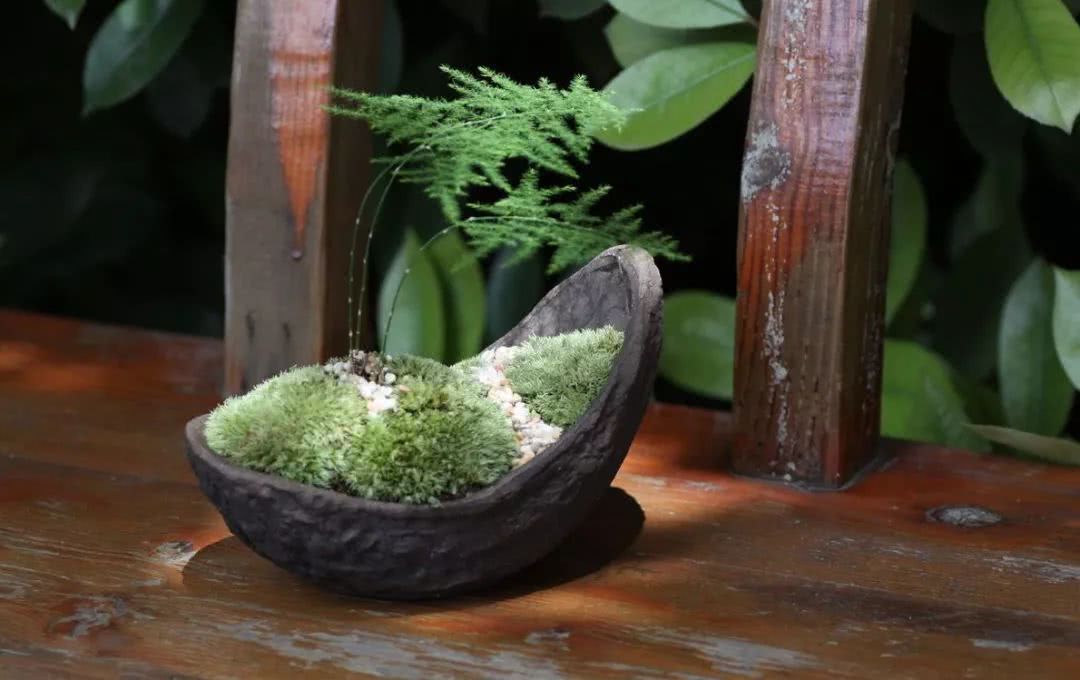
Grown on the Balcony has written quite a few articles about moss recently,
and many fellow gardeners have left comments saying moss is hard to grow and simply cannot be kept alive.
Silence... silence... silence...
The Editor-in-Chief feels this has nothing to do with growing techniques, patience, or personal preference. Perhaps it is because we do not yet understand this little thing called "moss" well enough. If you do not understand it, how can you grow it well?
You must know that moss is different from ordinary plantsdifferent!
Let us try to understand moss little by little, to know its virtues, its wonders, its brilliance. Perhaps growing it well will then come naturally.
In this article, let us talk about moss's way of survival and how it drives away the pests that want to eat it.
How Plants in Nature Drive Away Insects
Let the Editor-in-Chief explain first. This phenomenon is common in nature: an insect that feeds exclusively on a certain plant will also make its home on the underside of that plant's leaves, on the plant itself, or at the base of the plant, all for the convenience of feeding.
Sometimes multiple insects all favor the same plant. One has just eaten its fill and left, and the next starving one, wobbling as it walks, hurries over and buries its head in eating. Or several insects have roughly the same mealtime, so when it is time to eat, they all come at once, leaving the plant with old wounds barely healed and new ones added. The leaves are full of holes, big and small. How can it still carry out photosynthesis?
Plants also have feelings and emotions.
So, for the sake of ecological balance in nature, the Creator gave plants a special defensive ability: secreting toxins to drive away those greedy insects!
After willow leaves are damaged by caterpillars, they secrete an exceptionally bitter alkaloid that can reduce caterpillars' appetite.
If some starving caterpillars or other insects still ignore the warning and "refuse the toast only to drink a forfeit," the leaves will release a hormone that promotes the conversion of linolenic acid into jasmonic acid, and jasmonic acid then prompts some leaf cells to produce an enzyme called a "protease inhibitor."
This enzyme is formidable. It not only makes insects unable to digest properly, but also helps leaf cells produce another chemical called "cholecystokinin," which immediately gives greedy caterpillars and insects the feeling that "I am too full." So these pests, whose bellies have been "tricked into fullness," immediately turn around and leave.
Haha, the willow really has some tricks up its sleeve. With one combination punch, the dizzy pests slink away stupidly!
In addition, white poplar, maple, and willow all share a characteristic: when harmed by pests, they secrete defensive compounds on one hand, and on the other quickly transmit the message "there is an enemy" to their nearby companions, and then from nearby companions to all companions, so they defend against pests together.
Moss's Way of Reducing Harm
Plants use the method of "releasing toxins" to protect themselves. Moss also faces natural enemies. How does it protect itself?
Scientists have found that preserved moss specimens do not need disinfection and can be stored for a long time without easily becoming moldy or being damaged by insects.
This is because moss plants themselves contain antibiotic substances that can repel all mold molecules that might invade, and can even perish together with the invaders.
Scientists have found that among 111 species of moss studied, 56% (that is, 61 species) have extracts with antibacterial effects against at least one bacterium. In particular, Diplophyllum, Plagiothecium, and Pogonatum have antifungal effects.
As for the large and small pests that come to "eat for free," the insect antifeedant active ingredients possessed by the moss family also give them a hard time, so they have no choice but to arrive excitedly and leave utterly crestfallen.
One
Because moss belongs to the "pioneers" of the plant kingdom, and more than half of its members grow in extremely harsh environments, nature has endowed moss with the ability to survive in such environments and create possibilities for more green plants to survive. Therefore, unlike higher plants that grow in environments with ample sunlight, rich nutrients, and warmth and moisture, most moss members do not have the function of collecting and storing nutrients.
The conclusion is that ordinary herbivorous animals are simply not "interested" in moss.
Two
Some microorganisms in nature that are almost invisible to the naked eye are responsible for decomposing the remains of animals and plants. Because they are rich in cellulose and lignin-like substances, the cell walls of moss members are thin and hard, so they are always left for decomposers to handle last, because decomposing moss plants is both time-consuming and laborious. Or some mosses contain overly abundant certain mineral elements, or peat moss has too low a nitrogen content, and so on, all of which make herbivorous animals unable to adapt their appetites and give up.
In addition to having too low a nitrogen content, the acidic, waterlogged, and oxygen-poor living environment conditions created by Sphagnum also reduce its decomposition speed; at the same time, the sphagnol contained in Sphagnum and Hypnum also increases the difficulty for decomposers.
Three
There are also the secondary metabolites of moss plants, which are also very formidable. For example, benzyl benzoates produced by moss metabolism are fatal to greedy insects and hard-to-eliminate mites. Just one bite and they are "laid flat."
In addition, oxalic acid can also make those herbivorous insects (herbivorous insects refer to insects that feed on living plants) dizzy and uncomfortable all over. Any that have tasted oxalic acid will never dare to take a second bite.
What the Editor-in-Chief finds very interesting is that, counting from the ancestors of moss 370 million years ago, no virus to date can exist in moss plants!
Scientists have now discovered that moss plants contain antimicrobial active ingredients, antiparasitic and molluscicidal active ingredients, anti-gas active ingredients, plant growth-regulating active ingredients, enzyme-inhibiting active ingredients, and so on.
It can be seen how complete the moss family's self-defense equipment is. In the plant kingdom, it is not one to be trifled with.
Moss, this little thing, is formidable, isn't it?
Then again, the more undisturbed a plant is, the more it emphasizes its own living environment.
Where are its weaknesses then? What will affect its survival?
Through next issue's investigation, we will look for the answers.
Grown on the Balcony
Alright, that is all for today. If fellow gardeners still have any questions they would like the Editor-in-Chief to answer, leave a message in the comment section below.
I do not know whether the Editor-in-Chief explained clearly and in detail. For fellow gardeners who did not quite understand, the Editor-in-Chief has specially composed an acrostic poem for you. It may not be well written, but it can help you find the Editor-in-Chief.
More wonderful and brilliant articles are all in one acrostic poem:
A gentle breeze lightly caresses, flowers remain ever present
With unhurried steps, the spirit wanders south of the mountain's sunny side
Searching for wonders and seeking clever finds at Bronze Sparrow Terrace
Planting red and cultivating green, ascending the blue clouds
--Come take the challenge: four lines of an acrostic-and-tail poem. Connect the first characters + connect the last characters, and you can obtain an eight-character motto to summon the Editor-in-Chief's true form! When you come, remember to say: "Editor-in-Chief, your secret has been cracked by me!"
Grown on the Balcony. Learning knows no end.