Appreciation of another work by an Indonesian bonsai master
A few days ago we shared a work by Indonesian bonsai master Budi (Growth Diary | A Bonsai Master's 9-Year Journey to Create a Classic). Today we continue to share another of his works.
▲2004
Just like the tree we shared a few days ago, this tree also comes from Puerto Rico in Central America, and its Chinese name is unknown. It is a species of shrub in the Nyctaginaceae family unique to Puerto Rico. In the Americas it is a fairly common bonsai tree species.
▲First styling
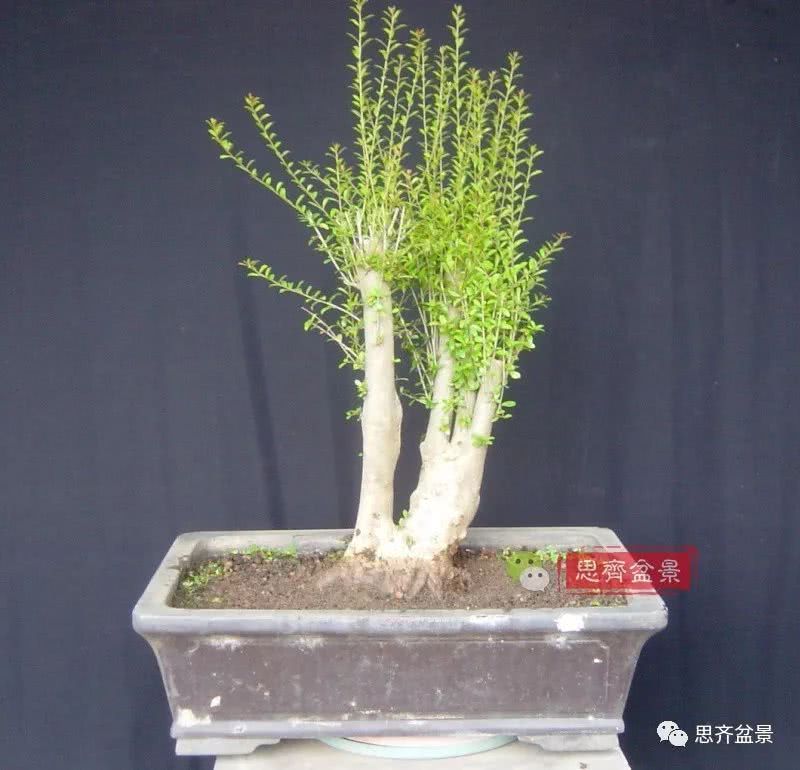
It was initially designed as a three-trunk style. After styling, it was appropriately wired to control the direction of the branches.
▲Summer 2005
The distribution of the three trunks was slightly crowded, so in the spring of 2005, the middle trunk was removed, turning it into a two-trunk style. After more than a year, the branches and leaves had already grown so lush that the speed of growth was astonishing.
▲Late 2007
The basic framework of this tree had formed and it was approaching its finished form. During this period, care still focused mainly on pruning.
▲Spring 2012
As time went on, the leaves grew more and more lush and full, and the form became more and more natural.
▲Red fruit
As can be seen in the photo above, the leaf size is very well controlled. Under natural growing conditions, the leaves are much larger.
▲The leaves of small plants grown from cuttings are much larger.
▲Cutting branch vs. bonsai branch
In the photo above, the left side is a cutting branch and the right side is a bonsai branch, showing that the difference in leaf size is enormous.
▲Comparison of cutting branch leaves and bonsai leaves
The reason bonsai leaves become smaller is thanks to a rich branching structure. When a tree has more branches and more leaves, the leaf size will naturally shrink.
▲Photo with the author
If you enjoy hands-on articles like this, please share them with your friends!