Why are peony bonsai, as one of the national treasures, so popular? The key lies in these four aspects of appreciation
Bonsai is a unique and beautiful treasure of Chinese garden art, with a history of 1500 years. It is a clever combination of potted plant culture and sculptural art. It is an organic unity of scenery, potted landscape and several frames, and is renowned for traditional arts such as painting, calligraphy, sculpture and music. It is called "silent poetry, three-dimensional painting."
Peony bonsai is a new type of ornamental flowering bonsai. It combines the majestic peony with the simple and elegant art of bonsai, forming an artistic form with a distinctive Central Plains flavor. It has been praised by experts and scholars in the field of bonsai. Master Chen Sifu of Chinese bonsai said: "Peony bonsai displays the charm and unique meaning of bonsai poetry." Chinese bonsai artist He Quansun said: "Looking at peony bonsai works as a whole, they reflect beauty of appearance, appropriate material selection, suitable, harmonious and contrasting arrangement, such as the appropriate stone pairing of 'Fragrance', with hardness and softness complementing each other; the ancient, vigorous branches of 'Competition', with tension and release following proper rules; the response of yielding and contending in 'Hometown', full of wild charm; the complete composition and dignified elegance of 'Lingering Charm of Tang and Song'; the coexistence of withered and flourishing in 'Withered Wood Meets Spring', with emptiness and solidity depending on each other, and so on. It reflects the artistic attainments of these peony bonsai. It is the sublimation of the beauty of peony cultivation art." Chinese bonsai artist Meng Lanting called peony bonsai "an unprecedented creation."
Peony bonsai is almost the same as other bonsai. For example, appreciating the scenery (grand scenery), second appreciating the pot, third appreciating the number, fourth appreciating the scenery name (title), and so on.
Appreciating the trunk scenery
Peony piled scenery can be viewed in all four seasons. Flowers in spring and summer, leaves in summer and autumn, buds in winter and spring, and trunks in the winter scenery. In order to obtain more ornamental value than ordinary peonies, it breaks the habit of only looking at flowers for thousands of years.
Peony bark: The branches of the peony are thick and strong, and the bark is dark brown or black-brown, mottled. After treatment through shaping art, there are thousands of ancient pines, century-old plum bones, either straight or hanging, or lying, or slanting, "with a meaning that overwhelms the hidden, possessing the momentum of a hundred-foot dragon."
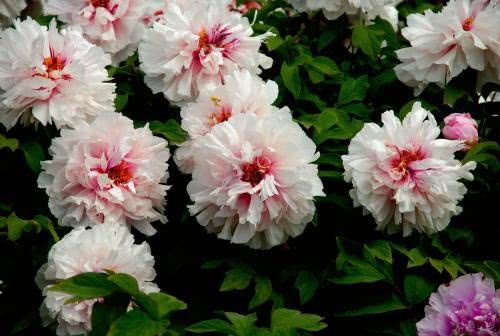
Flowers: Peony bonsai is mainly based on flowers. With variable design, and colors "red, orange, yellow, green, blue, purple," fragrance, and the potted elegance of some peonies, it will make you unforgettable.
Leaves: Peony leaves are pinnately compound leaves. The green leaves turn yellow, red, purple and other colors in spring and after autumn frost, very beautiful and eye-catching, with the charm of a "forest dyed in layers."
Buds: View after leaf fall until early spring; the bud shapes and flower bud colors differ. Buds are red, pink, purple, with torch-like, eagle-beak-like and narrow-pointed bud shapes, which can make people imagine.
Fruit observation: Its fruit is an exotic fruit, that is, the fruits are arranged in a radial circular oval shape, about five of them. Seen from a distance, it is like the "starfish" on the "five-pointed star" flag.
Peony roots: Through "root treatment" of the peony, people can directly see the roots of the roots. It gives people strong power and the beauty of nature, so that people's desire to return to nature is satisfied.
Appreciating the pot
The potting of peony bonsai requires attention. The "peony" painting should use the "base color" of the pot as a foil. Whether it is Jingdezhen colored porcelain, blue-and-white porcelain landscape pots, or the choice of Yixing purple clay pots, it must reflect the magnificence and elegance of the peony. It is best to have an antique pot, with plain colors and elegant style, and those from the Ming and Qing dynasties are the best.
Choose round shallow pots, pale antique pots, rounder pots, with conduits; colors using copper, agarwood, dark green leaves, sesame, deep red, metallurgy, and deep purple are the most beautiful. Peony-related pots carved with "calligraphy" are the best.
Appreciating the stands
Place the peony bonsai very elegantly. It is to improve the status of the bonsai space, separate the bonsai from the ground and surrounding environment, make it stand out, and further ignite the peony bonsai. Several of them are works of art themselves. Now more imitation Ming and Qing styles are used, and Ming style is simple and generous, concise and plain; mostly yellow pear wood and red sandalwood are used, light in color, with clear wood grain. Qing dynasty carving is fine and rich, mostly using purple sandalwood and mahogany. Both the Ming and Qing dynasties achieved relatively high technical results.
Modern mahogany, red sandalwood, and poplar production, the wood is fine and hard, with bright color. In addition, imitation mahogany and mahogany production, due to fine craftsmanship, has good ornamental effect. Styles include book stands, seal stands, curio shelves, small qin tables, root carvings, Tang Sancai drums, and so on. It is best to carve peonies on them.
Appreciating the scenery name
When appreciating bonsai, the title is very important; it can increase the ideological and artistic work and further express the artistic conception. Chinese painting pays attention to the artistic effect of combining poetry, calligraphy, painting and printing, and the proposal of peony bonsai is also an indispensable part of landscape, bonsai, and so on. Using concise and popular words to express the content and spirit of the work plays a certain role in adding the finishing touch to the completion of the work. The status of the peony in the hearts of Chinese people can be expressed by "national beauty and heavenly fragrance"; the beauty of the peony and the bonsai can be displayed at the same time; the ancient history of the peony can be expressed by "Tang and Song charm," making people look like drunkards. Returning to the past, reviewing the present. In short, through the limited scenery in the basin, there are unlimited associations, making the audience unforgettable.
In addition, the decoration of the basin surface is also very important, such as stone matching, moss, orchard and landforms, various accessories (pavilions, tables, buildings, kiosks, rafts, bridges, people and various animals), and so on.
The stone pairing of peonies is very exquisite. Chinese painting has a "peony stone picture." Common peony stones are Taihu stones and stalagmites, with the stalagmites depending on each other, making the landscape vivid and changeable, the composition more perfect, and the scenery more wild. Cloth or cloth makes the basin green and verdant, closer to the natural landscape. The placement of ornaments makes the picture more poetic and freehand.