A Detailed Guide to Rubber Plant Indoor Cultivation Techniques and Care Methods
For home cultivation, propagation is generally done by cuttings and air layering. In the Yangtze River basin, the period from April to September each year is most suitable. If cuttings are taken in spring or summer, choose vigorous one-year-old branches from the upper or middle part of the plant as cuttings. For autumn cuttings, choose vigorous new branches of the current year as cuttings. The specific steps are: cut off the branch to be used as a cutting, remove the tender tip at the top and the leaves at the bottom, keep the middle leaves, and cut the retained leaves in half. To reduce evaporation from the leaf surface, it is best to roll the leaves into a tube shape and pass a small wooden stick through the tube, then insert it into the soil to prevent the cutting from falling over. In addition, the cut ends of the cutting should immediately be sealed with plant ash or peat soil to prevent too much milky sap from flowing out and reducing the survival rate. The insertion depth for cuttings is generally 3cm-4cm; too deep and they will rot, too shallow and they will easily fall over. The rooting medium is generally fine sand. After inserting, keep the sand moist, place it in a shaded spot with scattered light, and be careful not to let it get rained on. After cutting, roots generally form after about one month. When lifting seedlings for planting, try as much as possible not to shake the medium loose around the new roots, so as not to damage the roots and affect growth after planting. For home use, air layering is more convenient and has a high success rate. The method is: choose a two-year-old branch, first make a ring-shaped cut 1cm-1.5cm wide on the branch, then wrap moist moss, peat soil, etc. around the wound, cover it tightly with plastic film, and tie both the upper and lower ends. Layer in June, and after rooting in July-August, cut it off and pot it.
The rubber plant has a well-developed root system and grows quickly. If the pot and soil are changed once a year, a cutting seedling can grow to more than 1.5m within 2-3 years. If it gets too tall, it is no longer suitable for household potting, so when planting, pay attention to the size of the flowerpot and do not choose an oversized pot. When changing pots, also trim off excess roots, replant it in the original pot, and keep the plant within a certain range.
The rubber plant likes plenty of water and fertilizer. Once established, the plant will not drown from too much watering, nor will it be burned to death by too much fertilizer, but it will cause leggy growth and affect its ornamental value. For rubber plants grown at home, in order to control their growth, the watering principle of "dry when dry, wet when wet" should be followed during care. Especially in the Yangtze River basin, in summer the plant should be moved to an outdoor balcony and watered thoroughly once a day. If kept indoors, water only after the surface soil in the pot has dried. Once it suffers from drought and loses water, it will drop leaves, and the terminal bud will also turn black and dry up. In winter, the rubber plant will stop growing or grow slowly because of low temperatures. As long as the potting soil has some moisture, do not water, so as to avoid root rot.
Because the rubber plant is not cold-tolerant, in winter it must be moved indoors to a sunny spot for care. In the Yangtze River basin, it should be moved indoors in mid-November, and the room temperature should be kept above 10°C, with the lowest temperature not below 5°C. If the temperature is too low and the potting soil is damp, the leaves will turn black and drop and the roots will rot, and even the whole plant may die. Wait until mid-March of the following year, then move the plant to the courtyard or balcony for care. The rubber plant is a sun-loving plant and cannot be kept indoors year-round, otherwise the branches will be thin and weak, the internodes will stretch, and the leaves will become thin and lusterless, losing their ornamental value. Therefore, great attention must be paid to this in home care. If it is placed indoors, then every 10 days the plant needs to be placed outdoors in sunlight for a period of time, so that the plant can get as much sunlight as possible.
To make a potted rubber plant full and shapely, pinch off the growing tip when the plant reaches 60cm-80cm in height, to encourage side buds to sprout. After side branches grow, select 3-5 of them, and thereafter shorten the side branches once a year. In 3 years, you can obtain a rounded, full tree body 1.5m-2m tall.
When choosing soil for a potted rubber plant, it is best to use a potting mix made of 1 part leaf mold, 1 part garden soil, and 1 part river sand plus a small amount of base fertilizer. Generally, apply liquid fertilizer or compound fertilizer 1-2 times a month, while keeping the soil relatively moist.
The roots of the rubber plant contain hard rubber and it has a very strong resistance to pests and diseases, so pests and diseases generally do not occur.
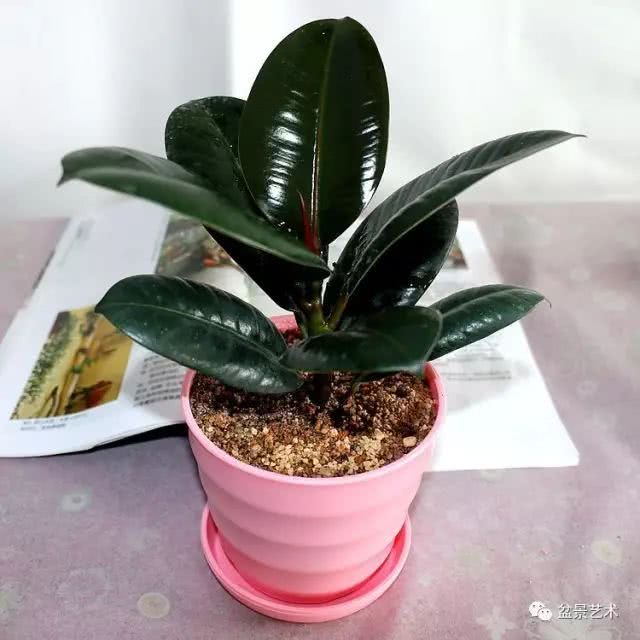
The rubber plant's leaves are thick, broad, and beautiful with a glossy sheen. The red terminal bud looks like a crouching cloud, and when the stipules split open they look just like a red tassel hanging down, full of charm. It is an excellent foliage plant for household potting.
Further Reading