A common roadside weed that looks like pennywort, and when it fills a pot it grows even more vigorously than pennywort
A friend spotted a large patch of wild plants by the roadside and immediately called Huahua, "I found lots of pennywort by the roadside, come dig some up quick!" Huahua ran over to take a look, and it turned out these "little pennyworts" were not real pennywort at all, but actually dichondra. Many people get them mixed up, so let's take a look today!
“
Real and fake pennywort
- Dichondra -
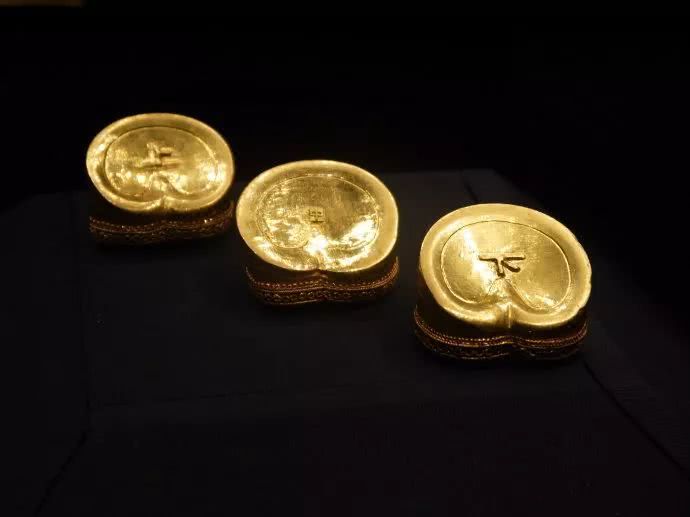
The dichondra we are talking about today is not the horse-hoof gold from the Tomb of the Marquis of Haihun, though they do share a slight similarity, because they both look like little horse hooves.
Han dynasty horse-hoof gold
Dichondra the plant
Dichondra, also called little moneywort, is a plant of the genus Dichondra in the family Convolvulaceae. Dichondra is very common in the south, and in many places it is used for landscaping. It has the characteristics of a long lifespan, a long green period, simple management and easy propagation. Planted on a lawn it looks like a green carpet has been laid down, and some flower lovers grow it in pots as a pot-cover plant.
Dichondra likes a warm and humid environment, is highly adaptable, and has low soil requirements. It has a certain therapeutic and protective effect on liver damage, and has some medicinal value.
- Hydrocotyle -
Hydrocotyle (pronounced: suī). Some flower lovers may not recognize the character sui. It is a herbaceous plant of the genus Hydrocotyle in the family Apiaceae, looks somewhat similar to pennywort, and is also called ground moneywort, broken moneywort and so on.
Some flower lovers plant it in the yard as a landscaping plant, and some grow it as a small potted plant; it looks a bit like cilantro.
The whole plant of hydrocotyle can be used as medicine, with the effects of clearing heat and promoting urination, reducing swelling and detoxifying, and treating jaundice.
Hydrocotyle likes a warm and humid environment, and is generally planted in semi-shaded places, avoiding direct sunlight, with low soil requirements. Some flower lovers even plant it directly in water, or keep it in a fish tank as an aquatic plant. The suitable water temperature is 22-28°C. It propagates very quickly and easily fills pots and tanks!
- Lysimachia -
Lysimachia is also called moneywort or true gold grass. It is a plant of the genus Lysimachia in the family Primulaceae, and is the moneywort medicinal material recorded in the pharmacopoeia. It can be used to treat urinary tract stones, cholecystitis, gallstones, icteric hepatitis and so on, and can also be applied externally to treat scalds and burns.
Lysimachia is a commonly used folk herbal medicine, generally grown in a warm, shady and humid environment, and is not cold-tolerant. It is suitable for fertile, loose sandy loam rich in humus.
Among the lysimachias, golden lysimachia is native to Europe, the eastern United States and other places. Its leaves are golden yellow. It likes light and tolerates shade, tolerates waterlogging, and is highly cold-tolerant. It has the effects of clearing heat and detoxifying, dispersing blood stasis and reducing swelling, and draining dampness and reducing jaundice, and is widely cultivated as a colorful-leaf plant.
- Pilea -
Pilea peperomioides has thick, fleshy leaves, and its leaf stalks are attached in a peltate manner, much like the mirror in which ancient immortals looked at their faces, so it is called mirror grass. The leaves of Pilea peperomioides are dark green and glossy, and there is a golden-yellow round dot where the leaf stalk attaches above the center of the leaf, so people also call it "one dot of gold". Radiating leaf veins extend from the center to all sides, so some also call it "gold-thread grass".
Since Pilea peperomioides was introduced to Europe in the early 20th century, it triggered a craze in countries such as the United Kingdom and Sweden. Its leaf shape is peculiar and its posture beautiful, making it very suitable for home matching. It is regarded as a treasure among indoor foliage flowers and is deeply loved by people.
Pilea peperomioides likes shade by nature, but also grows well in a sunny greenhouse. Its suitable growth temperature is 16-20°C. It is suitable for growing in relatively moist and well-drained peat soil. It is very shade-tolerant; as long as there is enough light to read an ordinary newspaper, it can grow, so it is very suitable for indoor potted plants at home. It likes a warm and humid environment. Below -4°C it shows cold damage, the leaves lose their luster and may even fall off.
- Pennywort -
Pennywort, like small lotus leaves, has long leaf stalks and round umbrella-shaped leaves. Umbrella plant can be grown in soil or hydroponically. Placed on a coffee table, desk or other places, its lush green is very refreshing and pleasant.
Pennywort likes warmth and humidity by nature. A semi-sunny or shaded spot is best for cultivation, avoiding direct sunlight. There are no strict requirements for the growing medium; loose, well-drained soil is best, or it can be grown directly in water. The most suitable water temperature is 22-28°C. It is shade-tolerant, moisture-tolerant, slightly drought-tolerant, and highly adaptable. Pennywort is robust by nature, easy to plant and quick to propagate, and can grow both in water and on land.
So there are actually so many plants called moneywort or pennywort
And each has different uses
Have you seen them all?
Show this to flower lovers who need it!