Bury sprouted ginger in a flower pot, and with this treatment, you can harvest 10 jin of fresh ginger in half a year.
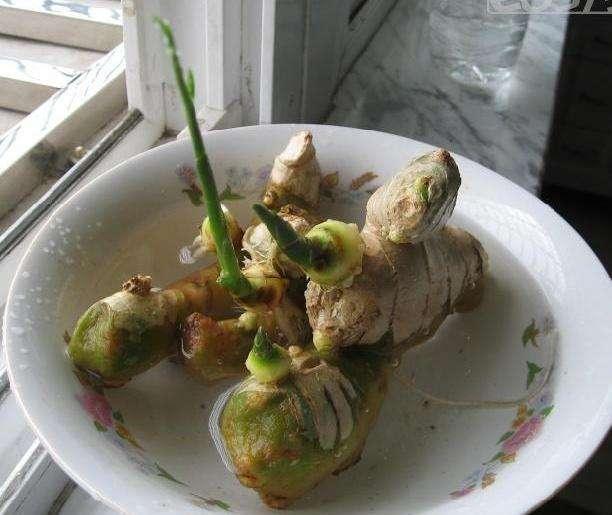
Growing flowers and vegetables at home is quite an interesting thing to do. Nowadays, as people's living standards have improved, it is better to use a lot of free time to grow some flowers and plants, or to study balcony container gardening. Growing flowers can not only delight the grower's mood, but also beautify the home environment, so why not do it? If vegetables and fruits are planted in flower pots, perhaps quite a lot can even be harvested! Take container-grown vegetables as an example. In daily life, many things that would quickly go to waste can be used for container growing. For example, sprouted potatoes, sweet potatoes, and sprouted ginger, etc. Today, we will mainly share how to grow ginger in containers after it sprouts.
Sprouted ginger, buried in a flower pot, treated "this way", will produce 10 jin of fresh ginger after half a year.
Many ingredients in the kitchen, if not eaten soon enough, are very likely to sprout. Garlic, ginger, potatoes and so on all sprout. For ginger, once it sprouts, we generally remove the sprouts and continue using it. But if too much has sprouted, then it cannot be used and has to be thrown away. Actually, for people who grow plants, sprouted ginger can absolutely be used for container growing. Not only can it be enjoyed as an ornamental, but if cared for properly, it can also grow quite a lot of fresh ginger. Of course, from container-grown ginger to harvesting fresh ginger, quite a few care tips are still needed along the way.
About the soil for container-grown ginger
Generally, when growing flowers at home, some soil is bought and some is made yourself. For container-grown ginger, it is recommended to make it yourself, because this way you can control the fertility of the soil, which is beneficial for ginger's rooting and growth. Ginger likes loose, fertile, slightly acidic soil rich in humus. Therefore, when making nutrient soil, you need to prepare leaf mold, pine needles, fine sand and loess. Of course, if you have eggshells, even better, as they can be used as a base fertilizer. Mix the above prepared materials in a ratio of 2:1:0.5:2, and the soil will be excellent; no matter what you grow, it will surely thrive more and more. If pine needles cannot be found, straw can be used instead.
About daily watering for container-grown ginger
Watering is mainly considered from the following aspects. First is newly planted ginger. At this time, what it needs most is a warm and humid environment, so it is recommended to water at least 3 times a week, preferably in the morning or evening. Second, when the ginger has grown to more than 20 cm, watering can follow the principle of "water when dry, stop when wet." "Water when dry, stop when wet" means that when the potting soil is dry, you can water, and when the potting soil is not dry, there is no need to water. Third, watering should take into account changes in weather and environment. For example, it is now late autumn, and severe winter will soon arrive, so it is best to water with warmed water that has been sunned, and do not use cold water or hot water.
About fertilizing techniques for container-grown ginger
Friends who grow flowers all know that almost all flowers and plants cannot grow vigorously without fertilizer. This is even more true for container-grown vegetables. When fertilizing container-grown ginger, pay attention to what kind of fertilizer to choose. Generally, in the early stage of ginger growth, nitrogen fertilizer is mainly used, and in the later stage during flowering and fruiting, phosphorus and potassium fertilizers are mainly used. For example, one month before ginger formation, applying some potassium dihydrogen phosphate liquid fertilizer is more suitable. Generally, ginger needs 5 or 6 months from planting to harvesting fresh ginger. During this period, except for the first month, thin fertilizer water should be applied every month afterward. When fertilizing, be careful not to get too close to the ginger root system; just apply along the edge of the flower pot.
That is all for the content about container-grown ginger. Finally, a reminder to flower growers: for container-grown ginger, the flower pot must be chosen with a diameter of more than 30 cm, otherwise the later growth space for fresh ginger will be restricted. Thank you for reading! If you have any questions during the process of growing flowers, vegetables, etc. in containers, you can leave a message below, and I will answer them one by one.
Remember to like and share~