What to do when orchids won't bloom? Keeping orchids strong and vigorous is the key
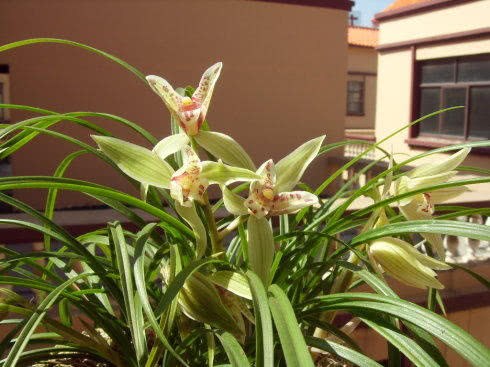
Many orchid enthusiasts love growing orchids, just looking forward to the moment when the orchid blooms. But what gives quite a few orchid growers a headache is that the orchids they grow at home won't bloom. As the saying goes: three parts planting, seven parts care - this is the orchid-growing experience of the ancients. The quality of care determines whether the orchid thrives and whether it can bloom.
Cymbidium goeringii (Spring Orchid) produces flowers from 5 leaves onward, and Cymbidium faberi (Faber's Cymbidium) from 7 leaves onward. This fully demonstrates the physiological characteristics of orchid blooming. As long as you grow the orchid strong and vigorous, there is no need to worry about it not blooming. Let us analyze the conditions required for blooming from the internal and external causes of orchid flowering.
I. Internal Conditions for Orchid Blooming
1. After going through the vegetative growth stage, the orchid has grown to the size and height that its species should have, and the above-ground part and the underground part are coordinated, unobstructed and intact, having reached the conditions for pre-flowering maturity and the appearance of the flower primordium.
2. The orchid has accumulated and stored sufficient organic nutrients within its body to meet the needs of flowering consumption, mainly the content and ratio of carbon and nitrogen compounds, which are favorable for bud gestation and flowering.
3. The adjustment and transfer of growth hormones within the orchid. According to measurements, when the auxin level in the orchid is at a high level, the orchid shows a vigorous state; conversely, only when auxin is at a low level while cytokinins and gibberellins are at high levels is it favorable for flower bud differentiation and blooming. Therefore, when entering the flower bud differentiation stage, the growth hormones within the orchid must undergo a process of adjustment and transfer.
II. External Conditions for Orchid Blooming
1. Temperature difference
If you want orchids to bloom abundantly, temperature difference is an essential condition - this is why orchids actually bloom more luxuriantly in winter. When the temperature difference between day and night is about 10 degrees Celsius, that is, under the temperature conditions of 18 to 21 degrees Celsius during the day and 7 to 10 degrees Celsius at night, they grow best and bloom more.
2. Watering
When caring for orchids, watering must be well controlled. Too much water easily causes the orchid to grow leggy, and of course it won't grow flower buds. Generally, you should use a bamboo stick to test the moisture of the potting soil, because humidity varies from region to region, and the amount and frequency of watering also vary. When the bottom third of the potting soil is moist, it's time to consider watering. Too little water easily causes the phenomenon of flower buds being trapped.
3. Fertilizing
Orchids like fertilizer, but because orchid roots are thick and long without root hairs, and live in symbiosis with root fungi. Therefore, during the growth period, the root cells provide organic nutrients, first supplying the root fungi, and then the root fungi absorb mineral nutrients from the outside to supply the plant. For Cymbidium goeringii (Spring Orchid) to accelerate growth and bloom, it must rely on fertilizing. Timely and appropriate fertilizing is an important part of growing orchids well. The nutrients that orchids absorb from the soil include nitrogen, phosphorus, potassium, calcium, magnesium, sulfur, iron and trace elements such as zinc, manganese, copper, molybdenum and boron. If these elements can be supplemented in appropriate amounts in the soil, it is very beneficial for the growth and blooming of orchids.
4. Light
Sufficient light is not only a necessary condition for gestating flower buds; relatively sufficient sunlight can also deepen the red, dark red and yellow colors when blooming. For orchid plants that bloom with green or white flowers, the light intensity should be reduced as soon as the flower buds first appear, to ensure the flower color is more plain and elegant, and after blooming is finished, give them more light again.
Orchid blooming is a complex physiological process, constrained by many factors of internal and external conditions. Only by mastering their habits and understanding the mechanisms, and making timely artificial adjustments according to the time, the pot and the plant, so as to satisfy all the conditions required for blooming, can they bloom as desired for appreciation and fragrance.
Thank you for reading the article. If you find it helpful, you are welcome to follow and share. This article comes from an original submission by Yumi Orchid. For reprinting, please contact the Yumi Orchid official account!